The Democratic Republic of the Congo is using its Security Council presidency to spotlight the link between minerals and conflict, while its own resource wealth continues to expose the limits of international law and accountability.
For the first time in more than 30 years, the Democratic Republic of the Congo (DRC) will assume the rotating presidency of the United Nations Security Council this month.
It does so as the country beats back a deadly outbreak of the highly contagious Ebola virus and remains deadlocked in a decades-long cycle of violence and instability fueled, in part, by the illicit trade and exploitation by armed groups of its natural resources.
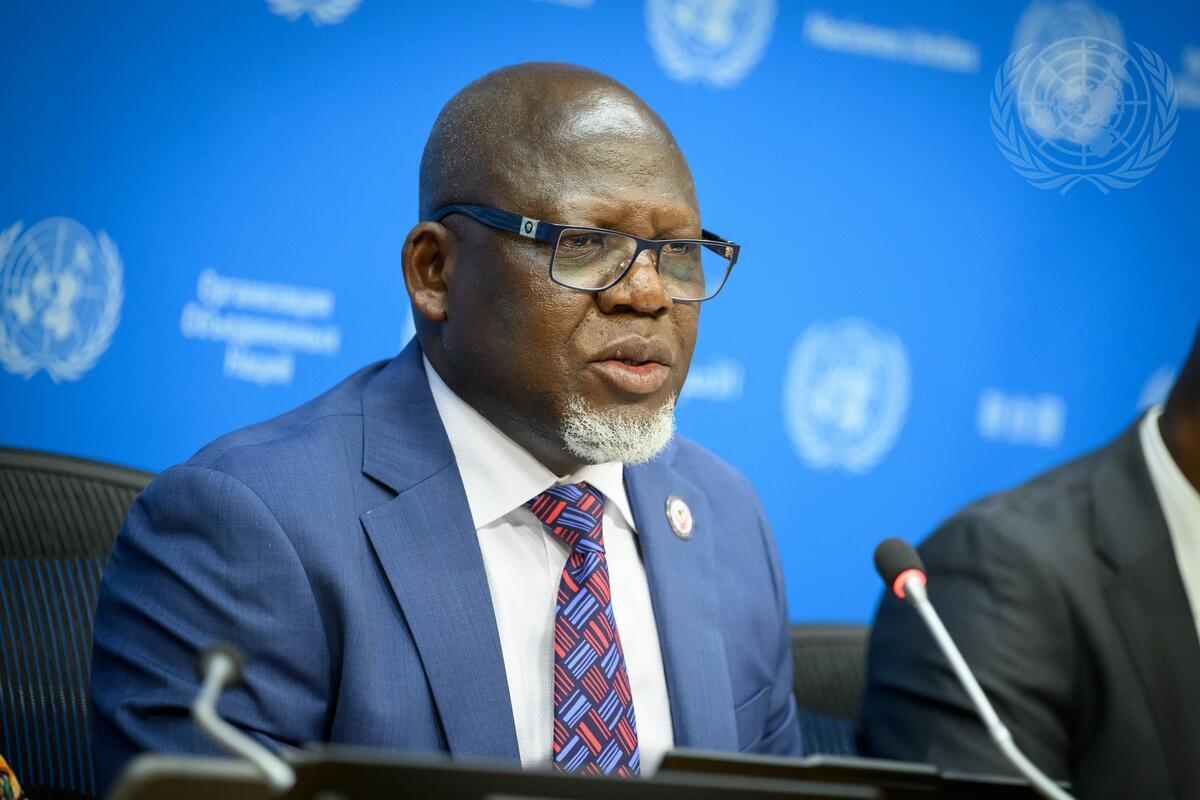
At a press briefing at UN headquarters in New York on July 1, Ambassador Zénon Mukongo Ngay, the DRC’s permanent representative to the UN, told reporters his country is placing natural resource governance at the center of its presidency. “We wanted to very clearly mark our passage through the Security Council by laying the foundations for what might eventually become a Security Council resolution” that sets a global standard for resource governance rooted in law and international principles.
The DRC is one of 10 non-permanent members (E10) serving on the Council, in addition to the five veto-wielding permanent members (P5), which include the United Kingdom, the United States, China, Russia and France. The DRC began its current two-year term in January 2026. This go-round marks the country’s third time sitting as a non-permanent member.
“This is a particularly important presidency for my country, marking our return to the Council after almost three decades,” said Ngay. “We take up this responsibility with a profound sense of duty and humility, fully aware of the expectations…at a time at which international peace and security are facing multiple and complex challenges.” He delivered his remarks in French throughout the briefing.
According to its program of work for the month, the DRC will hold three high-level events, with its capstone debate to be chaired by President Felix Tshisekedi, focusing on the theme “Natural Resource Governance: The Foundation of Peace, Security, and Prosperity.” However, to prepare for the high-level debate, scheduled for July 22, the DRC will also host, as part of its presidency, a similarly themed Arria Formula meeting—an informal version of a Council meeting—on July 13 to be chaired by the DRC’s Minister of Foreign Affairs, Thérèse Kayikwamba Wagner.
Ngay said he hoped that holding two meetings on essentially the same topic will “inject some momentum into finding solutions” that will plug the “serious gap between the exploitation of natural resources and respect for international principles and law.”
But the DRC’s effort to frame natural resources as a foundation for peace comes against a more complicated reality at home. Despite its vast mineral wealth, the country continues to grapple with child labor, corruption related to embezzlement and bribery and violence linked to illicit trade, underscoring the challenge of turning resources long associated with conflict into a credible tool for stability that benefits the country’s citizens.
According to media reports in 2025 a formal complaint was filed in Brussels alleging that nine members of President Tshisekedi’s family participated in corruption and other acts of criminal behavior connected to mines located in the provinces of Lualaba and Upper Katanga, in the country’s south. The case is ongoing.
Joshua Walker, a senior fellow at New York University’s (NYU) Center on International Cooperation, told Envoy that the meetings on natural resources and peace “are directly related to one of its fundamental, longstanding messages about conflict in the East: namely, that Eastern Congo has been destabilized by neighboring countries, and in particular, Rwanda, over the last 30 years due to their appetite for its minerals” and as President Tshisekedi has publicly accused its neighbor of wanting to “plunder the DRC’s resources using the M23.” The M23 is an armed group operating in the DRC, believed to be backed by the Rwandan Defense Forces (RDF). A claim that is repeatedly dismissed by Rwanda’s President Paul Kagame.
The European Union’s (EU) Generalised System of Preferences Hub (GSP), a trade program that grants developing countries access to the EU’s market, estimates the DRC’s raw minerals to be worth an estimated $24 trillion and includes the world’s largest coltan reserves and cobalt, critical ingredients for smartphones, electric vehicles and AI hardware. It is an exceptional amount of untapped wealth and resources that has not slipped under the Trump administration’s radar.
On December 4, 2025, the DRC’s President Tshisekedi and President Kagame of Rwanda met with US President Donald Trump at the White House to sign the Washington Accords, a peace deal aimed at ending decades of conflict and laying the foundation for greater economic cooperation between the two countries. Also signed were two separate bilateral agreements, one between the US and the DRC that, according to Erik Kennes, basically gives the US “a preferential position for anything related to the Congolese mining sector for several select minerals,” including copper, cobalt and zinc. However, the other bilateral economic-related agreement between Rwanda and the US has yet to be published, “so nobody knows what’s in it,” added Kennes.
A senior research fellow at Egmont, an independent think tank based in Brussels, Kennes also worked as a political affairs officer for the UN’s organization stabilization mission in the Democratic Republic of the Congo (MONUSCO) in Kisangani and Kinshasa from 2009 to 2017. Speaking over the phone, Kennes told Envoy he thinks Trump’s peace plan for the DRC is doomed to fail because it does not address the conflict’s root causes that stretch back decades.
Meanwhile, on July 8, the DRC will host an additional high-level open debate on women and peace and security, honoring the promise of international law to survivors of conflict-related sexual violence. The debate, to be chaired by the DRC’s Prime Minister Judith Suminwa, is particularly relevant given that the country was named in the Secretary-General’s most recent report on conflict-related sexual violence. According to the report, MONUSCO verified 1,534 cases of conflict-related sexual violence in 2025, an 86 percent increase from 2024. These cases include rape, gang rape, sexual slavery and forced marriage, and other forms of extreme physical violence, against men, women and children, with survivors as young as 1 year old.
The DRC was also called out in the Secretary-General’s annual report on children and armed conflict with 4,114 verified grave violations against 3,263 boys and girls. These violations generally include the killing and maiming of children in addition to abduction and recruitment by armed groups.
The work of the Council will kick off on July 2 with an emergency meeting requested by Bahrain to discuss Iran’s latest attack on the Gulf country.
On a lighter note, Ambassador Ngay ended the July 1 press briefing early to catch the remainder of the high-stakes FIFA World Cup playoff match between England and the DRC. “We have a great international team after 52 years of absence,” said Ngay. “If you don’t mind, we would love to leave now to watch the match.” In the end, DRC lost to England 2- 1.
In a post on X, President Tshisekedi congratulated the team, despite their devastating loss and urged Congolese people across the world to take pride in their nation “which has held high the flag of the DRC and, without a doubt, written one of the most beautiful pages in the country’s history.”
About The Author