The former Portuguese prime minister brought experience, instinct and reformist ambition to the UN. But Ukraine, Gaza and a broken Security Council turned his decade into a study in constrained leadership.
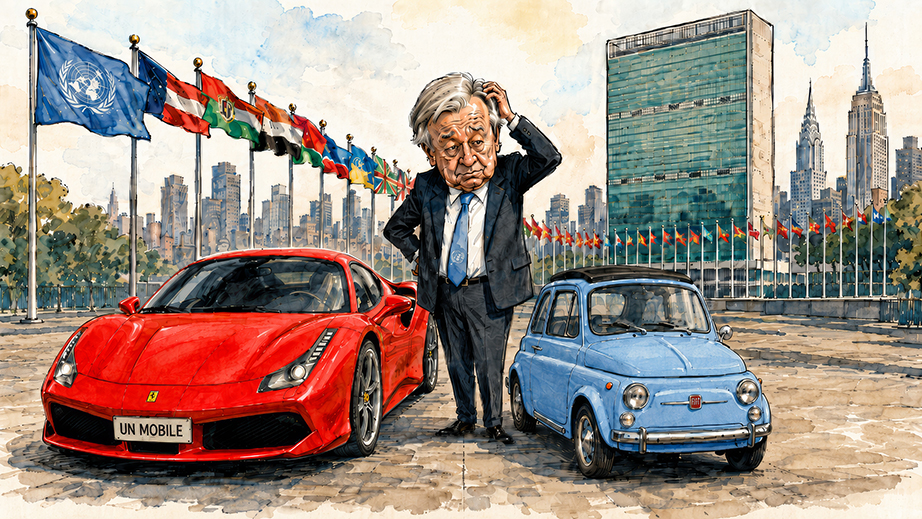
Was António Guterres’s decade at the United Nations like a Ferrari in the Grand Prix of global diplomacy, driven at the speed of a Fiat 500?
The metaphor captures the central paradox of his tenure: a leader with exceptional experience and political instinct, navigating an institution increasingly constrained by forces beyond his control.
When Guterres took office in January 2017, expectations could hardly have been higher. A former prime minister of Portugal and a widely respected High Commissioner for Refugees during one of the most severe displacement crises in modern history, he arrived at the helm of the UN with a rare combination of political credibility and operational experience. At a time when multilateralism was already under strain, his election—although some argued the position should have gone to a woman, possibly from South America or Eastern Europe—was widely seen as an opportunity to restore both purpose and authority to an institution struggling to remain central in a rapidly shifting geopolitical landscape.
Credit: UN Photo/Mark Garten
From the outset, Guterres framed conflict prevention as the central purpose of his tenure. The UN, he argued, had become too reactive, too focused on managing crises once they had already erupted. The real challenge was to act earlier, more decisively, and more politically to stop wars before they began. It was not just a policy shift. It was a redefinition of the secretary-general’s role itself. For a brief moment, it appeared possible.
More than nine years after taking over the organization, Guterres is leaving behind a UN that looks very different from the one he inherited from Ban Ki-moon. The organization’s personnel has shrunk under severe financial pressure, internal reforms have accelerated and its influence on questions of war and peace is often perceived as increasingly limited, particularly when major powers are directly involved.
To understand whether this reflects the failures of one secretary-general or the deeper transformation of the office itself, Envoy spoke with diplomats, former UN officials, ambassadors, scholars, and insiders who observed Guterres’s decade from inside the system he tried to reform, preserve, and, at times, politically revive.
An Early Test: Rohingya and the Promise of Action
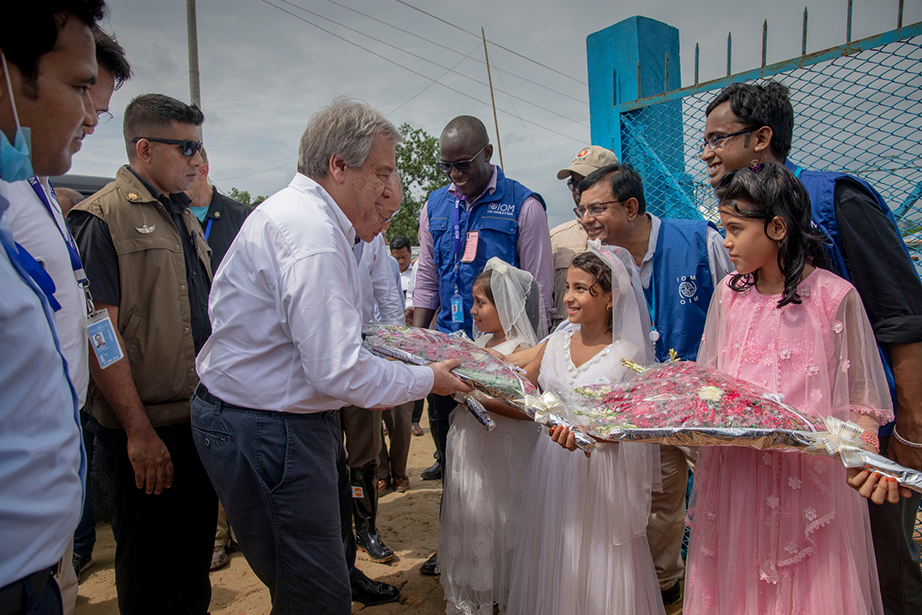
Guterres faced his first major tests almost immediately after taking office as secretary-general. As violence escalated in Myanmar’s Rakhine State and hundreds of thousands of Rohingya civilians began fleeing toward the border with Bangladesh, the UN risked falling into its familiar paralysis. The Security Council was divided, cautious, and hesitant to engage forcefully. Guterres chose a different path. Rather than waiting for a fragile consensus to emerge, he confronted the crisis head-on. In an unusually direct step for a newly appointed secretary-general, he sent a formal letter to the Security Council, publicly warning of the scale of the unfolding humanitarian catastrophe and urging immediate action. This time, the pressure worked.
The Council convened and directly confronted Myanmar’s authorities. Faced with growing international scrutiny and the prospect of a united response that could escalate under Chapter VII of the UN Charter, the Myanmar military—at the time under the orders of a democratically elected government led by Nobel Peace Prize laureate Aung San Suu Kyi—halted its operations amid growing international pressure. More than 750,000 Rohingya would ultimately flee across the border into Bangladesh. But within the UN system, that moment was seen as significant: a secretary-general willing to act early, willing to use his political capital, and willing to push the system toward decisive engagement.
It was, in many ways, the model Guterres had promised.
Cyprus: A Near Breakthrough, and a First Warning
Another early test would reveal how fragile that model really was. In 2017, Guterres invested significant political capital in efforts to resolve one of the longest-running disputes on the UN agenda: Cyprus. Negotiations in Crans-Montana brought the parties closer than they had been in decades.
Among those closely following the process was Colum Lynch, an award-winning reporter who has covered the United Nations for The Washington Post, Foreign Policy, and now Devex. Speaking with Envoy in a video interview, Lynch recalled how deeply Guterres was involved. “He was fully engaged,” Lynch said. “And they came closer than they had in years.” Still, the talks broke down.
The reasons behind the collapse were complex. Experts believe they were rooted in security guarantees, troop presence, domestic political pressures, and deep-rooted mistrust between the parties. But the broader lesson was unmistakable. Even when the secretary-general is fully engaged, success ultimately depends on decisions made by sovereign states.
“A secretary-general can be as good as the membership allows him to be,” Andreas Mavroyiannis, Cyprus’s former UN ambassador and a central figure in the island’s negotiations, told Envoy. For him, Crans-Montana exposed both the possibilities and the limits of the secretary-general’s office. He added that even the most engaged UN leadership cannot impose political solutions when sovereign states remain divided on fundamental security and governance issues. It was not a failure of effort. But it was an early reminder that the power of the office has limits.
The System Strikes Back
Those limits would become increasingly evident as Guterres’s tenure unfolded. “To judge the secretary-general, you must first judge the behavior of the Security Council,” Diego Arria, former ambassador of Venezuela whose name became shorthand for the Council’s informal “Arria-formula” meetings, told Envoy. “Mostly, I believe the Security Council is to blame.”
Abiodun Williams, Professor of the Practice of International Politics at The Fletcher School of Law and Diplomacy at Tufts University, who previously served in senior UN roles under both Kofi Annan and Ban Ki-moon, suggested that evaluating Guterres requires first understanding the different dimensions of the secretary-generalship itself. “A UN secretary-general has three important roles,” Williams told Envoy in written responses for this article. “Administrative, political, and normative.”
In his view, Guterres showed the strongest results in the administrative sphere, particularly through efforts aimed at streamlining bureaucracy, modernizing management structures, and reducing duplication across the system.
Politically, however, Williams argued that Guterres often appeared “more of a commentator than a mediator,” particularly during the defining geopolitical crises of his tenure. “He has been hesitant to use the moral authority of the office of secretary-general to resolve disputes and prevent deadly conflict,” he said.
Libya and the End of Early Mediation
Cyprus was not the only early mediation effort that left scars on Guterres’s doctrine of conflict prevention. “He made another big effort in Libya,” Lynch said. “He became personally involved in trying to advance the UN process between the Tripoli government and Haftar’s forces in the east.” But the effort collapsed dramatically. “He shows up in Tripoli,” Lynch recalled, “and on the day he shows up, Haftar launches a new offensive.”
For Lynch, Cyprus and Libya together marked a turning point. “Those are the two clearest examples of engaging in mediation where it doesn’t work,” he said.
It did not necessarily mean the failures were Guterres’s fault. But they reinforced the fragility of mediation in an international system increasingly dominated by regional rivalries and great-power fragmentation.
Trump and COVID: The Shrinking Space
By the time Guterres entered office, the geopolitical environment was already beginning to shift. The election of Donald Trump introduced a period of skepticism toward multilateral institutions. Because the US is by far the UN’s largest financial contributor, Washington’s skepticism carried unusually high stakes. Funding uncertainties and political pressure created a more fragile environment for the UN.
Lynch argued that Guterres’s handling of that period helped preserve a working relationship with Washington. “He managed to maintain a working relationship,” Lynch said, suggesting that confrontation could have carried higher risks. Then came COVID-19.
“For the two years I spent in the Security Council, I considered the secretary-general a shrewd, knowledgeable and witty figure,” a diplomat from an elected member told Envoy, speaking on condition of anonymity for this article. But, the diplomat added, the pandemic marked a turning point, as “cooperation between countries failed to match the speeches.”
The role of the secretary-general then shifted from political actor to global advocate.
Lynch believes this was the period in which Guterres fundamentally recalibrated his understanding of the office itself. After the failures in Cyprus and Libya, Trump’s election, the COVID-19 pandemic, and the growing paralysis between Washington and Beijing inside the Security Council, Lynch said, Guterres appeared to conclude that “he didn’t have space.”
“The divisions between the key powers were too deep,” Lynch said. “And I think he makes a calculation that the time is not right.” According to Lynch, this marked the gradual transition from an activist secretary-general focused on mediation to a more cautious leader increasingly oriented toward institutional survival, climate diplomacy, humanitarian arrangements, and long-term global governance issues such as artificial intelligence.
Ukraine: The Collapse of Prevention
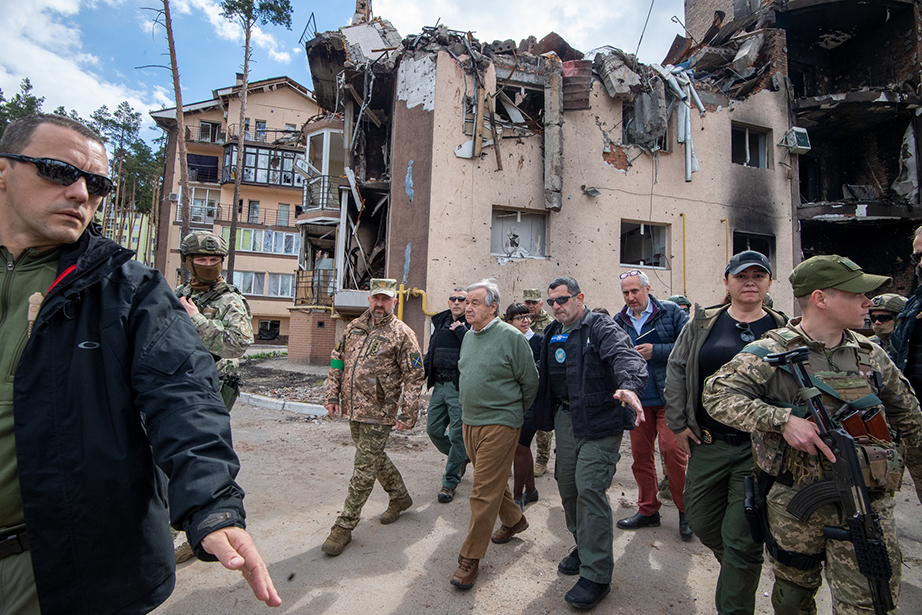
If Cyprus exposed the boundaries of the role, Ukraine marked the collapse of prevention. In the weeks before the invasion, there was no visible attempt at shuttle diplomacy. As a correspondent, I repeatedly asked whether Guterres might engage directly between Moscow and Kyiv in an effort to de-escalate what was rapidly becoming the most dangerous crisis in Europe in decades.
The answer, conveyed through his spokesperson, was consistent: a full-scale Russian invasion was not considered likely. The prevailing view was that such a move would not be in Moscow’s interest, even as US intelligence warnings grew increasingly stark.
As tensions reached their peak, Guterres traveled to Beijing for the Winter Olympics, a decision that puzzled some diplomats and correspondents who believed the moment called for shuttle diplomacy rather than symbolic distance. The optics were hard to ignore: as Europe stood on the brink of war, the secretary-general appeared absent from the last-minute efforts to prevent it.
Then it happened. As the Security Council met in New York to address the crisis, Russia launched its full-scale invasion of Ukraine. Guterres used the meeting to make a direct appeal to the Russian leader: “President Putin, stop your troops from attacking Ukraine. Give peace a chance. Too many people have already died.”
“It’s not that a secretary-general can stop these wars,” Lynch said. “The question is how much space he actually has to act.”
Credit: UN Photo/Eskinder Debebe
That is, in many ways, the central question. Few believe that even the most assertive secretary-general could have changed the Kremlin’s strategic calculations. But the criticism that followed was less about the outcome than about the absence of visible effort. Could he have succeeded? Probably not. But should he have tried more visibly, more urgently, more publicly? For many observers, that remains the unanswered question.
Years later, when I raised this broader question directly at a UN briefing—asking last May whether the repeated failures of conflict prevention reflected geopolitical realities or structural limitations of the office itself—Stéphane Dujarric, Guterres’s spokesperson, offered perhaps the clearest institutional defense of the secretary-general’s record: “The secretary-general has been focused on conflict prevention,” Dujarric said, noting that such efforts are often conducted discreetly and away from public view. But, he added, “the secretary-general doesn’t hold all the cards. His fingers are not on the trigger.” Conflict prevention, Dujarric argued, ultimately depends on active cooperation from member states and on governments “living up to the commitments they have made under the Charter.”
It was a concise answer, but one that perhaps captured the deeper dilemma of Guterres’s decade more clearly than many longer analyses.
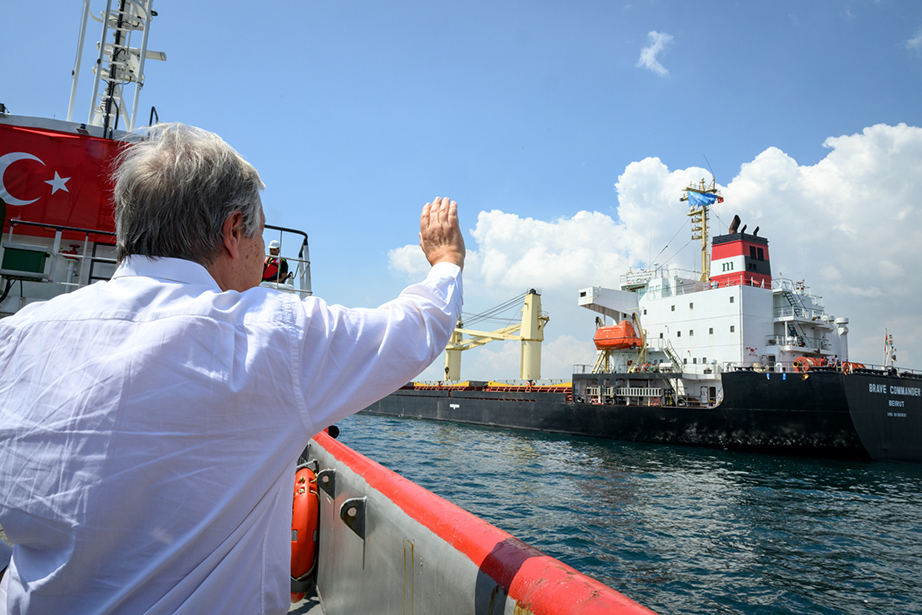
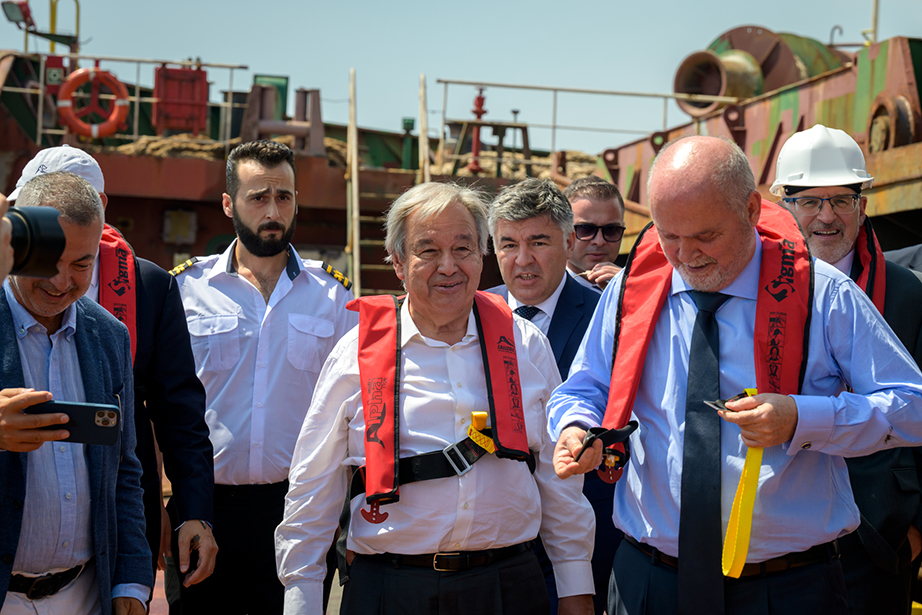
The UN chief would later help broker the Black Sea Grain Initiative, one of the few diplomatic successes of the war, which allowed Ukrainian grain and other food exports to resume through a safe maritime corridor in the Black Sea. The agreement restored some operational relevance to the United Nations. But by then, the defining moment of his doctrine, conflict prevention, had already passed its most critical test.
Lynch argued that the Initiative also reflected a broader strategic recalibration. “If we can’t mediate peace, then what can we do?” Lynch said, describing what he called a shift toward “limited ambition.”
Rather than attempting to negotiate an end to the war itself, the UN increasingly focused on humanitarian arrangements, side agreements, food exports, fertilizer shipments, and confidence-building mechanisms that could reduce global instability without directly resolving the conflict.
“Let’s not have any expectations that we’re going to negotiate a peace deal between Ukraine and Russia,” Lynch said, summarizing the logic that emerged during the war.
Gaza: A Crisis of the Office
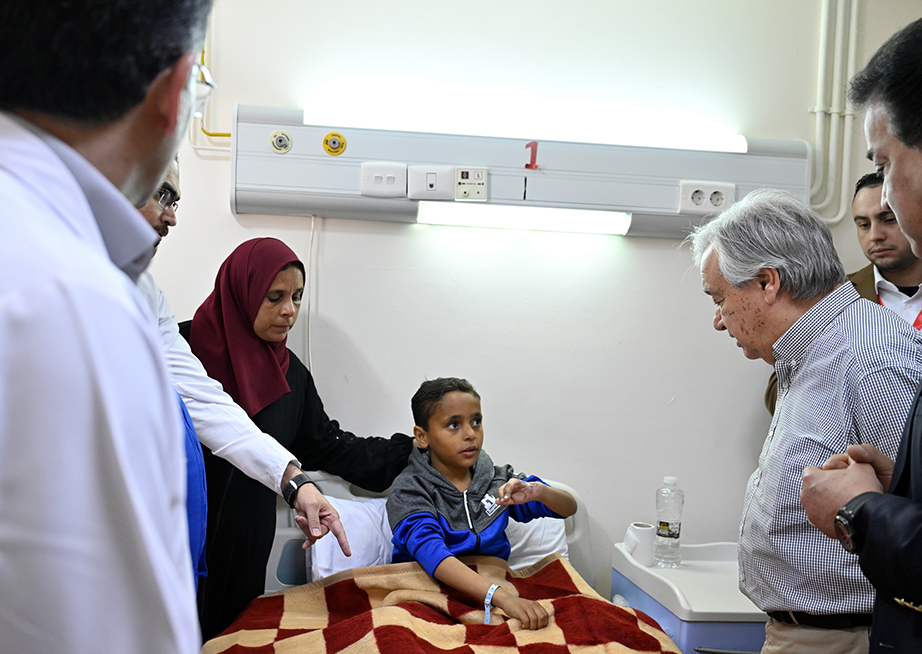
After October 7, 2023, and the subsequent Israeli military campaign in Gaza, the crisis exposed something deeper than the limits of multilateral diplomacy. It exposed a crisis of the office itself.
When Guterres told the Security Council that the attacks “did not happen in a vacuum,” reactions were immediate and politically explosive. Israeli officials accused him of justifying terrorism, called for his resignation, and relations between Israel and the UN leadership deteriorated sharply. In October 2024, Israel declared Guterres persona non grata. In diplomatic terms, it marked one of the most direct confrontations between a secretary-general and a member state in recent years. From that moment on, Guterres appeared increasingly constrained.
As the conflict escalated, another development raised the stakes even further. South Africa filed a case against Israel at the International Court of Justice, alleging violations of the Genocide Convention. The proceedings—and the Court’s subsequent provisional measures—placed the war in Gaza within a legal framework that went far beyond political condemnation, bringing the most serious accusations in international law into the global debate. In this context, the secretary-general’s position became even more delicate.
Guterres continued to call for a ceasefire, humanitarian access, and respect for international law, but avoided directly engaging with the legal characterization of the conflict in terms of genocide. For some observers, this caution reflected the need to preserve the neutrality of his office and avoid further political escalation with key member states. For others, it appeared as a series of careful political contortions aimed at staying outside one of the most defining legal and moral debates of the conflict.
“The UN has sidelined itself,” Dali ten Hove, a former UN political affairs officer who left the organization in late 2025, said in a video interview with Envoy. “It has become a spectator to world events.” While acknowledging Guterres’s experience and intelligence, he argued that the organization has struggled to translate its normative authority into real political leverage at decisive moments.
Credit: UN hoto/Mark Garten
Others point instead to structural constraints already visible throughout his tenure, particularly the paralysis of the Security Council.
Lynch contrasted Guterres’s caution with moments of greater public confrontation under previous secretaries-general, particularly Kofi Annan during the Iraq War. “One thing I thought was pretty courageous,” he said, “was Annan’s position before and after the US invasion of Iraq.” By openly describing the intervention as inconsistent with international law, Annan infuriated Washington and faced significant political backlash in the United States. But Lynch argued that, over time, the episode strengthened the perception of the UN as an institution willing to uphold the principles of the Charter even against major powers. “The institution benefited because they were seen to have taken a principled position,” he said. Yet even within those constraints, perception matters.
That sense of marginalization became even more visible in the diplomatic initiatives that followed. In one of the most striking examples, the Trump administration advanced its own Gaza framework, centered on a ceasefire, hostage releases, humanitarian access, reconstruction, and postwar governance arrangements, while keeping the UN largely outside the core negotiations. For many diplomats in New York, the message was unmistakable: the UN was not simply being sidelined; it was being excluded from one of the most consequential geopolitical crises.
In diplomatic circles, the episode was widely perceived as a humiliation for the organization, reinforcing the impression that, despite its global legitimacy, the UN had lost its centrality in high-stakes political decision-making.
Still, that humiliation was at least partially tempered by the fact that most European and democratic countries chose not to align themselves with the initiative, signaling that, while weakened, the UN had not entirely lost its political and moral reference point among key international actors.
For critics, the central question remains whether Guterres could have used the authority of his office more forcefully, shaping the global narrative with greater clarity. For supporters, his restraint reflects a deliberate effort to preserve what remains of the UN’s operational space, ensuring humanitarian access and avoiding a complete diplomatic rupture.
Savita Pawnday, executive director of the Global Centre for the Responsibility to Protect, offered one of the sharpest critiques of Guterres’s leadership. While acknowledging his use of Article 99 of the UN Charter in December 2023 to call for a humanitarian ceasefire in Gaza, she argued that the secretary-general has too often remained “reserved” in other atrocity situations.
“During Guterres’ term the number of conflicts worldwide has increased,” Pawnday said, pointing to repeated “grave breaches of the UN Charter” and what she described as missed opportunities to galvanize stronger international responses in places such as Sudan. In her view, both the UN system and the secretary-general himself bear responsibility for the current paralysis.
“We did not see a forward-leaning secretary-general who worked to directly diplomatically engage with the states involved to mediate the crisis, de-escalate tensions, challenge perpetrators or speak truth to power,” she said. Pawnday argued in a recent essay that the organization increasingly risks “choosing irrelevance over courage.”
Gaza, in this sense, became more than a conflict: it became a test of what the secretary-general can say, can do, and ultimately can be in a world where power politics increasingly override multilateral authority.
Reform from Within: The UN80 Agenda
Yet focusing only on geopolitical crises risks overlooking one of the areas where Guterres has arguably been most effective: internal reform. From the early years of his mandate, he pushed for a restructuring of the UN system aimed at making it more agile, more efficient, and better aligned with contemporary challenges. That effort, later framed within broader initiatives often referred to as the UN80 agenda, included streamlining bureaucratic structures, strengthening coordination across agencies, and confronting long-standing inefficiencies.
In practical terms, this has translated into difficult and sometimes controversial decisions. Plans to reduce staffing levels, rationalize overlapping functions, and reallocate resources have drawn criticism from within the organization. Yet for many diplomats and observers, such changes were not only inevitable but long overdue.
Several officials interviewed for this article noted that, unlike in the political sphere where outcomes depend heavily on member states, internal reform is one of the few areas where a secretary-general can exercise more direct influence. In that domain, Guterres has shown a willingness to act. Even critics tend to agree on one point: reforming the UN was unavoidable.
Rhonda King, who was ambassador of Saint Vincent and the Grenadines between 2013 and 2025, served on the Security Council during part of Guterres’s tenure. She offered one of the strongest defenses of his record in remarks provided to Envoy for this article. “Antonio Guterres was a secretary-general of structural ambition and moral clarity who served during the worst geopolitical decade for the United Nations since its founding,” she said.
King argued that many assessments of Guterres focus almost exclusively on geopolitical crises while overlooking the areas where a secretary-general can exercise more direct influence.
“He reformed what he could reform from the thirty-eighth floor: management, the development system, gender parity, the institutional response to racism,” she said. “He could not reform what only Member States can reform: the Security Council, the financing gap, the wars themselves.”
Speaking from the perspective of a small island developing state, King said Guterres made the organization more accessible to countries often marginalized in global diplomacy and strengthened the effectiveness of the UN at country level. Saint Vincent and the Grenadines, she noted, directly experienced his “very hands-on approach” during the devastating volcanic eruption of April 2021 and again following Hurricane Beryl in 2024. “He gave us a Secretariat that worked better at country level than the one he inherited,” she said.
Whether these changes will ultimately strengthen the organization’s ability to respond to global crises remains an open question. But under Guterres’s leadership, they have undeniably set in motion a process of reshaping the institution itself.
Low Profile or Survival Strategy?
In the final phase of Guterres’s tenure, the question becomes even more difficult: has his caution been a failure of leadership, or a strategy of survival? Trump’s return to the White House, the war in Gaza, the widening regional crisis involving Iran, and fears over the Strait of Hormuz have all reinforced the impression that the UN is increasingly watching events unfold from the sidelines. The secretary-general continues to issue warnings, appeals, and calls for restraint. But the machinery of power appears to move elsewhere: in Washington, Tehran, Jerusalem, Moscow, Beijing, and in the capitals of the permanent members of the Security Council.
This is where the most charitable interpretation of Guterres’s late tenure begins. Perhaps his low profile is not simply passivity. Perhaps it is a calculated attempt to keep the institution alive through a hostile geopolitical storm. With the United States again threatening the multilateral system, and with Israel and some of its allies openly attacking UN agencies and officials, confrontation could carry a heavy price. Funding, access, humanitarian operations, and even the basic ability of UN officials to operate on the ground could all be placed at risk.
In this reading, Guterres is not trying to win the political argument. He is trying to preserve the UN so that it survives the storm. It is a logic that recalls an old Sicilian expression: calati junco ca passa la china, or bend like a reed until the flood passes. Better to bend than break.
Even former Secretary-General Ban Ki-moon has recently acknowledged how structurally constrained the office has become.
Speaking before the Security Council in late 2025, Ban warned that the UN itself risks “collapse or irrelevance” without meaningful reform, openly criticizing the repeated use of vetoes by permanent members “to shield themselves, their allies and their proxies from accountability.”
More strikingly, Ban argued that the current system of renewable five-year mandates weakens the independence of secretaries-general themselves. Because reappointment depends heavily on the support of the permanent members of the Security Council, he warned, secretaries-general can become “overly dependent” on the very powers they may at times need to confront. He proposed replacing the current arrangement with a single, non-renewable seven-year term in order to reduce political pressure and strengthen the autonomy of the office.
In that context, some of Guterres’s caution may appear less as a personal trait than as a structural condition of the modern secretary-generalship itself.
Similar concerns have also emerged from within the broader circle of former UN leaders and senior international diplomats associated with The Elders, the organization of global leaders founded by Nelson Mandela.
In a recent essay titled “The Choice of the Next Secretary-General Could Decide the UN’s Fate,” former UN High Commissioner for Human Rights Zeid Ra’ad Al Hussein warned that “the diminishing scope for political leadership by the UN” has become one of the defining crises of the institution itself.
Zeid argued that the next secretary-general must act independently, “not constrained by political caution or beholden to the governments they are meant to hold to account,” and must possess the courage “to speak truth to power.” “A UN without an empowered secretary-general,” he wrote, “is a UN that cannot fulfil its primary purpose: to save succeeding generations from the scourge of war.”
The argument raises a difficult question for Guterres: was the secretary-general too cautious, or has the office itself become increasingly unable to exercise the kind of political and moral leadership the world still expects from it?
But the weakness of that argument is that the flood has not passed. It has widened.
From Ukraine to Gaza, from Sudan to Lebanon, and now to the confrontation with Iran and the risk of escalation around Hormuz, the world has moved deeper into precisely the kind of power politics the UN was created to contain. If the secretary-general bends too long, critics ask, what exactly remains standing?
The recent crisis involving Iran and the Strait of Hormuz has further highlighted both the persistence and the ambiguity of UN diplomacy under Guterres.
As fears of a wider regional war intensified in early 2026, the secretary-general appointed veteran French diplomat Jean Arnault as his personal envoy to support mediation efforts linked to the conflict and its regional consequences. Announcing the appointment, Guterres warned that “the world is staring down the barrel of a wider war” and insisted that diplomacy “must succeed.”
Arnault, one of the UN’s most experienced mediators, was tasked with working “directly on the ground” to support a durable end to the conflict, strengthen the fragile ceasefire, encourage dialogue among regional actors, and address mounting concerns over freedom of navigation in the Strait of Hormuz.
In the weeks that followed, Arnault engaged in intensive shuttle diplomacy across the region, including consultations in Tehran and meetings with mediators like Pakistan, as the UN simultaneously warned about the global economic and humanitarian consequences of prolonged instability around Hormuz, including disruptions to oil, gas, fertilizer shipments, and global food security.
From New York, the practical scope of the mission often remained difficult to assess. Diplomats and correspondents could see the envoy traveling, meeting officials, and engaging in consultations, but it was less clear what concrete leverage or political mandate the UN actually possessed in a crisis increasingly dominated by military calculations and direct power politics among regional and global actors.
In many ways, the episode encapsulated the broader dilemma facing the modern secretary-generalship: even when the UN deploys highly experienced mediators and activates its diplomatic machinery, the organization often struggles to demonstrate visible influence over events unfolding at the speed of contemporary geopolitics.
Critics have echoed the view that the UN has increasingly appeared sidelined in major global crises, arguing that it has struggled to shape the diplomatic agenda or offer credible alternatives in moments of escalation.
Ten Hove also argued that part of the problem may stem from a deeper mismatch between Guterres’s diplomatic instincts and the political culture of the current era. “He seems to conduct diplomacy in the way diplomacy was conducted in the 1980s and 1990s,” he said, describing a model based on quiet mediation, closed-door negotiations, and discreet shuttle diplomacy.
But according to ten Hove, today’s geopolitical environment is fundamentally different: more polarized, more public, more shaped by disinformation, social media, and permanent political confrontation. “You can’t rely on quiet diplomacy anymore,” he argued. “You need to be seen. You need to be vocal.” In that sense, the criticism directed at Guterres may not concern only the substance of his diplomacy, but also whether the traditional model of secretary-general diplomacy still functions in the age of Trump, social media warfare, and collapsing global consensus.
Lynch offers a more cautious judgment, noting that the space for action has narrowed dramatically, with a divided Security Council and major powers directly involved in conflicts. Reflecting on the origins of the Black Sea Grain Initiative, he noted that some of the key ideas initially emerged outside UN headquarters, among individuals and organizations operating within the broader humanitarian and mediation community connected to the UN orbit.
“What the UN has lost,” Lynch said, “is a lot of the creativity and dynamism in terms of peacemaking and mediation that it had in the past.” In his view, this may partly explain why the organization increasingly appears reactive during major international crises.
Arria’s verdict points even more directly at the system itself, arguing that responsibility lies primarily with the behavior of the Security Council and its permanent members.
That may be true. But it does not entirely absolve the secretary-general. The office still has moral authority. It still has the power to name dangers, to frame choices, to mobilize public pressure, and to remind states of the Charter when they would rather forget it.
Williams nevertheless cautioned against viewing the current paralysis as entirely unique to Guterres’s tenure. The Security Council, he noted, has been deadlocked repeatedly throughout UN history whenever major powers entered direct confrontation.
“And therein lies the opportunity,” Williams argued. “History shows that if a secretary-general provides workable solutions to crises, the member states may ask for more.” In his view, a more politically dynamic secretary-general than Guterres might not necessarily have resolved conflicts such as Ukraine or Gaza, but could potentially have increased “the UN’s relevance and influence during international crises.”
Williams also suggested that modern expectations of the office remain deeply shaped by the legacy of Kofi Annan. “Annan’s strategic vision, moral and political courage, and agile diplomacy made him a transformational leader,” he said. “In today’s geopolitical climate it is more important than ever to have a secretary-general who embodies those qualities.” Yet the comparison may itself reveal how much the geopolitical environment has changed since Annan’s era.
A Ferrari, or Something Else?
So was Guterres’s decade at the UN a Ferrari driven like a Fiat 500? The answer, after almost ten years, is more complicated than the metaphor suggests. Guterres was certainly a Ferrari driver in terms of experience. Few secretaries-general entered the office with a stronger résumé. He understood the system. He had the intelligence, the discipline, and the political instinct.
And yet, the record is mixed. He showed early assertiveness on the Rohingya crisis. He came close in Cyprus. He helped deliver the Black Sea Grain Initiative after Russia’s invasion of Ukraine. He pushed climate change, AI governance, and institutional reform. Under his leadership, the UN began a painful process of restructuring that many saw as unavoidable.
But on the defining conflicts of his decade, the picture is far darker. Ukraine was not prevented. Gaza became a test of moral and political courage. Sudan collapsed. Lebanon remained fragile. The Iran crisis and the threat to Hormuz showed again how quickly the UN can be pushed outside the room when great powers decide to act alone.
Mavroyiannis refined the Ferrari metaphor best. “Even a Ferrari has to slow down if the road conditions do not allow it to run at full speed.” That may be the fairest judgment. Guterres had the engine, but the road was broken.
Yet even some critics defended Guterres’s caution as a survival strategy, but questioned what exactly was being preserved. Ten Hove suggested that the organization may have succeeded in protecting its institutional structure while gradually losing political relevance.
“If you are only preserving the architecture of the UN, if you are only preserving the building in New York,” he said, “but you are allowing the soul of the UN to die, what are you still preserving?” For ten Hove, the deeper risk was not only paralysis, but the gradual transformation of the United Nations into a passive observer of crises rather than a political actor capable of shaping outcomes.
After listening to diplomats, former UN officials, ambassadors, scholars, and even Guterres’s own defenders, another possibility begins to emerge.
Perhaps the problem was not simply that a Ferrari was forced to slow down on a damaged road. Perhaps the deeper problem is that the international community continues to expect from the secretary-general the performance of a Ferrari while the office itself increasingly resembles something far smaller and structurally weaker: a diplomatic Fiat 500 from another era, operating under rules written in 1945 for a very different geopolitical world.
Even some of Guterres’s critics acknowledge that he may have inherited the office at the worst possible historical moment: the return of great-power rivalry, the collapse of multilateral consensus, the rise of disinformation politics, and two Trump presidencies.
The UN Charter gives the secretary-general no army, no enforcement mechanism, and increasingly little leverage over the major powers themselves. The office relies instead on persuasion, moral authority, political timing, mediation, public pressure, and the willingness of member states to cooperate.
In that sense, Guterres may not have been a Ferrari driver forced to move like a Fiat 500. He may have been the driver of a Fiat 500 asked to compete in a Formula One race against states operating with the speed and force of modern geopolitical powers.
Some secretaries-general managed to push that small diplomatic engine further than others. Dag Hammarskjöld expanded the political imagination of the office so aggressively that the UN itself later concluded his 1961 plane crash near Ndola, while he was en route to negotiate a ceasefire in the Congo crisis, was likely not an accident but the result of an “external attack or threat.” Boutros Boutros-Ghali proved too independent for Washington and was denied a second term. Kofi Annan, perhaps the most politically gifted secretary-general of the post-Cold War era, succeeded in restoring much of the UN’s moral authority, but even he ultimately governed through persuasion rather than power.
In that light, Guterres’s decade may ultimately be remembered less as the story of one man’s limitations than as the moment the world fully discovered the shortcomings of the office itself.
About The Author