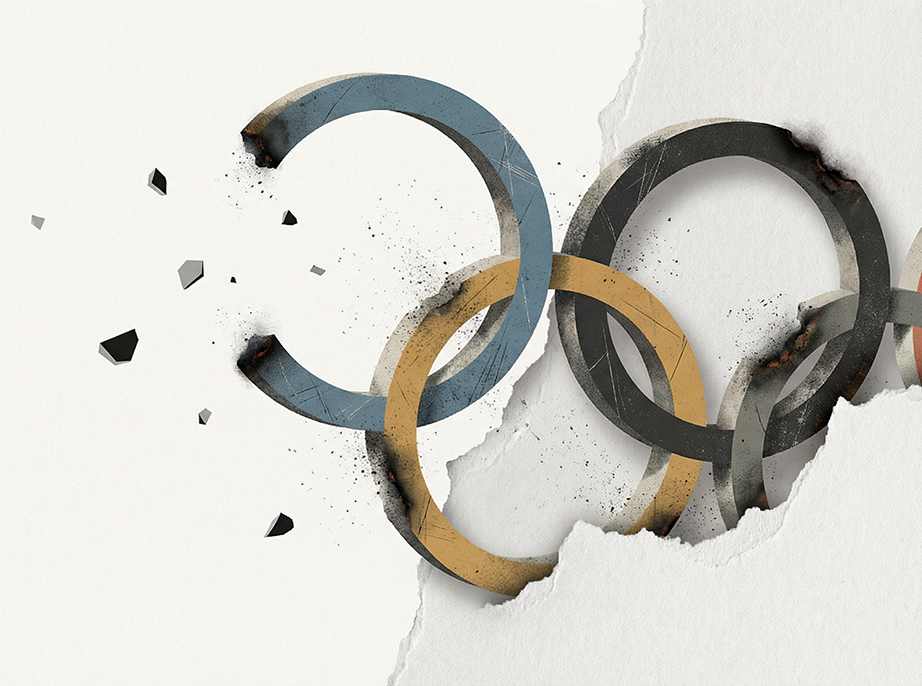
As war broke out during the Paralympic Games, a new initiative seeks to name and shame violators of the millennia-old Olympic Truce.
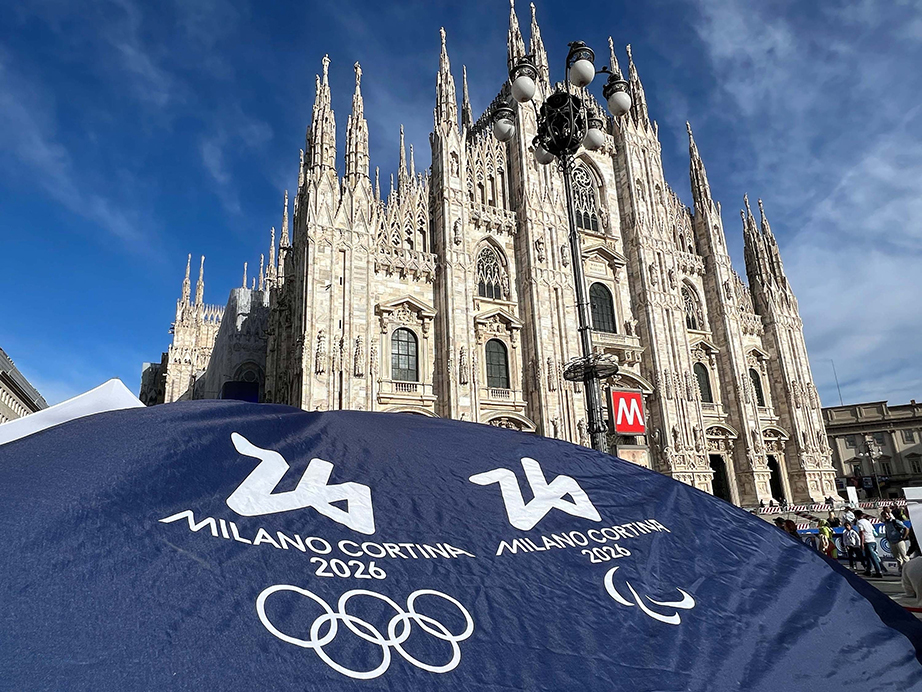
The final event of the 2026 Milan Cortina Olympics featured a fiercely competitive hockey game between arguably the two best men’s teams. On February 22, 2026, the United States upset Canada in overtime to win gold, replicating the women’s outcome days before. The final was one of the Games’ most-watched events. The tensions on the ice weren’t just about sport.
The rivalry between the US and Canada reflected growing political tensions between the two countries, undercutting the Olympic ideal of unity. When Canada beat the US in 2025, it was at the height of President Donald Trump’s calls for the northern neighbor to become the 51st state. As former Canadian prime minister Justin Trudeau wrote on X at the time, “You can’t take our country—and you can’t take our game.”

“The Olympics serve as a proxy battlefield of sorts, of a cultural plane, in relations among states, whether they’re friendly or adversarial,” said Hugh Dugan, a US diplomat who has served at the United Nations and the US National Security Council under both Republican and Democratic presidents. Dugan is the founder of the Truce Foundation and its Olympic Truce Compliance Index. “That component of the Olympic Games is enduring—that can’t be changed, and it won’t be changed—but during the Games themselves, we hope that sport is the main event and that it’s not simply a proxy for ongoing geopolitical relations.”
“Sport is its own independent entity, although you are literally wearing the flag of your country on your chest [at the Olympics]. It can be misused as a tool for propaganda or it could be used for patriotism. Sometimes that is one in the same,” said Ashleigh Huffman, the former chief of sports diplomacy at the US Department of State. “There’s so much power there. Sports diplomacy is the space between politics and people. It opens doors that politics cannot enter and humanizes the other.”

The Olympic Truce Compliance Index, launched in January of this year, highlights how closely sports, through the Olympic ideals, are tied to politics. The digital tool tracks armed conflict, humanitarian corridors, and other threats to compliance in near real time, with the goal of identifying countries that violate the Olympic Truce and creating accountability where little has existed.
Once again, this year real battlefields broke out between the Olympics and the Paralympics. The US and Israel launched a a war in Iran on February 28, 2026, before all of the Paralympics athletes had landed in Verona, Italy’s Olympic Village. This attack happened during the Olympic truce, a global ceasefire established by a biennial UN General Assembly resolution. The war prevented Iran’s sole athlete, two-time Paralympic cross-country skier Aboulfazl Khatibi Mianaei, from competing due to travel concerns.
Trump’s late-February strike on Iran follows a grim precedent: Russia invaded Ukraine on February 24, 2022, just days after the closing ceremony of the Beijing Olympic Games, and a few days before the Paralympic Games began.
On the opening day of the 2022 Beijing Winter Olympics, ironically, Putin met with Chinese President Xi Jinping. A statement issued after that meeting testified to a friendship that had “no limits” and “no forbidden areas of concentration,” a meeting that many experts saw as signaling Beijing’s tacit acceptance of Russia’s impending invasion of Ukraine.
Russia’s invasion led to its athletes being banned from future Games until there is a peaceful resolution to the Ukrainian war. However, breaking the Olympic Truce did not provoke the ban. The International Olympic Committee (IOC) banned Russia in response to its annexation of regional sports organizations in the areas it had invaded, which is a breach of the Olympic Charter. Russia’s paralympians were expelled from Beijing, before they could compete in any event.
China, however, is not Russia’s only close ally in international relations; because it provided so much assistance to Russia during the Ukraine invasion, Belarus athletes have experienced the same national ban. Athletes from both countries can compete under a neutral flag in Olympic Games, but they cannot represent their native country.
“I’m not saying the scope, or the scale or the purpose of the U.S and Israel attacking Iran is the same as Russia and Belarus invading Ukraine,” said Huffman, who was in office during the time of the invasion. “But the truth of the matter is that what was done in 2022 is eerily similar to what has happened in 2026. And in 2022, there was an outcry from 34 nations that called for about 16 different actions over the course of 4 strongly worded joint statements that said, this is what should happen to Russia and Belarus. We should condemn the invasion. We should affirm the Olympic truce.”
While the United States has not usurped leadership of any regional sports organization, on March 5, military strikes battered three sports complexes in Tehran, Iran. Included among those stadiums is Iran’s Azadi Stadium, the historic home of the national soccer team. On March 11, Iran pulled out of the 2026 FIFA World Cup, which will take place in Canada, Mexico, and the US, while American paralympians continue to compete in the current Games.

After the attacks on Iran, the IOC issued a statement on the Olympic Truce Resolution urging member states to uphold the ceasefire in support of athletes, while acknowledging that it “has no means of enforcing the implementation of the resolution.” Dugan noted that the resolution is not only the world’s longest-standing international treaty, dating back to the ancient Olympics, but also, in his view, its “most popular,” as it is routinely approved by consensus with the support of more than 100 countries.
Since 1993, the U.N.’s Truce Resolution has called for disarmament during both the Olympics and the Paralympics, as well as seven days before and after. Based on the concept of ekecheiria—a ceasefire during the ancient Olympics that allowed athletes and citizens of various city-states to safely travel to the Games, the Truce is meant to be a diplomatic tool during the modern Games.
“Sarajevo hosted the Olympics in 1984, and by 1992, Yugoslavia was dissolving,” said Dugan about the first resolution, which he drafted with input from the International Olympic Committee. The resolution is an organic document adopted before each Olympic Games, keeping it fresh and in front of civil society, diplomats, and politicians. Yet, like many U.N. resolutions, there is no enforcement mechanism for the Truce.
Italy, the host country of this year’s Winter Olympics, submitted a draft in October 2025 for the Milan-Cortina Games. According to Salvatore Napolitano, spokesperson for the Italian Mission to the U.N., the final version of the resolution was the result of what he termed “very dynamic” negotiations among member states. Napolitano explained that the final document was adapted to his country’s specific agenda for these Games, and included recognition of the sustainable and lasting legacy of the Games for the host territories and local communities, specific provisions on women and girls in sports, and support the long-term priorities of the Games themselves –– to use sport as an enabler of peace and sustainable development.
Under President Trump, the US, which hosts the next Games in Los Angeles, has formally rejected the SDGs and has withdrawn from U.N. programs while withholding or reducing payments to various U.N. entities and the organization. In 2025 the US asked that the UNFPA “remove divisive cultural concepts from its programming, especially diversity, equity, and inclusion; gender ideology and sexual and reproductive health.” In March 2026, the US was the only country to vote against a General Assembly draft resolution regarding women and justice.
Diplomats familiar with the negotiations said Washington initially opposed language in the resolution around inclusivity. That was until administration officials were reminded that the US will have to pass the same resolution in the General Assembly. The US re-affirmed its commitment, at least on paper, after the adoption of the Olympic Truce resolution: “The United States is . . . committed to promoting peace and global stability through sport in Los Angeles and again in 2034 when we host the Winter Games in Salt Lake City, Utah.” While Italy’s mission to the U.N. did not want to talk about the specifics of the negotiations around the resolutions, it acknowledged adopting that one was an uphill battle. “Generally speaking,” said Napolitano, “it’s not easy to reach a consensus.”
Nevertheless, Italy sees the adoption of the resolution as a success in itself. “Doing so on this Resolution reflects a broad support for the Olympic values. [It] brought cross regional support with the remarkable number of 165 co-sponsors,” said Napolitano on the importance of the consensus vote. “There’s still a collective willingness to reinforce that there is a confidence in multilateralism, and in the ability of sport to promote peace and security.”
However, once again, the overwhelming support for the resolution did not translate into action. “The Olympic truce has always represented something that’s aspirational rather than enforceable,” said Huffman when asked about the Truce and timing of violence in 2022 and 2026. “It’s a shared global norm, and those symbolic commitments are really important. The credibility of the Olympic truce depends on whether major powers like the United States, Russia, Israel, Belarus, are willing to treat it as meaningful.”
While there is no formal enforcement mechanism, Dugan believes in the moral power of naming and shaming countries violating the Truce.
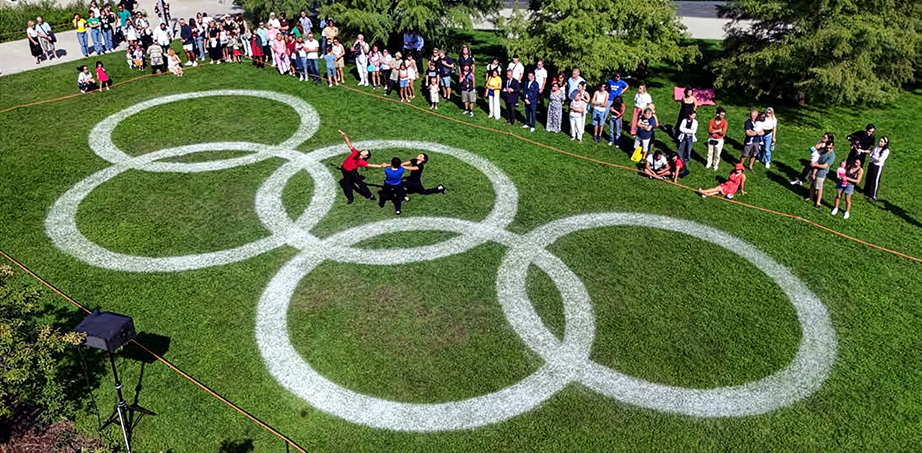
“We want more accountability,” Dugan said. “The Olympic movement is the world’s largest movement, beyond any single religion or any single country, with the most recognizable emblems in the world. The rings are more commonly known than any other symbol on Earth. That should be a good measure, to start looking at what is the accountability of member states to the resolutions that they adopt in the General Assembly, and something that the public could easily fathom because they’re already paying attention to the Olympics.”
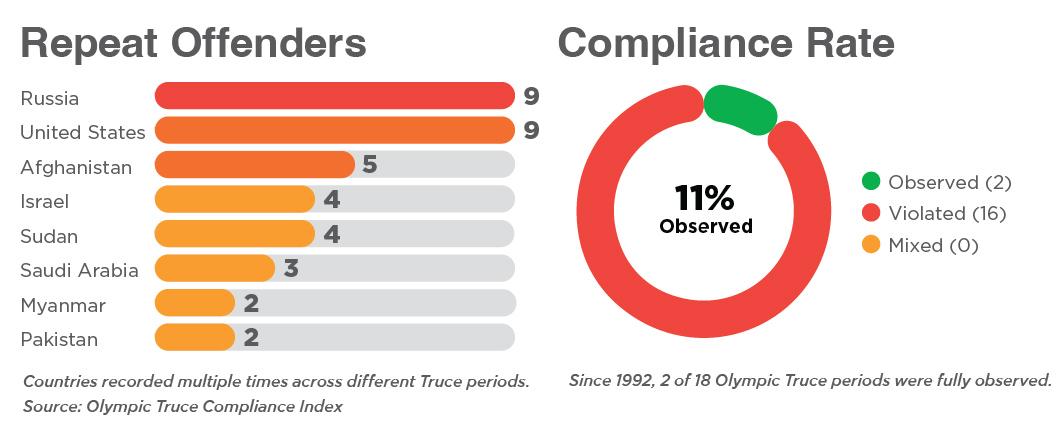
The need for accountability drove the launch of the Compliance Index. The Index uses data from ACLED Data, an independent conflict monitor, and is produced in partnership with Multilateral Accountability Associates. Using a color-coded map, a digital dashboard tracks conflicts and other threats to peace and security around the world, which are ranked by threat level. Data is presented in as close to real-time as possible, which is notable considering, according to ACLED, from December 2024 through November 2025, there were more than 204,000 violent, conflict-based events worldwide which resulted in at least 240,000 deaths. The Index, according to Dugan, garners thousands of views each month. The Truce Foundation also publishes the Truce Portal, a daily briefing of threats to global peace and security and the Truce Pulse, a weekly analysis of current events mapped against the Olympic Truce principles. The Portal also tracks threats to specific programs, like humanitarian aid. The site even offers a Wall of Shame which claims roots in ancient times, as the page boasts those who violated ekecheiria had their names inscribed in stone at Olympia, “creating a permanent record of shame visible to all visitors for generations.” Today, two countries are tied for the dubious honor of first on the leaderboard: Russia and the United States.
“I felt it was overdue to install some type of a monitoring mechanism that would provide us some real-time feedback on what the world’s member states have resoundingly agreed to do,” Dugan said, when asked why he created the digital tool, “and whether they’re actually obliging it during the Games themselves.”
About The Author