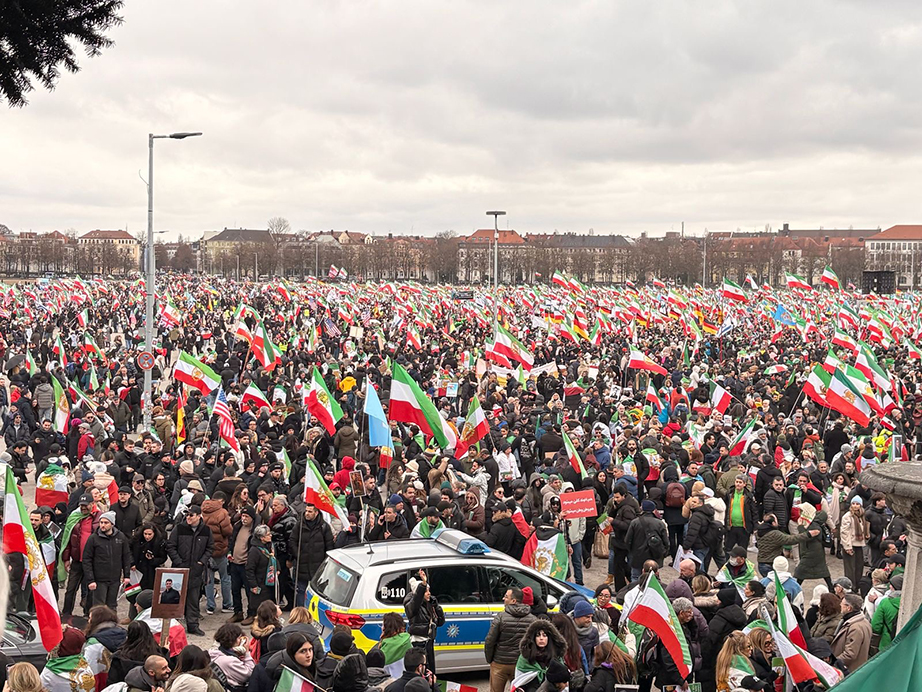
As diaspora crowds cheered Khamenei’s death, rival opposition camps are still battling over what comes next.
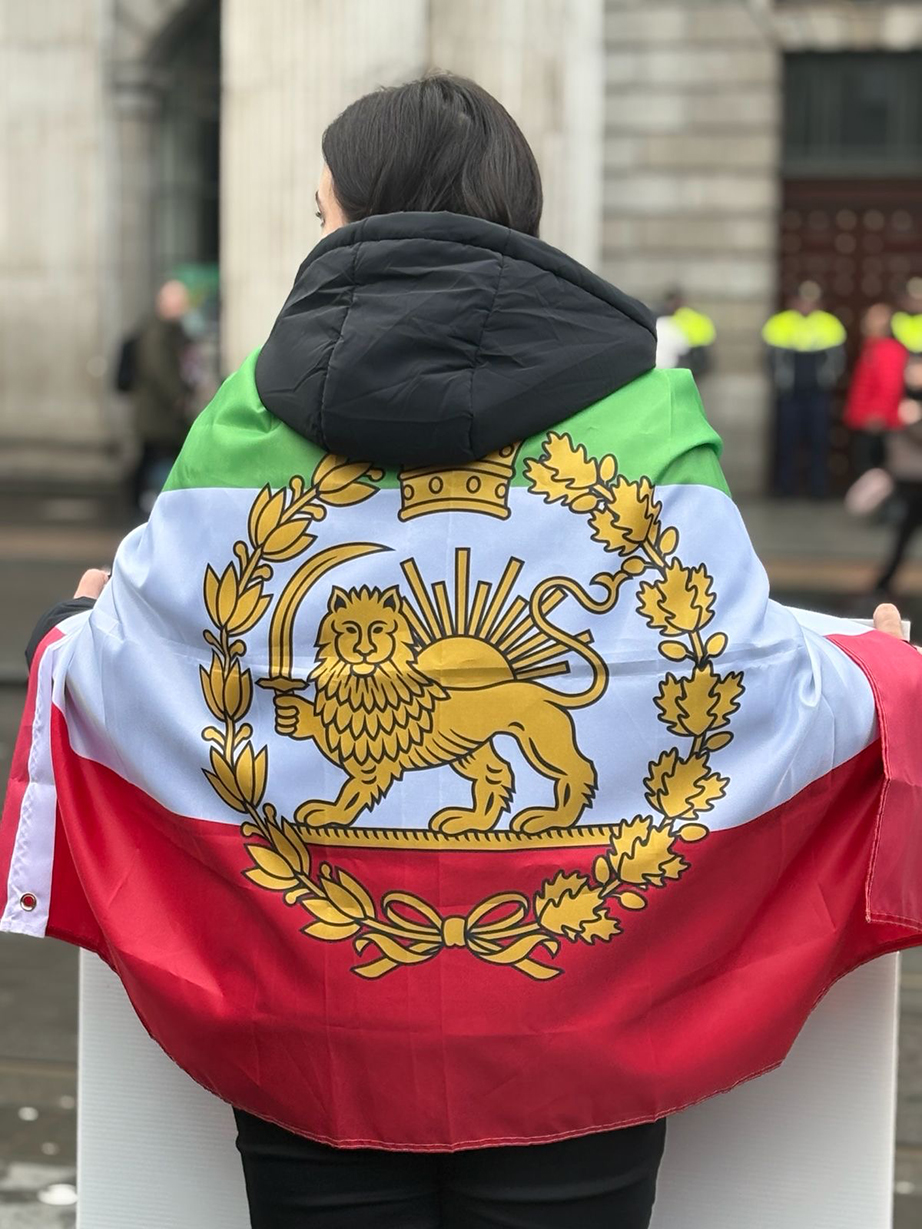
From above the crowd, a man’s voice booms out from a speaker like thunder. He chants, slowly at first, in Farsi, “We are a proud and great nation. We will reclaim Iran from tyranny!” and the people standing below repeat the words as if breathing from one massive lung. As the momentum builds, heads covered in fuzzy winter hats bob up and down, gloved fists punch up at the dusky sky, and a sea of bright red, white, and green-striped flags stamped with golden lions ripple and slap back at the wind.
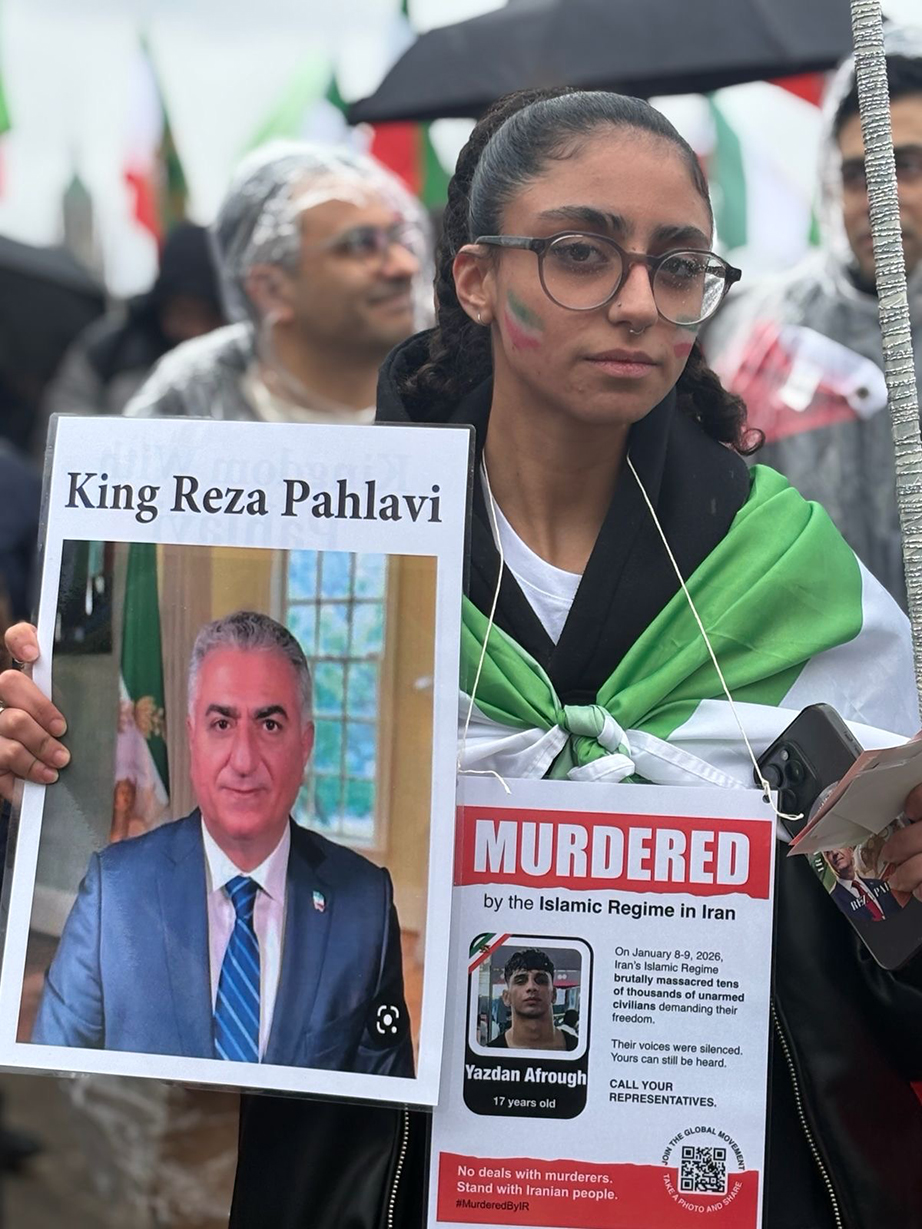
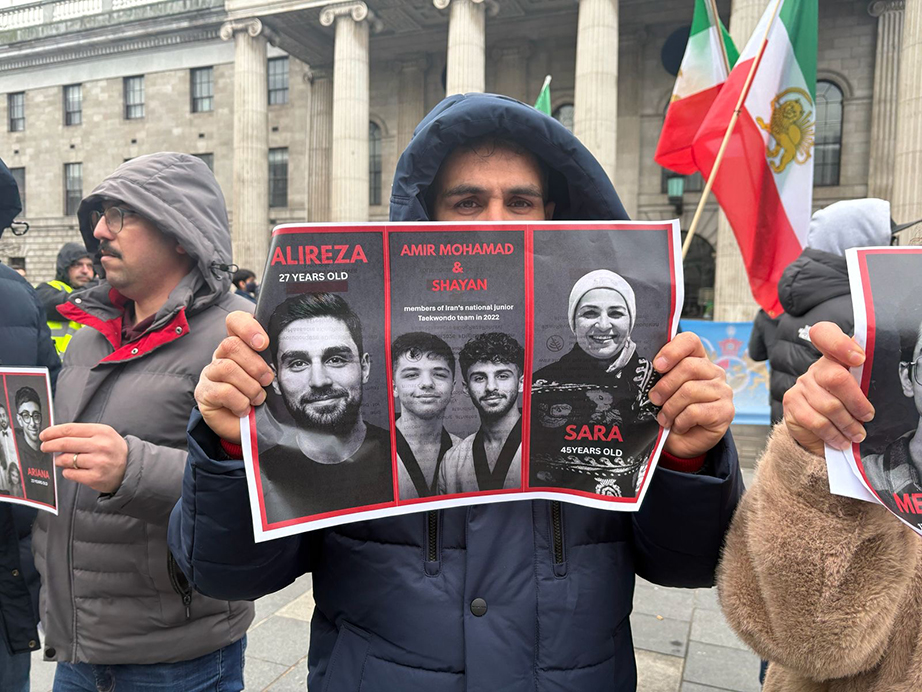
DeDe, a 40-year-old Iranian wearing a mask reminiscent of the COVID-19 era, is one of at least 200 protesters parked outside the Embassy of the Islamic Republic of Iran in London on Jan. 17, calling for the end of the Iranian regime in response to the deadly crackdown on anti-government protesters in late December 2025 and early January. Like DeDe, many of the people interviewed for this article shared only their first names and ages for fear of retaliation.
“It was a massacre,” said DeDe. “People with bare hands were shot like in a war with bullets. Simply, they were mothers, fathers, sisters, daughters, children, asking for freedom. Who cares about their blood and suffering?”
Within the Iranian diaspora, two of the more visible opposition leaders, Reza Pahlavi, the exiled crown prince of Iran and eldest son of the last Shah, Mohammad Reza Pahlavi, and Maryam Rajavi, president-elect of the National Council of Resistance of Iran (NCRI), a democratic political coalition, separately declared themselves transitional leaders if the regime falls. Over five weeks, Envoy spoke with dozens of pro-Pahlavi Iranians, also called monarchists, protesting in London, Dublin, and Munich, and with supporters of Rajavi via text messages and phone interviews to understand the contentious divide between the two groups.
The recent assassination of the Supreme Leader Ayatollah Ali Khamenei in an Israeli airstrike on his compound in Tehran on Feb. 28 has done nothing to quell their deep-seated mistrust and skepticism of each other. On paper, both camps say they envision a free and democratic Iran, but they vehemently disagree on how to get there.
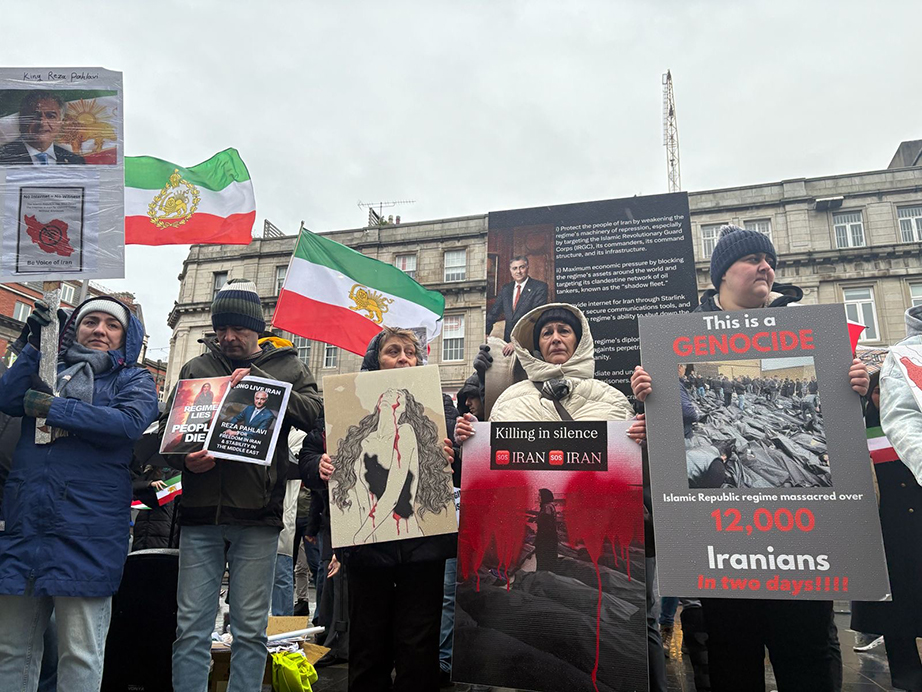
These groups are like “oil and water,” said Pedram Baldari, a scholar on Iran and professor of art and design at the University of Michigan, Ann Arbor. “Their issue with one another is as equally fundamental as their issue with the Islamic Republic’s government.”
For Pahlavi, his father’s legacy as the last Shah of Iran—who ruled from 1941 until 1979, when the Islamic Revolution toppled the monarchy and established the Islamic Republic—often overshadows his vision for a secular and democratic Iran. Memories of brutal torture and murder by the SAVAK, the Shah’s secret police, of political dissidents, intellectuals, and members of armed opposition groups have left “deep wounds,” said Kamran Dalir, a member of the foreign affairs committee of the NCRI and supporter of Rajavi. “We are still alive, and we remember our history,” he added.
According to Amnesty International, during the reign of the Shah, the SAVAK carried out “arbitrary arrest and detentions” that included “systematic torture and other ill-treatments” of political dissidents, student activists, and “ethnic minority groups seeking a degree of autonomy.”
In a recent interview on 60 Minutes, Pahlavi described his father’s repressive reign as being “one narrative.” Meanwhile, in a post on the social media platform X, he called Khamenei “the bloodthirsty despot of our time” and said his death marks the end of the Islamic Republic that will soon “be consigned to the dustbin of history.”
Dalir sees Pahlavi as representative of his father’s “dictatorship,” despite Pahlavi touting himself as the transitional leader of Iran, as outlined in the Emergency Phase Booklet, a document providing a phased timeline to guide the country through the collapse of the Islamic Republic. It is part of the National Union for Democracy in Iran’s (NUFDI) Iran Prosperity Project, endorsed by Pahlavi. The NUFDI is a nonprofit organization representing the Iranian American community, based in Washington, D.C.
Envoy reached out to the NUFDI for comment, but they declined to respond.
It is difficult to measure with certainty the level of support each opposition figure has among Iran’s general population of around 90 million people. “Iran is not just Tehran. Iran is not just one particular city,” said Dr. Nazir Hussain, an academic and professor of international relations, in Islamabad, Pakistan. Iran is composed of different regions and cities, and every region has its own dynamics, he added.
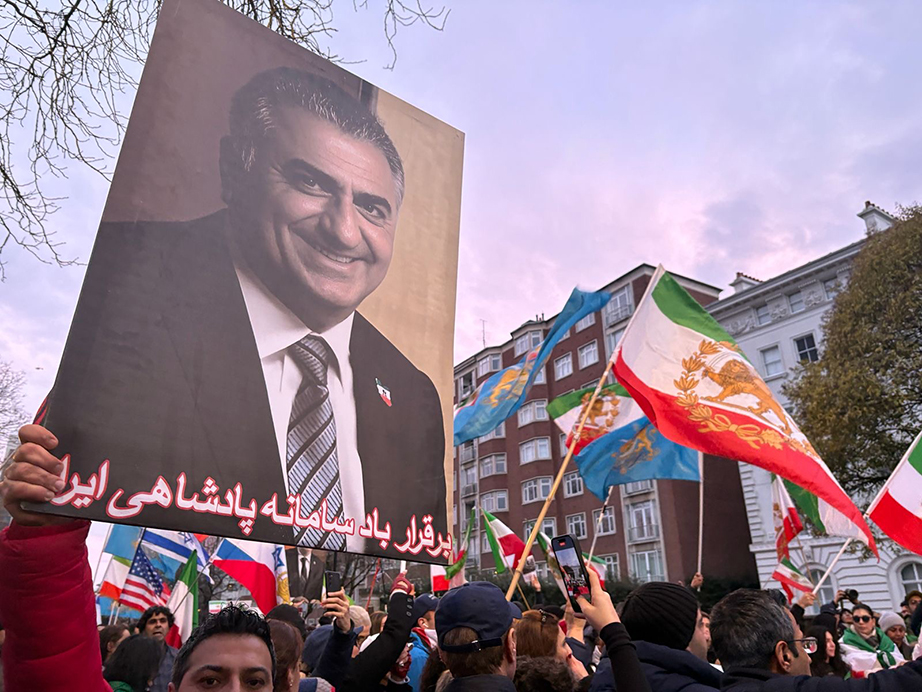
Still, pro-Pahlavi supporters in Europe, like DeDe in London, say millions of Iranians were shouting his name in the streets in late December and early January. “He’s the one the people have chosen,” she said.
Pahlavi has “a doctrine that embodies life with dignity for Iranians and Middle East region as a whole,” said Ash, a 42-year-old oral surgeon in Dublin. He called the killing of the Supreme Leader a “very welcoming” move. This cancer needs to be removed. In my opinion, at this point, there is no return.
Notably, on Feb. 20, Mai Sato, the U.N. Special Rapporteur on the situation of human rights in the Islamic Republic of Iran, and other experts urged the Iranian authorities to “fully disclose the fate and whereabouts of individuals detained, forcibly disappeared, or missing in the aftermath of the nationwide protests, and to halt all death sentences and executions related to the demonstrations.” According to the statement, the Iranian authorities “have acknowledged 3,117 deaths and approximately 3,000 arrests” during the recent protests, but “human rights organizations estimate these figures to be in the tens of thousands.”
In a public address on Jan. 17, the late Khamenei blamed anti-Iran affiliates of the US and Israel for sowing unrest in the country and for killing “several thousands” of people.
Siavush Randjbar-Daemi, a senior lecturer in modern Middle Eastern history at the University of St Andrews in Scotland, told Envoy that protests in Iran were initially triggered for a “combination of reasons,” including a “collapsed economy” and “very persistent inflation” that “emasculated middle-class life.” He added: “Retired teachers have to spend as much as a quarter of their monthly pension on cooking oil, for example,” he added. “This clearly has created deprivation and anger,” that exploded into nationwide anti-government protests.
“Many countries have lived for years under democracy, peace, and the separation of religion and politics,” said Tayyebeh, a 36-year-old PhD student and Pahlavi supporter. “They haven’t reached the same kind of desperation that we have.”
Meanwhile, unlike Pahlavi, Maryam Rajavi, the president-elect of the NCRI, is criticized for supporting the Mojahedin-e-Khalq (MEK), also known as the People’s Mojahedin Organization of Iran (PMOI). The exiled resistance group was designated a foreign terrorist organization by the US Department of State in 1997 for “acts of terrorism,” including “its involvement in the killing of US citizens in Iran in the 1970s and an attack on US soil in 1992”—claims the MEK denies. However, in 2012, the State Department delisted the organization. The U.K. delisted the group in 2008, and the European Union in 2009.
For Pahlavi, the issue of the MEK is personal, given that the group helped overthrow his father, the Shah, in 1979. “The MEK are not my friends,” said Pahlavi at a press conference in Munich on Feb. 14. “I do not represent them” because they do not “adhere” to my “core principles.” But for regular Iranians, their grievances remain on the dusted-over battlefields of the 1980s Iran-Iraq War—a deeply painful period for Iranians—when the MEK sided with Saddam Hussein. Some Iranians, including monarchists, say this legacy makes it difficult to see the MEK and Rajavi as a credible and trustworthy alternative for Iran.
Rajavi, like Pahlavi, also touts herself as Iran’s transitional leader. Upon news of Khamenei’s death, she took to social media to declare a provisional government by the NCRI to “Transfer Sovereignty to the People of Iran and Establish a Democratic Republic” built on her Ten-Point Plan: “a plan based on freedom, equality, separation of religion and state, and the abolition of the death penalty.” She runs on a platform that rejects the Shah and the mullahs, the Muslim clerics.
In Berlin on Feb. 7, Rajavi and her supporters held a rally at the famous Brandenburg Gate to mark the anniversary of the anti-monarchical revolution against the Shah. “The struggle continues,” Rajavi said to a flag-waving crowd. But we will “rise anew” and “reduce the clerical regime to dust and ashes.”
Ryan, a 21-year-old volunteer with the Coalition of Young Iranians (CYI) in the US and Canada, traveled from California to attend. He described the event as one of the “most representative demonstrations of Iranians from every background and nationality” who “came together and said no Shah, no mullahs, [and] yes to a secular democratic republic.” The CYI is a group of volunteers that advocates for a secular and democratic Iran.
Ryan told Envoy that his mother, who was 17 at the time, was a political prisoner for five years in Evin prison, one of the most notorious in Iran. “She was tortured there, and her brother was also executed for being a supporter of the MEK,” he said. Born in the US, Ryan has never been to Iran. He said he was shocked by the killing of the Ayatollah.
Unlike those in the Pahlavi camp, who applaud the ongoing US and Israeli strikes in Iran, Ryan, who personally supports a provisional government based on Rajavi’s Ten-Point Plan, does not. “A sustainable future for Iran can’t be imposed from the outside. Whatever happens within Iran will have to come from the Iranian people themselves.”
About The Author