Canada’s former deputy prime minister recalls businessmen raising the possibility of bribing Donald Trump, warns of a new era of transactional diplomacy and questions whether the United States can still be trusted as an ally.
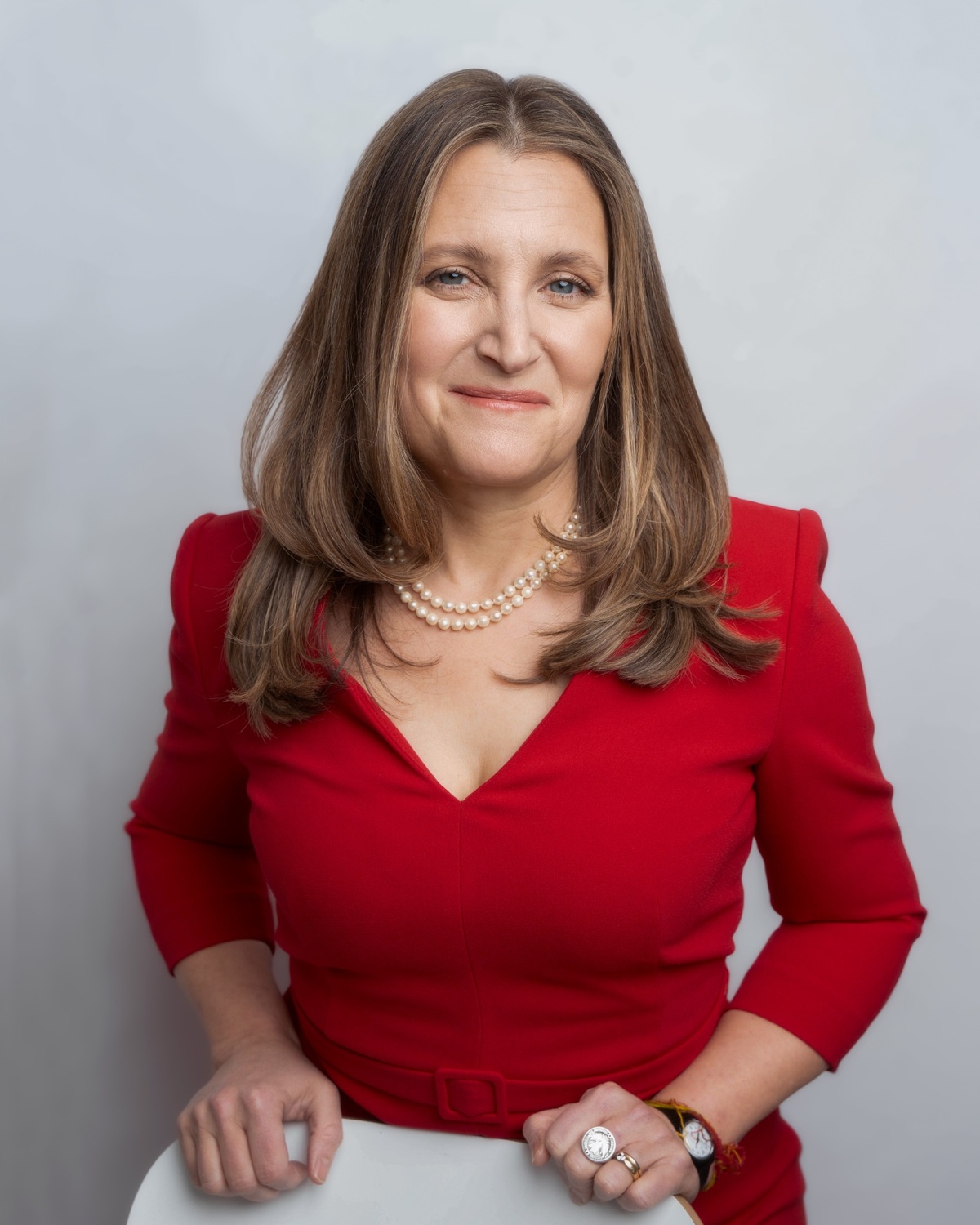
Buried in the more than 300 pages of Chrystia Freeland’s new book is an anecdote that might once have caused a diplomatic scandal. Today, it reads almost like routine advice.
Canada’s former deputy prime minister, who now advises Ukrainian President Volodymyr Zelenskyy on economic development and is CEO of the Rhodes Trust, recalls an American businessman casually telling her to “encourage the Ukrainians to cut the Trump family in on any peace deal.”
“I know it sounds bad, he said, but you can be sure the Russians are doing it. It is just the cost of doing business with the United States today,” Freeland writes in her most recent book, Unreliable Boyfriend: An Insider’s View of Dealing with a Chaotic Superpower, Plutocrats, and Other Complicated People.
“I was just shocked,” Freeland told Envoy Magazine in an exclusive interview on October 16. “Because this person who was saying this to me is not a bad guy. It’s actually someone you would know if I named the name. It’s actually a good person who I think believes in democracy, understands that Ukraine is right, and that Russia is waging an illegal criminal war. It was just kind of a genuine, serious advice.”
Freeland said such discussions were not limited to Ukraine. During her time in Canada’s government, she recalled, Canadian businessmen also raised such a possibility.
“When I was still in cabinet, Canadian businessmen asked me that question, and I write about this. And they asked, so should we as a country be figuring out how to bribe the president? Like, is that the only way? My goodness. I mean, this is terrible.”
Before entering politics, Freeland reported on the rise of Russian oligarchs after the Soviet Union collapsed. In her 2012 book, Plutocrats: The Rise of the New Global Super-Rich and the Fall of Everyone Else, she examined the growing influence of the global financial elite and its implications for American democracy.
“It’s hard to find words that are powerful enough to convey the degradation of the United States,” she said. “But also how this degrades the whole world of international relations. Because what you’re seeing right now is countries and companies that know how to bribe governments are really successful in dealing with the world’s biggest economy.”
Her latest book suggests that many of the problems she identified more than a decade ago have only intensified.
“You think when you are a writer that what you want is your predictions to come true, but sometimes you don’t want that,” she said. “I’m so sorry that I turned out kind of to be right.”
For Freeland, the consequences extend far beyond Washington, reshaping international relations and potentially benefiting America’s adversaries.
“There is a big global fight between democracy and dictatorship right now, and Russia is fighting for the dictators,” she said. “But we have to remember that China is on Russia’s side.”
Freeland entered Canadian politics in 2013 and served in several senior cabinet positions under Prime Minister Justin Trudeau. As foreign affairs minister from 2017 to 2019, she helped lead the renegotiation of NAFTA with the first Trump administration. Trump famously called her “nasty”—a remark she now wears as a badge of honor, reproducing it on the back cover of her latest book.
The politician later served as deputy prime minister and finance minister before resigning from Trudeau’s cabinet in December 2024 amid disagreements over his government’s direction. After an unsuccessful bid to lead Canada’s Liberal Party, she became an unpaid economic adviser to Ukrainian President Volodymyr Zelenskyy in January 2026.
“We can’t talk about the United States as Ukraine’s ally anymore. And we have to be clear about that,” she said. “In terms of what’s happening with Ukraine, I do think this is appalling to say and even to think, but it is certainly the case that Russia has a bigger checkbook than Ukraine and Putin’s Russia is much more willing to engage in corrupt deals,” she added.
She believes the US is stabbing Ukraine in the back right now, and that American voters should send Washington a strong signal during the midterm elections.
“I think some people are having second thoughts. I think there’s a little bit of buyer’s remorse now,” she said. “The midterms are going to show America and the world whether the policies we’re seeing right now coming from the White House are Donald Trump’s policies or are America’s policies.”
But for Freeland, the question extends beyond Trump and the upcoming midterm elections. Even if a future American president seeks to restore the country’s traditional alliances, can its partners ever fully trust Washington again?
“I think it really, really depends on where America goes,” she said.
At a recent Council on Foreign Relations event, Freeland recalled being asked what a future American president with different views would need to do to convince Canadians that Washington had changed course.
She said the question surprised her—and gave her hope.
“I was so happy to get that question,” she said. “It’s important that Americans are starting to ask themselves that question.”
For now, it’s unclear whether the world’s most powerful democracy can, or wants to, repair its relationships.
As with any unreliable boyfriend, the question may no longer be whether he will change, but whether his partners will ever believe him again.
About The Author