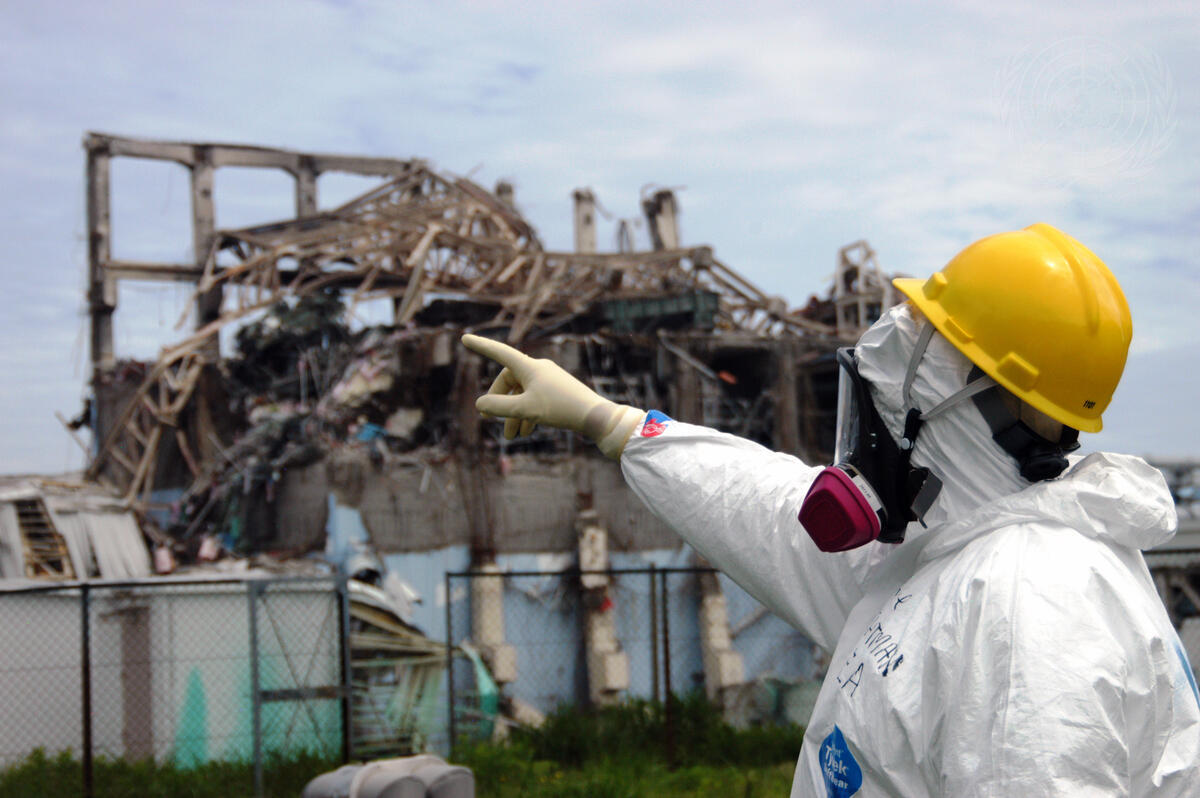
From Ukraine’s embattled Zaporizhzhia plant to reactors built just kilometers from national borders, Envoy maps the cross-border risks of nuclear power and examines whether international safety arrangements are keeping pace.
When Russia invaded Ukraine in February 2022, attention turned to some of the country’s key energy infrastructure, which could become the source of an international disaster.
The region had already experienced the Chernobyl nuclear disaster in April 1986, when Reactor No. 4 of the Chernobyl Nuclear Power Plant, in what was then Soviet Ukraine, exploded, releasing radioactive material into the atmosphere.
The disaster killed 30 people from immediate causes, exposed millions to radiation, displaced hundreds of thousands, and increased long-term cancer risks across affected regions.
As conflicts intensify, the proximity of some nuclear reactors to national borders has raised concerns about cross-border safety and emergency preparedness. A new data visualization project by Envoy maps the proximity of nuclear power plants to international borders, highlighting the potential cross-border consequences of accidents, attacks and security failures. While some neighboring countries have established bilateral agreements to address these risks, others lack similar arrangements, raising questions about gaps in international nuclear safety cooperation.
Even inland civilian nuclear power stations for energy generation have remained under threat, with a United Nations Commission of Inquiry on Ukraine documenting several attacks in the vicinity of the Zaporizhzhia Nuclear Power Plant, Europe’s largest nuclear power station.
“There have been occasions in which arms with high explosive power have been used in the vicinity of the plant, causing a tremendous concern about the safety of the plant and its reactors,” Pablo de Grieff, a commissioner, said, responding to a question by Envoy.
The station has been under Russian control since March 2022.
“We have been witnessing targeted attacks against critical energy infrastructure, which is a matter of great concern, especially with the winter coming,” Sanita Pavļuta-Deslandes, Latvia’s ambassador to the UN, which holds the presidency of the Security Council in November, told Envoy. “We have seen that in previous winters, but this winter the situation is significantly worse regarding the attacks to the energy infrastructure.”
Nuclear power plants have long been vulnerable during armed conflicts, but the war in Ukraine has brought renewed attention to the risks they pose beyond the battlefield. As countries continue to invest in nuclear energy, the findings raise a broader question: Are international safeguards and cross-border cooperation sufficient to prevent a nuclear incident from becoming a regional disaster?
Stations Located Close to National Borders
Data mapped by Envoy using information from the Council of Europe shows that several nuclear power stations are located close to national borders. There is a practical explanation: nuclear plants require large amounts of water for cooling, and rivers often form natural boundaries between countries. But this proximity also raises concerns about cross-border safety, emergency preparedness and regional security. In Belgium, the Doel reactors sit just four kilometres (2.5 miles) from the Dutch border, making them among Europe’s closest reactors to an international boundary.
Note: The map shows nuclear power plant sites without distinguishing between individual reactors or their operational status. In Belgium, several reactors at the Doel and Tihange plants have been permanently shut down. As of November 2026, only Doel 4 and Tihange 3 remain operational.
For example, the Armenia-2 reactor is 16 kilometres (10 miles) from the Turkish border, while Bulgaria’s Kozloduy-5 and Kozloduy-6 reactors are five kilometres from the Romanian border.
Belgium’s three Tihange reactors are listed as 38 kilometres (about 24 miles) from the Dutch border.
Data from the World Nuclear Association (WNA), analyzed by Envoy, shows that nuclear reactor development expanded between 1954 and 2026, with new reactor connections peaking in the mid-1980s.
Note: The map shows nuclear power plant sites without distinguishing between individual reactors or their operational status. In Belgium, several reactors at the Doel and Tihange plants have been permanently shut down. As of November 2026, only Doel 4 and Tihange 3 remain operational.
New reactor connections declined sharply after their peak in the mid-1980s. Over the past two decades, permanent shutdowns have slightly outnumbered new reactors entering operation, contributing to stagnation in the global operating fleet. However, this trend does not necessarily reflect a decline in nuclear generating capacity or investment, as countries continue to build new reactors, often with greater generating capacity than older units.
Despite the decline in new reactor connections since the 1980s, countries are continuing to develop nuclear power stations. Türkiye is building four reactors at Akkuyu, with a combined planned capacity of 4.8 GW and staggered commissioning schedules. Egypt is also developing its first nuclear power plant at El Dabaa, comprising four reactors with a combined planned capacity of 4.8 GW.
Once operational, Egypt would become the second country in Africa with an operating nuclear power plant, after South Africa.
State of Bilateral Agreements
Susi Snyder, program director at the International Campaign to Abolish Nuclear Weapons (ICAN), says that while some countries have bilateral agreements on nuclear safety, the absence of such arrangements elsewhere has contributed to tensions between neighbouring states.
“It’s something that there is a bilateral agreement between the Netherlands and Belgium about what to do in the case of an accident or an urgent situation,” Snyder says.
Similarly, Romania and Bulgaria have had a bilateral agreement since 1997 covering the rapid notification of nuclear accidents and the exchange of information about nuclear installations.
Germany also has bilateral agreements with eight neighbouring countries on information exchange concerning nuclear installations near their borders.
These arrangements cover countries including Austria, Belgium, the Czech Republic, Denmark, France, the Netherlands, Poland and Switzerland.
Snyder told Envoy that greater cross-border cooperation on nuclear safety could offer benefits beyond emergency preparedness.
“It would actually strengthen our security as well as regional cooperation, which is always good for people if we had more of those. So borders like nuclear power stations are generally built near waterways and waterways are often the border,” Snyder said. “It would be really good to make sure we do a little bit more of that and build more radiological protection as well.”
These bilateral arrangements are distinct from the nuclear safeguards overseen by the International Atomic Energy Agency (IAEA). While IAEA safeguards are designed primarily to verify that nuclear material is not diverted from peaceful uses to nuclear weapons, nuclear safety agreements address risks such as accidents, emergency preparedness and cross-border notification.
Concerns about the safety of nuclear stations near national borders are not new, as Denmark repeatedly pressed Sweden to close the Barsebäck plant, about 20 kilometres (12.5 miles) from Copenhagen. Sweden eventually shut down its two reactors in 1999 and 2005.
Similarly, Cyprus has raised concerns about Turkiye’s Akkuyu nuclear power project, located 90 kilometres (56 miles) from the Mediterranean island, particularly over safety and consultation, illustrating how a nuclear development can become a concern for neighbouring countries even when the facility is not directly on their border.
Not Every Reactor Is a Bomb
Beyond the risks of accidents and attacks, civilian nuclear energy raises a separate concern: the potential diversion of nuclear materials and technology toward weapons development. While international nuclear safety arrangements focus on preventing accidents and protecting populations, nonproliferation safeguards are designed to ensure that nuclear material intended for peaceful purposes is not used to develop nuclear weapons.
However, Snyder says these trends alone cannot establish whether there is a danger of nuclear technology being used to develop weapons, even though some of the underlying technology and knowledge overlap.
“Not every civilian reactor could be prepared on that level to produce a weapon,” Snyder says. “But the knowledge and understanding of how to create a weapon does support the same knowledge and understanding of how to create nuclear weapons.”
She added that international rules govern access to nuclear technology and seek to prevent its use for weapons or other nuclear explosive devices under the guise of peaceful activities.
“But the question is, there are international rules in place that don’t permit access to the technology to use nuclear weapons or other nuclear devices in peaceful ways.”
Snyder says countries seeking access to civilian nuclear technology must also demonstrate that they will not use it to develop weapons.
“They do that under the Nuclear Non-Proliferation Treaty (NPT) and the Treaty on the Prohibition of Nuclear Weapons, both of which require countries to have safeguards agreements with the International Atomic Energy Agency. Those safeguards agreements are pretty straightforward,” she says.
Under the Nuclear Non-Proliferation Treaty (NPT), non-nuclear-weapon states are required to conclude safeguards agreements with the IAEA to verify that nuclear material is not diverted to nuclear weapons. The Treaty on the Prohibition of Nuclear Weapons also contains safeguards provisions, but its requirements differ from those of the NPT. Neither treaty’s safeguards system should be confused with international nuclear safety arrangements, which address reactor operations, accident prevention and emergency response.
Countries Can Transition From Weapons to Energy Alone While Retaining Influence
South Africa’s representative to the United Nations, Mxolisi Nkosi, said during a disarmament event at the UN that dismantling the country’s nuclear weapons program did not undermine its ability to advance its interests internationally.
South Africa shut down its former nuclear weapons program and now operates two civilian reactors at Koeberg, with a combined generating capacity of about 1.9 GW.
“And the dismantling of our nuclear weapons program has not in any way impacted on our ability to project our influence, to advance our interests in our region globally,” Nkosi said.
As more countries invest in civilian nuclear energy, the challenges extend beyond preventing nuclear weapons proliferation. From reactors situated near international borders to facilities exposed to armed conflict, nuclear safety increasingly depends on cooperation between states. While bilateral agreements and international mechanisms provide frameworks for managing these risks, their effectiveness ultimately depends on countries’ willingness to share information, coordinate emergency responses and maintain cooperation even amid political tensions.
About The Author