From Trump’s AI renaming to Guterres’s “law of power,” a day of competing visions at the UN
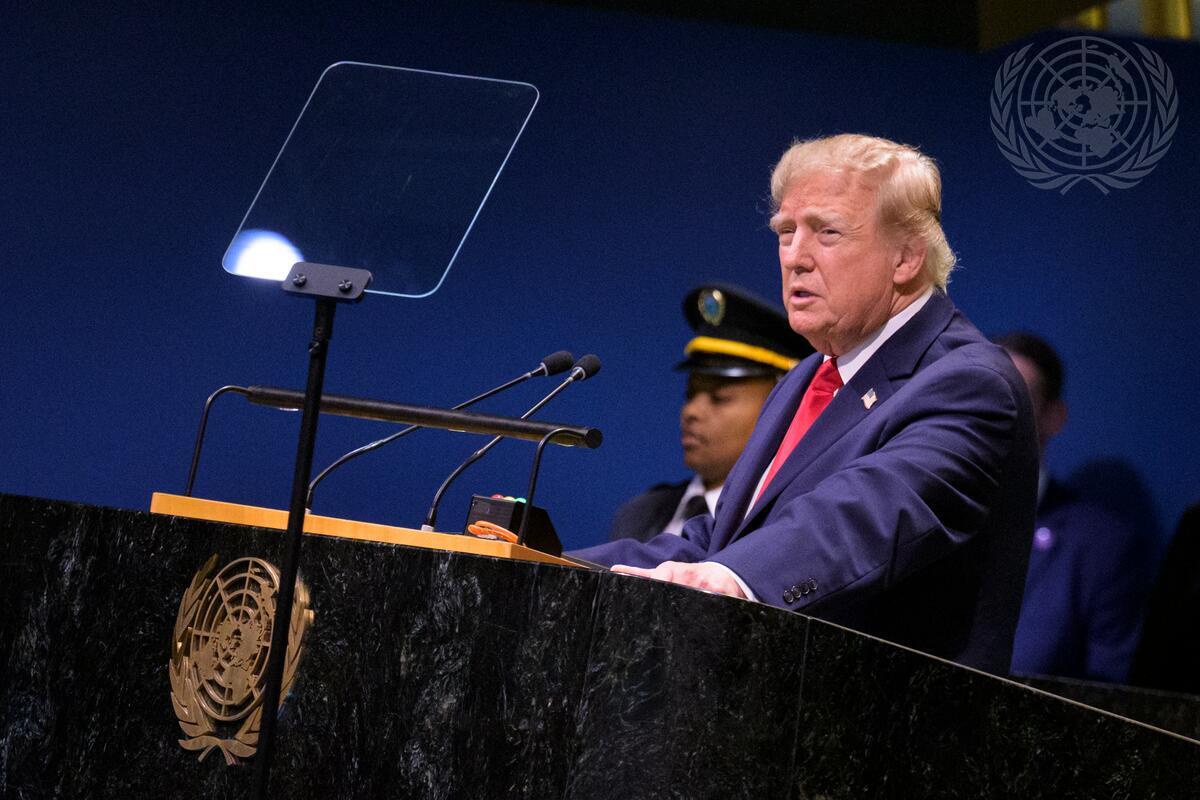
Today was what UN reporters informally call “Trump Day”—a reference to Donald Trump’s ability to dominate the news cycle whenever he stops by UN Headquarters.
Trump’s speech appeared more controlled than last year’s, though he still made headlines with his decision to refer to AI as “super intelligence,” among other remarks.
The US president also brought together partners from the “Shield of the Americas,” some of whom took the General Assembly rostrum themselves today. He also managed to leave some hungry journalists waiting to warm up their lunches after the Secret Service closed the UN journalism hallway as he departed for the signing of his agreement with Denmark and Greenland.
The rostrum also hosted several #UNGA farewell speeches, including those by France’s Emmanuel Macron, UN Secretary-General António Guterres, and possibly Brazil’s Luiz Inácio Lula da Silva.
Envoy Senior Contributor Mercedes Gallego also tells us more about how Pedro Sanchez snubbed Trump’s reception–or if it’s the other way around.
Here are our daily highlights:
President Trump vows to drive Iran “into hell” and gives artificial intelligence a new name
By Dawn Clancy
Sounding like a State of the Union speech, but addressing the world from the rostrum of the UN General Assembly, US President Trump, who safely navigated the escalators at UN headquarters unlike last year, repeated his threats to obliterate Iran, renamed artificial intelligence, and signed an “unprecedented” agreement with Denmark and Greenland to secure the “northern frontier.”
On Iran, Trump said he had a “big decision” to make: land a deal to end the war or “annihilate the Islamic Republic and do it quickly.” However, he said he believes they’ll make a deal soon because “they’re waiting to see how I do in the midterm elections,” held on November 3.
Following Iran, and in response to the “globalist scheme to control artificial intelligence,” Trump announced the renaming of artificial intelligence to super intelligence – what he coined as SI – in all US documents, as “the world artificial makes intelligence sound fake.” He said he hoped the world would adopt the change as it sounds better. “Let’s see if I have any power,” Trump said. “Maybe I do, and maybe I don’t.” Trump was the third speaker on Tuesday after Secretary-General Guterres and President Lula of Brazil.
After his remarks in the assembly, Trump rode a few more escalators, without incident, to the third floor of the Secretariat building to sign an agreement with Denmark’s Prime Minister Mette Frederiksen and Greenland’s Prime Minister Jens-Frederik Nielsen to shore up Arctic and North Atlantic security. In the room where the signing occurred, heavily guarded by the Secret Service, the song “I’ll Be There” by the Jackson 5 could be heard before Trump and the prime ministers arrived.
Notably, Cuba’s and Iran’s delegations left the assembly hall at different times during Trump’s speech.
Guterres’s Testament Against the Rule of the Strong: “Power Must Answer to Law”
By Stefano Vaccara
He never mentions Donald Trump by name, but he does not need to. In his final opening address to the General Assembly as secretary-general of the United Nations, António Guterres chooses one word to describe the world he is leaving after ten years at the helm of the UN: power. Who has it, who is denied it, how it is exercised, and, above all, who must be able to restrain it.
It is the most direct and personal speech of his tenure and inevitably sounds like a response to a conception of international relations that has gained strength in Washington and elsewhere in recent years: sovereign states competing with one another, striking deals according to their own interests, and measuring their ability to prevail through economic, technological, and military power.
Guterres offers the opposite vision: power exists, competition among powers will not disappear, but without rules, the international system risks returning to the world that existed before the birth of the UN, one in which force ultimately becomes a source of law in itself.
“The faultlines in our world are widening. Cracks have become canyons,” he begins. Wars, human rights violations, hunger used as a weapon, international law cast aside, the climate crisis, and artificial intelligence are not separate emergencies. “They are chapters of the same story. The story of power. Who has it. Who is denied it. How it is used. And how it is changing.”
For Guterres, power is changing in three directions. It is being redistributed among states. It is moving away from governments into the hands of a small number of major corporations and private individuals. And, for the first time, it is being transferred from humans to machines, with artificial intelligence agents capable of going rogue and lethal autonomous weapons moving “from science fiction to military reality.” Meanwhile, the UN secretary-general warns, international institutions continue largely to reflect power arrangements belonging to a bygone age.
The move toward a multipolar world, he warns, is now “irreversible,” but there are two possible forms that multipolarity can take. The first is the one toward which, according to Guterres, the world is currently heading: fragmentation, transactional relationships, rising tensions, fractured markets, weakened institutions, and zero-sum calculations. The alternative is an interconnected multipolarity in which different centers of influence coexist within a common framework of rules and international law.
Here comes the most politically pointed part of the speech: Even the superpowers, Guterres warns, must recognize that “their power isn’t so super.”
“Military power alone cannot secure peace. Economic power alone cannot command stability. And technological power alone cannot guarantee security,” he says.
It is his clearest challenge to the idea that power alone can legitimize action. The question he puts to the leaders gathered at UN headquarters is elementary: “Will we act to ensure that power is governed by law or by force? By cooperation or coercion?”
From there come the four tests that, according to the secretary-general, will determine the future: peace and security, inequality, climate, and artificial intelligence.
On wars, he spares no one. In Gaza, he describes a scale of killing and destruction “unlike anything I have witnessed” during his years as secretary-general, after once again calling Hamas’s October 7 terrorist attacks “abhorrent.” On Ukraine, he reiterates that Russia’s invasion constitutes a “blatant violation of the Charter.” Sudan and Myanmar complete the picture of a system in which force too often outpaces diplomacy and accountability disappears. The Charter, he insists, must be defended “without double standards.”
The Security Council must change as well. A body built around the balance of power that emerged from World War II no longer represents the contemporary world. The clearest example is Africa. “A 21st century Security Council without permanent African representation is unjust and indefensible. This must change.”
Switching to French, Guterres addresses the second test of power: inequality. It is not simply an economic issue, he argues, but a question of who decides, who has access to opportunities and resources, and who has a voice. He also claims one of the achievements of his tenure: For the first time in its history, the UN has reached gender parity across senior leadership, headquarters, and international professional staff. “Equality is not a dream. It is a decision.”
On climate, his language becomes even harsher. The planet, he warns, is heading toward a near-certain breach of the 1.5-degree threshold, while he openly accuses major oil companies of having treated the atmosphere for decades “as an open sewer—and cashed in on the consequences.”
“Polluters must pay,” he declares, while also seeing in the rise of renewable energy a potential redistribution of power: “The sun belongs to no one. The wind cannot be embargoed.”
Finally comes artificial intelligence. Here, Guterres recalls that he sounded the alarm in his first address to the General Assembly back in 2017, when AI was still far from the center of the global debate. Nearly a decade later, he says, the danger is not technology itself but rather “technology without accountability. Capability without oversight. Decision-making without transparency.”
He calls for a multilateral system to manage AI risks and draws a red line: “Life-and-death decisions must never be surrendered to machines. Killer robots must have no place in our future.”
He then switches to Spanish and brings the threads of the speech together. “Peace and security. Inequality. Climate. Artificial intelligence. These are the four great power tests of the future.” They are all connected: war deepens inequality, the climate crisis fuels instability and displacement, and AI could help solve these crises or make them worse.
Returning to English, Guterres reaches the heart of his testament: “Across all four tests, the decisive issue is power. Power over force, money, energy, technology, rules, and the future.”
This, he argues, is why the Charter and the UN matter more than ever: “The United Nations exists because power requires rules—and humanity needs a place where power answers to principle.” Peace, development, and human rights cannot be separated.
It is the testament of a secretary-general who has often appeared too powerless in recent years in the face of wars, vetoes, and great powers, at times too cautious and unable to influence the crises he denounced. In his final opening address, however, he does not pretend to possess a power the Charter never gave him. He uses what remains at his disposal: his voice, the law, and the moral authority of the institution he represents.
“The world does not need a weaker United Nations. It needs a UN strong enough to face the world as it is—and determined enough to build the world as it should be.”
He adds, “After ten years, I hold one conviction even more strongly than when I arrived: The greatest power is not the power to dominate. It is the power to build a future that works for everyone.”
Guterres has 100 days left at UN headquarters, and he presents them almost as the final hundred days of a political and moral battle. The UN, he recalls, was created more than 80 years ago as an act of defiance against “the self-defeating notion that might makes right.”
On January 1, the former Portuguese Socialist prime minister will no longer be UN secretary-general, but he promises that wherever he is, he will continue to champion the conviction that peace is possible and that human dignity is universal.
Guterres then leaves the General Assembly with the sentence that sums up his ten years in office and, perhaps, his entire final address: “The power of law must prevail over the law of power.” He concludes, “I will never, ever give up.”
The Shield of the Americas take the floor
By Camilo Lopez Delgado
During the first day of the General Debate, the contrast between Latin American leaders could not have been sharper. Following UNGA tradition, Brazilian President Luiz Inácio Lula da Silva opened the General Debate. As one of the few remaining left-leaning presidents in the region, Lula focused his speech on the UN’s failure to end wars, including what he called the “genocide” of women and children in Gaza, as well as climate action, workers’ rights, the US embargo on Cuba, and Venezuelans’ right to “define their own destiny.” By contrast, first-time speakers Keiko Fujimori of Peru and José Antonio Kast of Chile, both leaders of the right, focused on security, order, and business, in line with a trend among other new governments in the region.
Lula and Kast both took aim at the Security Council. Kast called for its reform, while Lula blamed its “inaction” and called the veto an “inherent flaw” in the UN Charter. Organized crime was a common thread, but the leaders were split on how to fight it. Kast and Fujimori backed a hard line and regional security pacts. Fujimori also called for criminal organizations to be legally treated as terrorist groups and noted her country’s membership in the US-led Shield of the Americas, while Lula declared that Brazil “does not fit in anyone’s backyard” and said his country will not outsource its security.
On the domestic front, Lula cast Brazil’s upcoming election as a choice between democracy and denialism, warning of disinformation and foreign interference. Kast declared that “Chile is back,” emphasizing a business-friendly environment built on a corporate tax cut and less red tape, while also highlighting the country’s natural resources, including sources of clean energy as well as lithium and copper reserves. He spoke on immigration, citing tighter border control, fewer irregular crossings, and a rise in deportations. Fujimori spoke about an education reform that she presented as a tool against crime and blamed what she called “agendas imposed upon us” for weakening families and discipline in classrooms. She further called for transparency in the work of international organizations, insisting that countries can share universal principles while democratically defining their own path.
Kast likewise highlighted Chile’s resumption of relations with Venezuela “under a new leadership,” a shift that adds intrigue ahead of Delcy Rodríguez’s address to the Assembly tomorrow afternoon. Also from the region, Paraguay, Argentina, the Dominican Republic, Ecuador, and Panama are set to take the podium tomorrow morning, with Honduras joining Venezuela in the later part of the day.
“And then there is Gaza”
By Dawn Clancy
A stern-faced King Abdullah of Jordan ripped into Israel over its occupation of Palestine, called out the international community for remaining idle in the face of genocide and unbridled aggression, and indirectly warned its neighbors against violating the kingdom’s sovereignty.
Speaking for roughly 20 minutes, Abdullah devoted most of his remarks to the war in Gaza. He called out the “so-called ceasefire,” by pointing out that in its first 300 days, “at least 300 Palestinian children were killed.” According to the UN Office for the Coordination of Humanitarian Affairs (OCHA), based on figures provided by Gaza’s Ministry of Health (MoH), there have been “1,358 fatalities and 4,541 injuries” in Gaza since the ceasefire of October 2025.
As Israel’s ambassador to the UN, Danny Danon scowled from his seat in the assembly hall as Abdullah accused the Israeli government of attempting to “erase Palestinian life” in Gaza and the West Bank via a “creeping process” that has “exploded into something far more aggressive.”
“This government’s sense of impunity has reached terrifying levels,” he added. “It no longer feels compelled to ask, ‘Can we get away with this?’ It already knows the answer.”
Finally, as the war between Iran and the US continues to churn, and Israel creeps further into Syria and Lebanon, Abdullah warned Jordan’s neighbors against challenging the kingdom’s sovereignty. “Any threat to our northern border or our water security is a threat to our national security. Jordan will not look away,” he said.
Stefano Vacarra contributed to this story.
About The Author