The veteran Ugandan diplomat says the UN must reform or risk irrelevance, while making a late bid in a contest still expected to favor Latin America
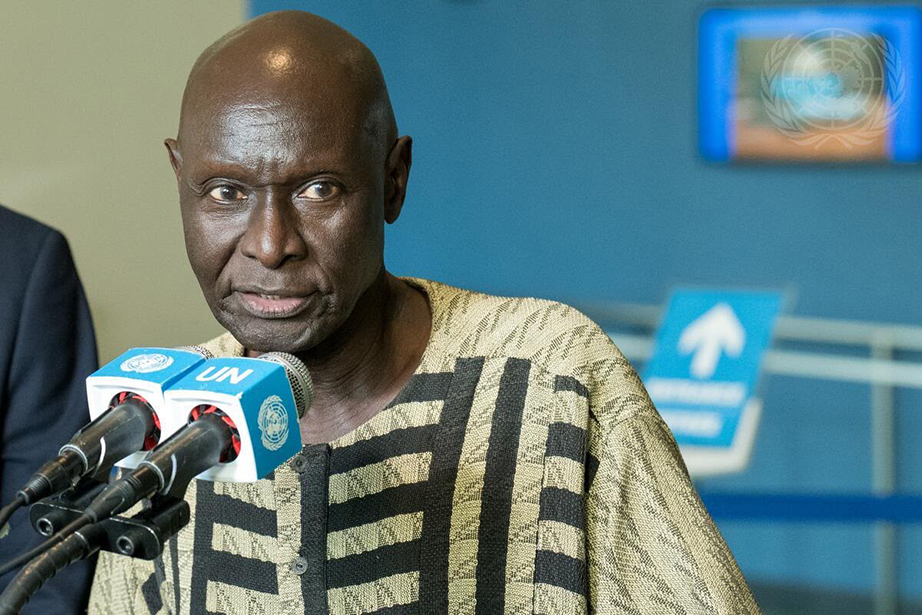
As the world navigates a period of “profound upheaval and radical change,” Ugandan politician and diplomat Olara Otunnu called for a return to the basic principles of the UN Charter, warning that reform of the eighty-year-old body is no longer optional.
“Let me say this clearly and simply: reform is no longer an optional choice. It is an imperative,” said Otunnu. “Without it, the institution is at grave risk. We cannot continue to do business as usual. To do so will be a grave mistake and an error of judgment.”
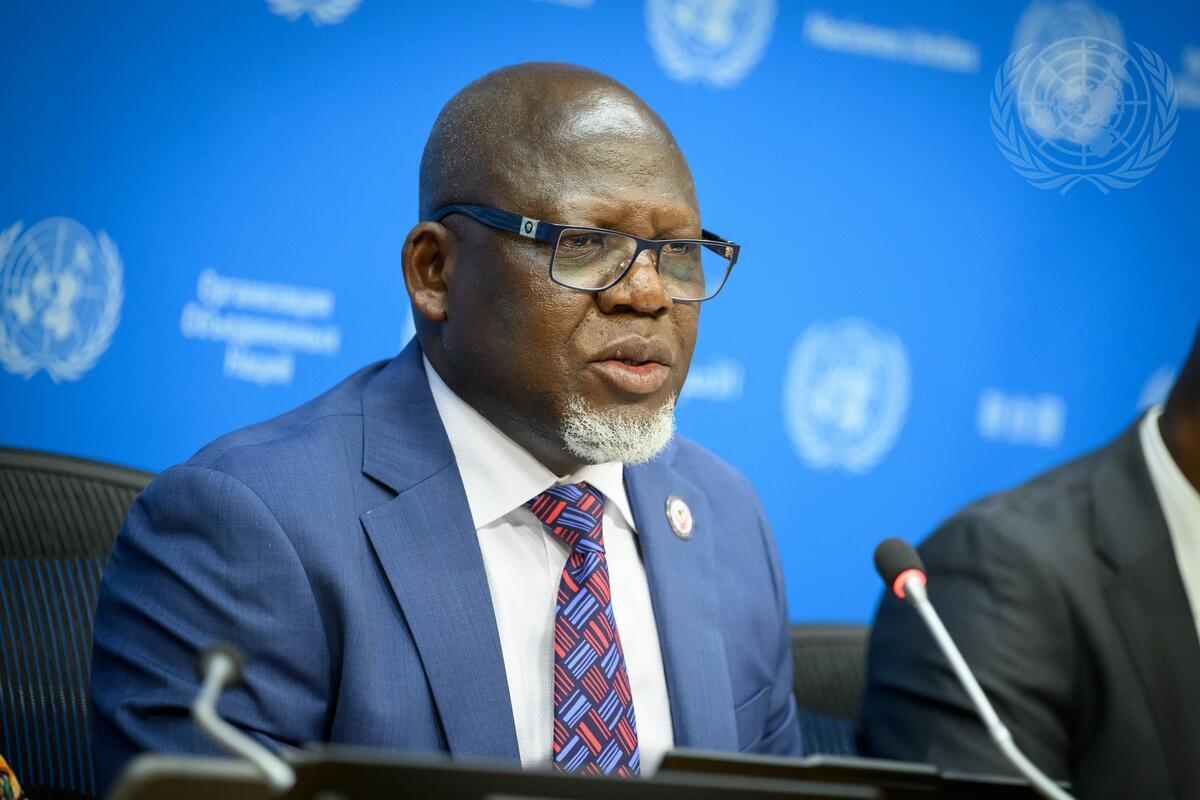
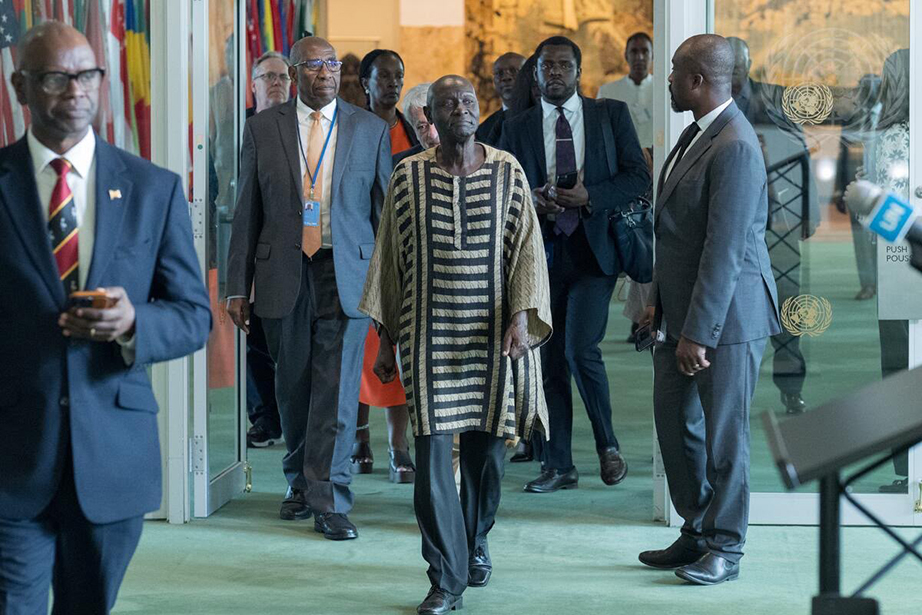
Speaking at an informal interactive dialogue at UN headquarters in New York on Wednesday, August 19, Otunnu presented his vision for the secretary-general role to a room full of member states and civil society members. Appearing calm and assured, Ugandan journalist Angelo Izama described Otunnu as being “completely in his element.” Izama spoke with Envoy on the phone from Kampala, Uganda’s capital. “It is like he came home,” he added.
Otunnu, a man of many firsts, began his decades-long UN career in the 1980s, first as Uganda’s permanent representative to the UN (1980–1985) and later as the first UN under-secretary-general and special representative for children and armed conflict (1998–2005). He also served as Uganda’s minister of foreign affairs from 1985 to 1986.
Izama, who told Envoy he spoke with Otunnu shortly after his candidacy was announced, said he was “quite convicted that it was the right decision to enter the race” even though some criticize his bid as being thirty years too late.
“If you look at his CV he has a very long and auspicious, I would say, record of engagement in multilateral processes, most obviously at the UN,” Elizabeth Sidiropoulos told Envoy in a call. Despite the lag in his candidacy, she added that “he has a really broad and deep knowledge of the UN system and I think very aware of its challenges.” Sidiropoulos is a non-resident fellow at the Global South Policy Hub, a think tank based in Washington, DC and chief executive of the South African Institute of International Affairs (SAIIA), a think tank in Johannesburg, South Africa.
Uganda announced his nomination on July 26, becoming the race’s seventh candidate. The other contenders include Michelle Bachelet, Rafael Grossi, Rebeca Grynspan and Macky Sall, all of whom sat for their dialogues in April, followed by later candidates María Fernanda Espinosa and Carolyn Rodrigues-Birkett. Their dialogues were in June. The latest and eighth candidate to enter the race, former Ecuadorian diplomat Ivonne A-Baki, is scheduled for Thursday, August 20. Both Baki and Otunnu are seventy-five years old, making them the oldest candidates so far.
Initially, Otunnu’s candidacy drew sharp criticism from UN watchers, as the announcement came only days before the first round of the informal straw poll in the Security Council on July 30. Otunnu was included on the ballot without having first sat through an informal dialogue, unlike the other candidates.
According to his resume, Otunnu credits himself with inventing “the straw-balloting procedure for electing the UN Secretary-General – the ‘Otunnu Formula’—while President of the UN Security Council in December 1981; it has been standard UN practice since.” The poll is an informal, closed-door procedure used to gauge Security Council members’ support for each candidate. After the first round in July, Grynspan emerged as the frontrunner while Otunnu, who had only been in the race for four days, appeared to finish at the bottom of the pack. The next straw poll is scheduled for Aug. 21.
As is traditionally the case, the next secretary-general will ultimately be decided by the five permanent veto-wielding members of the Security Council (P5)—the US, UK, France, China and Russia. What that means for Otunnu’s candidacy remains unclear.
Not Your Classic Geneva or New York Diplomat
Despite a rocky launch, at his dialogue, Otunnu managed to frame himself as both a leader with great moral clarity and a reformer that the UN, which is only five years older than Otunnu, desperately needs at this time in its history. The latter approach surprised Phil Clark, a professor of international politics at SOAS University of London who described Otunnu as usually “careful” when he speaks and “doesn’t shoot from the hip.”
“I thought he’s always been seen as a bit of a maverick in the UN system, and that he might try and tone that down in running for the Secretary General’s position, but actually, right from the outset, he’s saying this is an institution that needs reform, including at the Security Council level.” Clark added that he has never been “your classic Geneva or New York diplomat.” During his tenure at the UN, “he was always looking to get out of the office and was traveling to conflict zones,” which Otunnu implied will remain a priority if he is elected to be the world’s next top diplomat.
“I especially have in mind the conflicts in Ukraine, Gaza, the Great Lakes region of Africa, Sudan, Iran, the Horn of Africa, the Sahel,” Otunnu said during his dialogue. “The most disturbing features of the situations I refer to is the fact that innocent civilians, particularly women and children, are disproportionately affected by these conflicts. It is one of the reasons why we cannot stand still. We must do everything within our powers to act.”
After the dialogue, Otunnu told the media, “When I began receiving calls and messages from around the globe, suggesting that I should consider entering this race, I was not in New York. I was not in London or Paris. I was not even in Kampala. I was deep in the womb of the countryside in Northern Uganda” where a horrific twenty-year war between the Government of Uganda and the Lord’s Resistance Army brutalized the civilian population.
An Unexpected Twist
The next UN secretary-general is expected to come from Latin America, in keeping with the informal tradition of regional rotation. However, Otunnu is now the second candidate from Africa after Senegal’s Macky Sall to enter the race. According to Yusra Abdullahi, a UN historian, another candidate from Africa gives the African Union (AU) more options, as an endorsement from the AU has tremendous political value in the eyes of the world.
“For Macky, it’s quite essential, especially since he’s been in the hot seat with the AU recently,” Abdullahi told Envoy. In March, after Sall’s nomination was announced, a controversy stirred within the AU when its Chairman Évariste Ndayishimiye, also the president of Burundi, tried to allegedly ram through an endorsement for Sall, a close ally of Ndayishimiye. The attempt ultimately failed but it left Sall at odds with the group.
As a result, “there might be a slow drift towards Otunnu, even if he does not have the open support right now,” Abdullahi told Envoy. “I’ve heard murmurs here and there that this might be an interesting twist for the continent.”
Neither candidate has yet to win the AU’s stamp of approval. According to Abdullahi, the AU’s endorsement would give Otunnu “further legitimacy and show that he does have a significant bloc behind his candidacy.” As of now, he is only backed by his home country, Uganda.
Never a Bureaucrat or Bean Counter
Like the other candidates, in their dialogues, Otunnu said he supports the UN80 initiative, and that if elected he would build a team around him that “reflects the membership, the cultures, and the geography that compose the United Nations.” He stressed the imperative of development and said he supported gender parity and would welcome a woman as the next secretary-general.
However, on addressing the UN’s financial crisis, Otunnu fell short. Unlike Grynspan who in her dialogue said the first thing she would do if elected is “ask for the numbers” his response lacked any notion of a plan. When asked after his dialogue how he would tackle the issue, Otunnu reiterated that reform “is not optional” adding, “We cannot continue with business as usual.”
“Otunnu has never been a bureaucrat” and “he’s never pretended to be a bean counter,” said Clark at SOAS. “He’s always been a hands-on the ground people person,” he added. “I guess the tricky thing with the secretary general’s role, particularly at the moment, is that you need to do both.”
“I’ve never thought of Otunnu as someone who would necessarily be on top of that kind of mechanical or bureaucratic detail, and that may count against him,” added Clark. “There may have been times in the UN’s history where that didn’t matter so much for the Secretary General. I think we live in a moment where those traits are vital.”
About The Author