Small states may have tiny diplomatic teams, but at the UN, careful priorities, close coordination and experienced ambassadors can give them influence far beyond their size.
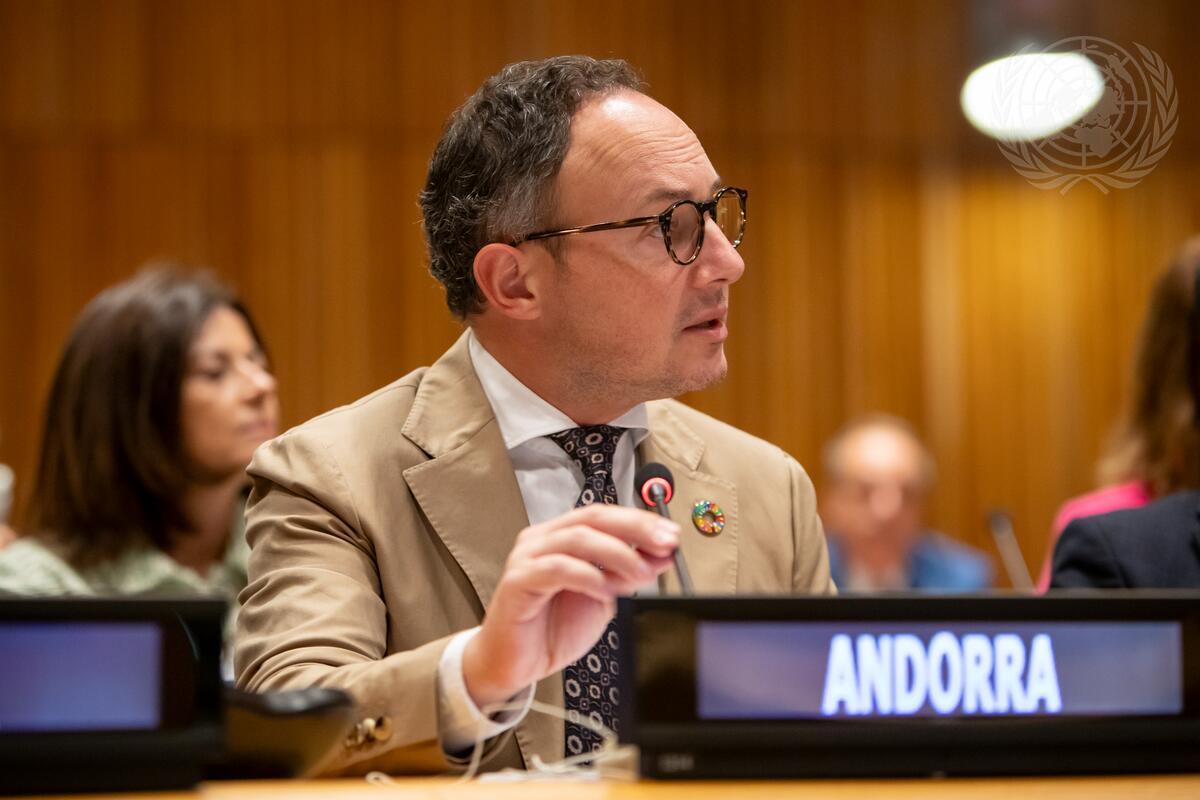
Xavier Espot, Andorra’s Head of Government, leads one of the world’s smallest countries. With a population of roughly 90,000 people, Andorra’s residents could fit in Manhattan’s neighborhood of Chinatown. But that doesn’t make his time at the United Nations General Assembly any less busy. “Multilateralism is the only way by which all states, no matter their size or their economic or military weight, can make their voice heard,” he told Envoy in Andorra’s mission office at Two UN Plaza on the sidelines of the UN General Assembly.
Espot has made his trip to the UN forum a priority: he hasn’t skipped one speech in his eight years in office (two were delivered via video due to pandemic restrictions). But the General Assembly address was just one of the many items on his agenda. To navigate every engagement during his official trip, his team prepared a hefty booklet listing every event, summit, meeting, and bilateral that the leader of the country located between the Spanish and French Pyrenees had to attend.
“Tomorrow we are going to a summit of heads of state and government of small European states,” said Espot. He has also participated in side events on conflict resolution, protecting children from AI, pandemic preparedness, and the Crimea Platform. With over 130 leaders in the city, the General Assembly is also a good time for bilateral, or country-to-country, agreements. During this UNGA, Andorra has established diplomatic relations with Sierra Leone, Guyana, the Central African Republic, Zambia, and Eritrea.
There are between two and three dozen microstates worldwide, depending on which definition is used. The majority are island states in the Caribbean and the Pacific, alongside five historic European microstates. With populations that vary from a town to a medium-sized city, their resources to participate at the UN can be limited. Most of their missions have a team of three to five people, compared with the 150 staffers at the US mission.
While diplomats acknowledge the difficulties of operating with limited resources, they argue that the key to success is knowing how to prioritize. Instead of trying to attend every possible meeting, they focus on topics that matter most to them. For Andorra, those are child protection, climate change, and multilingualism. Espot always addresses the General Assembly in Catalan, the country’s official language. “It is part of our identity,” he said.
Small States Can Lead by Example
Even smaller is the population of Dominica, a Caribbean island with 65,000 inhabitants. For the small team at the country’s mission, the logistics when high-level week approaches are many: coordinating the agenda with the capital, choosing which side events to participate in, and, when the head of state attends, as was the case this year, coordinating with the US Secret Service. Like Andorra, Dominica makes sure to prioritize and have clear goals so it can assess its level of success by the end of the week.
“We’ve not allowed our size to determine our contribution on the international stage, because we believe that our voice matters,” Kelver Darroux, deputy permanent representative of Dominica to the UN, told Envoy in the country’s mission. The island makes a point of being an active contributor on issues like climate resilience and renewable energy, despite its size. “We do not see ourselves as a victim of climate change, but we see ourselves as a model that can be replicated by other countries in terms of our ability to bounce back from disasters,” he says, in reference to the island’s recovery from Hurricane Maria in 2017.
Darroux also highlights the “critical” coordination work of forums like CARICOM (which brings together Caribbean states) and AOSIS (the Alliance of Small Island States). While each member is fully sovereign and independent, these forums allow the islands to share best practices for similar challenges and amplify their voice on issues of common interests.
Dominica’s mission shares the floor with other Caribbean and Pacific islands in a joint space subsidized by the Commonwealth of Nations. The arrangement eases the financial burden of having offices in Manhattan and centralizes certain common administrative tasks. The idea was reportedly first proposed over 35 years ago by long-time Grenada UN Ambassador Lamuel Stanislaus. At the time of his death, Stanislaus’ family described it as one of his greatest contributions to his country. Today, the offices are still home to some microstate missions including Tuvalu, Kiribati, Saint Vincent and the Grenadines, and a few others. The Commonwealth did not respond to Envoy’s questions about the Joint Office operations at the time of publication.
A Leading Voice on Climate Issues
Being a small state comes with unique—and sometimes funny—challenges. Darroux recalls times when they were mistaken for the Dominican Republic, and the security officer at the building that hosts Andorra’s mission had to double-check with a colleague that the delegation indeed has offices there.
Still, in recent years, smaller states have managed to get prominent positions in the UN system. “We’ve seen small states sitting on the Security Council,” explains Darroux, “and we’ve seen small states sitting at the chair of the President of the [General Assembly], Trinidad just recently.” In 2020, Saint Vincent and the Grenadines, a Caribbean island with a population of 110,000, became the smallest country ever to sit on the UN Security Council.
Some diplomats give credit to outgoing Secretary-General António Guterres, who really focused on the climate crisis’ impact on islands. “He was the first one to regularly visit the [Pacific Island] region,” Oliver Hasenkamp, an expert on Pacific Islands at the United Nations Association of Germany, told Envoy in a video call. Hasenkamp has analyzed the speeches delivered at the General Assembly by the 12 Pacific Island states and identified common themes and omissions. All but two of the speeches included messages of gratitude for Guterres and, according to Hasenkamp, “not just in a ceremonial way,” as many of them “have several paragraphs thanking him for his many visits.”
Early in his tenure, Guterres was photographed standing knee-deep in Tuvalu’s waters. The iconic image, captured by Christopher Gregory-Rivera for Time magazine, became a warning about climate change and rising sea levels. The UN has repeatedly warned that islands like Tuvalu or Kiribati could be completely submerged by the end of the century.
Last week, the General Assembly adopted a rare unanimous declaration on the issue, showing how coordination among microstates can drive impact. “Sea-level rise reaches far beyond the environment. It is a threat multiplier—battering economies, trade, infrastructure, and food systems,” said Guterres. According to Hasenkamp, many Pacific Islands recognize the declaration as an “important step forward” that ensures the continuity of the states, but consider that, in itself, without climate action, it “is not enough to really provide security to Pacific people.”
Despite this progress, Darroux of Dominica thinks there is room for greater small-state representation as expert staff in UN agencies, as well as greater access to UN funds. “The financial infrastructure has to change, so instead of always responding to disasters, we are better able to place ourselves in a state where we can withstand; we can be more resilient,” he says.
Andorran Head of Government Espot would like to see Security Council reforms that lead to “greater representativity of the different world states” so smaller countries have “more possibilities and less difficulties to participate.” For him, that could also lead to small states playing a more prominent role in the secretary-general selection process.
Small States’ Diplomats Can Punch Above Their Weight
The secret behind successful small-state negotiations might lie in the diplomats themselves. For Sabrina Arias, Assistant Professor of International Relations at Lehigh University, “diplomacy is an interpersonal process.” Since diplomats from smaller countries tend to stay longer in their roles, they develop what she calls “diplomatic capital.” Between 2021 and 2022, Arias interviewed 50 different delegations, including many small states, to understand their role in the UN. Now, she is finishing revisions for her upcoming book tentatively titled ‘Diplomatic Capital: How Powerful Ambassadors and Small States Shape International Organization Policymaking.’
Her thesis points to the important role that small states have in setting the agenda early on, even if, in some cases, the initiatives end up getting blocked by major powers. “Malta’s diplomats, going all the way back to the 1950s and 1960s, started to get ocean issues raised,” explains Arias. “Other states like Costa Rica and Barbados are drawing on their diplomatic capital to raise issues like the right to a clean environment and climate financing.”
When Arias asked delegations which diplomat punched above the weight of their country, many agreed on the same candidate: Liechtenstein’s Permanent Representative Christian Wenaweser. The diplomat has been leading the Alpine country’s diplomatic mission for almost 25 years, reportedly becoming the longest-serving UN ambassador. Wenaweser has been credited as the mind behind the 2022 Veto Initiative, which automatically triggers a General Assembly meeting every time a P5 state uses its veto in the Security Council.
Speaking on how it is possible that, despite popular belief, small states’ missions can play a meaningful role in the UN, Arias points to skills and experience: “They form social networks. They learn the substantive issues the UN is working on, as well as how to navigate the complex bureaucracy.”
About The Author