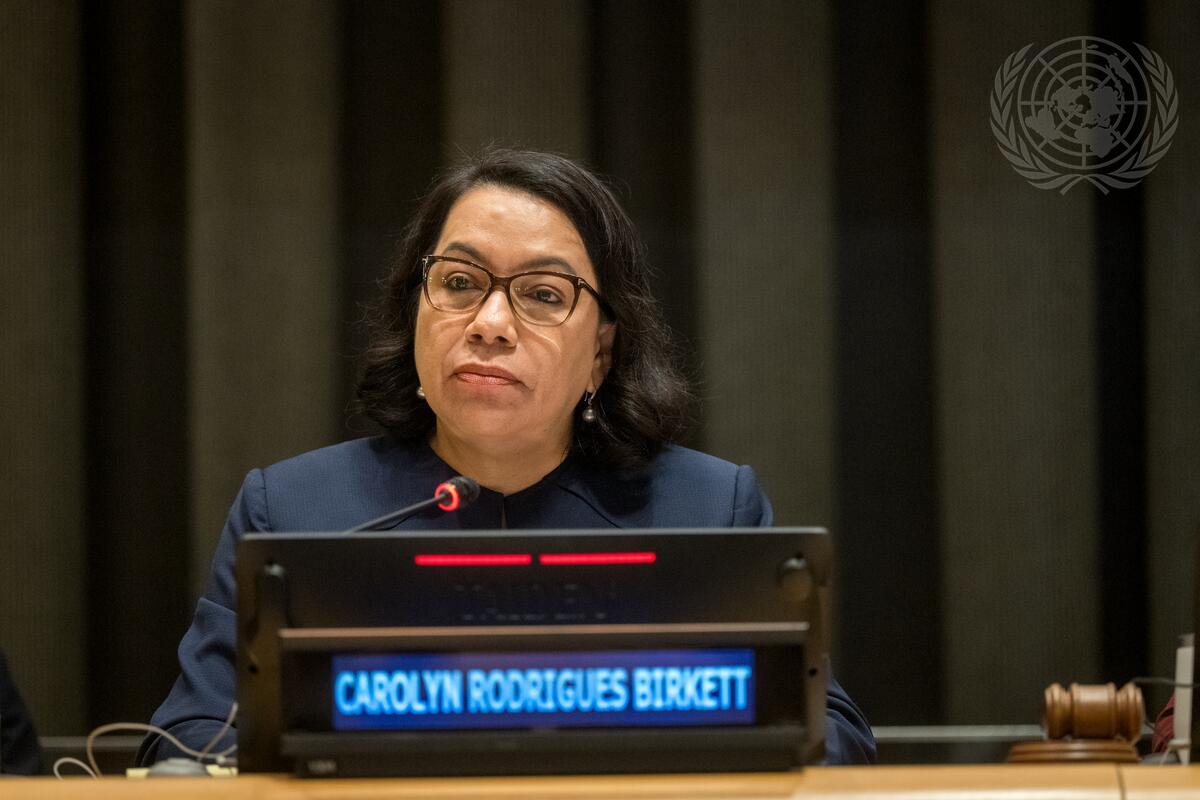
The No. 2 candidate in the race to lead the United Nations told Envoy that recent reports about her Middle East record were intended to boost a rival—and sought to clarify her position on genocide.
Ahead of what could be a decisive month in the race to appoint the next UN secretary-general, runner-up Carolyn Rodrigues-Birkett sets the record straight on recent reports and opinion articles in the American media that were critical of her, as well as others suggesting she does not have Washington’s support.
“It is obvious that this campaign is aimed at a preference of a candidate, which is not me,” she said.
In an exclusive interview with Envoy Magazine, Rodrigues Birkett addresses a Wall Street Journal opinion piece written by the Journal’s editorial board member Eliot Kaufman criticizing statements Rodrigues Birkett made on Gaza when she was Guyana’s ambassador to the UN. The Guyanese candidate said the piece showed a misunderstanding of what the role of a diplomat is.
“If the measure of trying to convince a position on a person is based on what they have said as a diplomat representing their country, then there will be no diplomats left, because they will not be able to get jobs,” she said.
The opinion piece brought back statements she gave as ambassador to the UN Security Council that the situation “did not begin on 7 October 2023.” The piece also criticized Rodrigues Birkett for repeatedly using the word genocide in the Security Council when talking about Gaza. In the interview, Rodrigues Birkett did not retract the statements, but clarified her position: “In terms of determining a genocide, that is not in the hands of the Secretary-General. That will be in the hands of the relevant courts.”
She also reiterated the importance of understanding the role of an ambassador and a secretary-general. “The credibility of the secretary-general’s office comes from the secretary-general being impartial and being dedicated to the UN Charter and international law, not representing any country’s position,” she said. Guyana sat on the Security Council in 2024-2025, at the height of the crisis between Israel and Gaza.
She sat down with Envoy for a 30-minute interview in which she described recent coverage of the campaign by American outlets as “interestingly timed” and aimed at favoring one candidate over her. She did not say which one. The New York Times article described opposition to her candidacy and to Rafael Grossi’s, but not to that of Rebeca Grynspan, her closest rival in the straw polls. The New York Times did not answer Envoy by the time of publication.
The Security Council’s fourth straw poll on Tuesday, September 29, barely moved the race. Costa Rica’s Rebeca Grynspan led again with 10 “encourage”, three “discourage” and two “no opinion” votes. Guyana’s Carolyn Rodrigues Birkett was runner-up with eight, six and one, and Argentina’s Rafael Grossi also drew eight “encourage” votes but seven “discourage.” Seven candidates remain after Michelle Bachelet withdrew last month.
Greece, which holds the presidency of the Security Council in October, signaled that it intended to make progress on the appointment during its presidency, including by holding colored-ballot polls, which will finally reveal which candidates are facing discourage votes from the five permanent members of the Security Council.
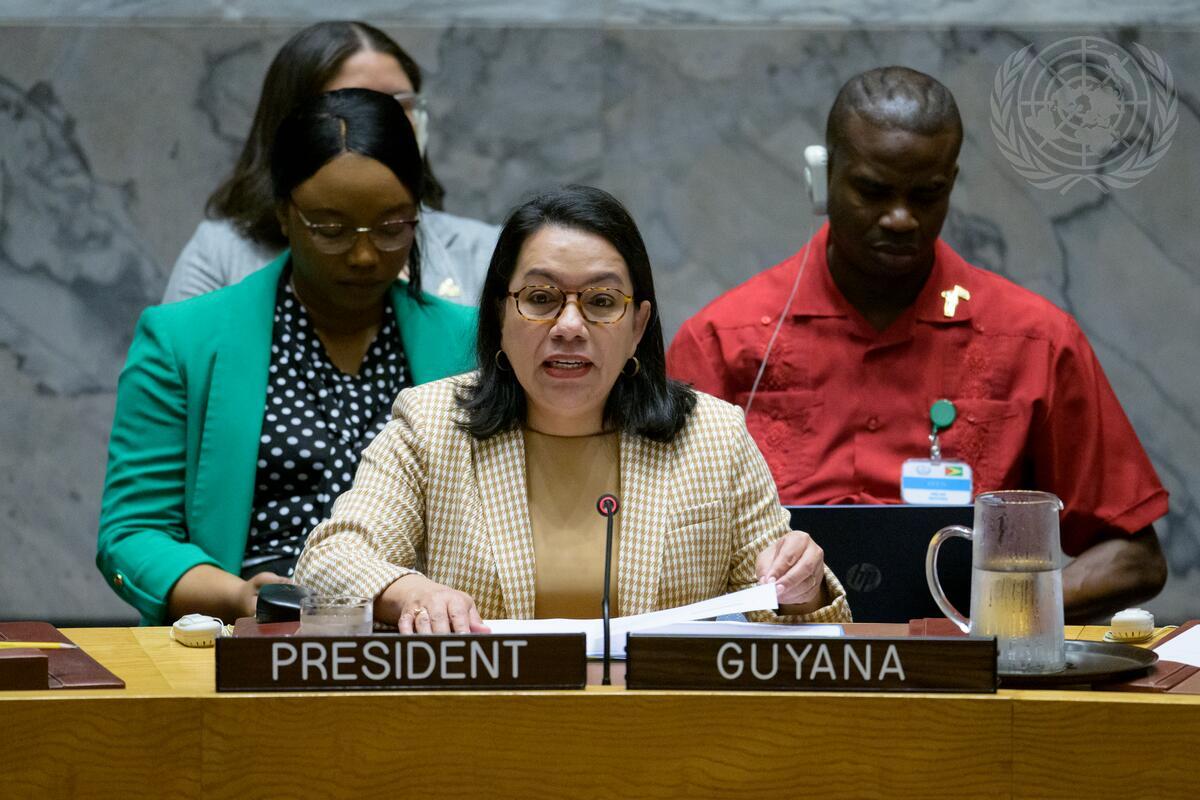
The Voice of a Country
Rodrigues Birkett said her main reason for addressing the allegations was to put them behind her and move on. “I would not want to spend the rest of my campaign trying to prove who I am,” she said. “Answering articles is not going to bring peace to this world.”
Her experience has proven both a blessing and a curse. When she launched her campaign, many diplomats at the United Nations who had worked with her directly in her previous role spoke positively about their experience. However, that recent experience is also being used against her.
“Perhaps that is why it’s easy to go back to what I’ve said, because I was the only candidate that had the experience of the Security Council over the last two years,” she said. “And on the Security Council, countries have to give their positions. You expect that, because what you do there as a country on the Security Council, as an elected member, it’s about accountability as well to the wider membership.”
On Gaza, Rodrigues Birkett argued that other candidates would face similar scrutiny if their countries’ positions were examined as closely. “Almost all of the countries have spoken on this matter, and if you look at the countries that have nominated candidates, all of them have spoken on the situation in Gaza. The difference with me is that I was the voice of my country,” she said.
In a written response to Envoy, Kaufman said: “I presume that Guyana did not also instruct Ms. Rodrigues Birkett to make a gross factual error in her September 2024 remarks, revealing a remarkable ignorance as to which side accepted the two-state solution in 1947-48 and which side “violently rejected” it. In her all-out effort to smear Israel, she got the history precisely backward. Or is someone else again responsible for the words that came out of her own mouth?”
Cuba and ‘Comandante Fidel Castro’
In his opinion piece, Kaufman also brought up a speech Rodrigues Birkett gave as foreign minister of Guyana in 2013 in which she said Cuba’s achievements couldn’t be discussed without paying tribute to “Comandante Fidel Castro” as the visionary revolutionary behind them, and thanked him for what he’d done for Guyana and “for humanity at large.”
On Cuba, she did not fully want to distance herself from what she said, but once again provided context.
“We were recognizing the 40th anniversary of our relations with Cuba,” she said, “and as it is with anniversaries, you speak of what has been, perhaps, the accomplishment of your relations. And it was actually very wise, the entire Parliament of Guyana, to recognize what our health landscape had been like with the assistance of Cuba. And that is what we did during that time. And so it’s the same government of Guyana right now, the same government that one of the articles spoke about as an ally.”
As such, she said “I was privileged to speak for my country, and so I would not disown what I said as foreign minister for my country. I’m always true to the role that I am in. As foreign minister, as permanent representative, and definitely I would be as Secretary-General as well. Understanding your role is very, very important. And if you look at foreign ministers now, and you look at what they may have said some years ago and what they say today, it might be very different. Because countries, certain aspects of their foreign policy may be adjusted depending on time, depending on what has changed in the world.”
At 53, Rodrigues Birkett would be the first woman, the first Caribbean national and the first person of Indigenous descent to lead the UN. She is hoping her remarks will allow her to move on and be able to focus on substantive matters. During the General Assembly high-level debate, she was the only candidate who was named in several speeches as her region’s preferred candidate, as most members of the Caribbean Community (Caricom) repeated their pledge to support her.
“I come here not only with the blessings and support of my region, but as my region offering the world one of their nationals… And let’s see how the world answers,” she said.
Rodrigues Birkett said she’s raised the issue directly with Washington, and that American officials reassured her the information in the Times report did not come from them. ‘I cannot speak for the American of course, but given the transparency that we work with, I wanted to ensure that, and they said it does not come from them.”
While there is no clear way of knowing for sure if she faces a veto from the United States, the upcoming round of colored ballots will likely give us an answer and narrow down the still crowded field of seven candidates.
Editor’s note: This article has been updated to remove a sentence stating there was no indication that Rebeca Grynspan or her campaign had any role in the coverage. The sentence was removed after Rodrigues Birkett’s campaign raised concerns that it could be misread.
About The Author