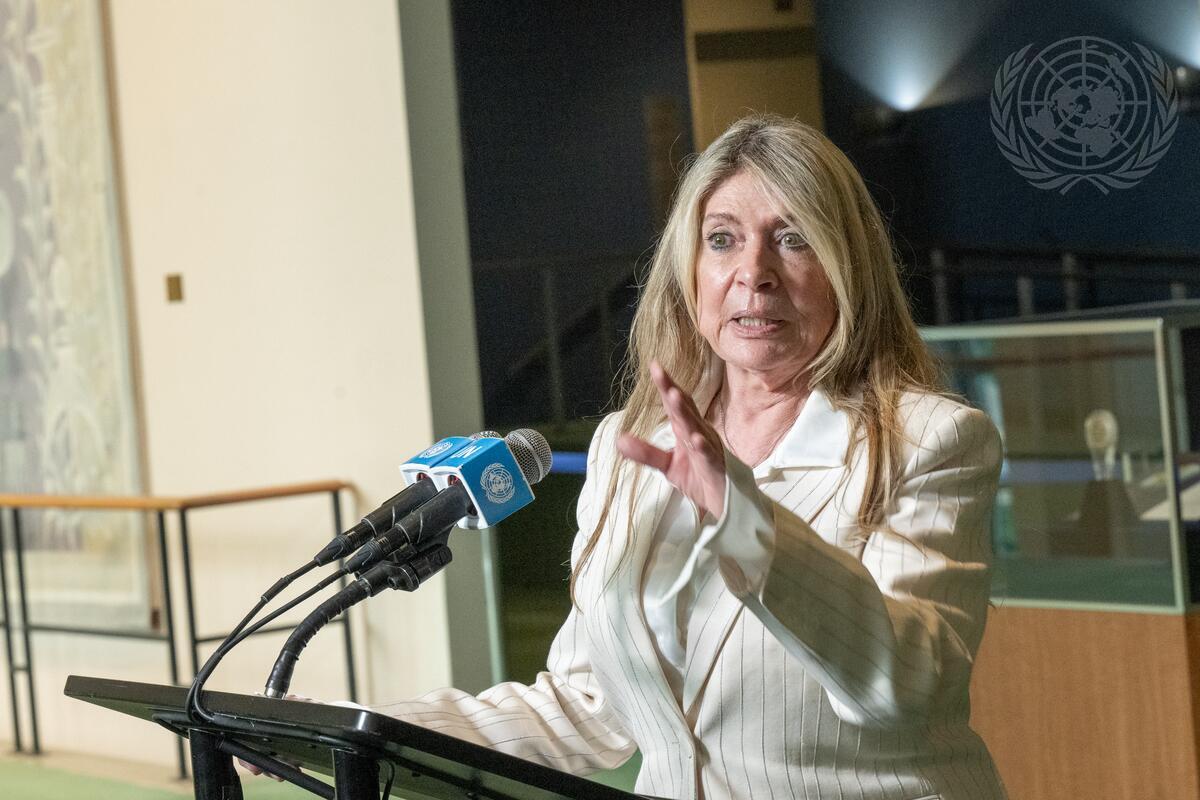
After finishing last in three Security Council straw polls, the Ecuadorian-Lebanese diplomat tells Envoy she has no intention of dropping out.
Ivonne Baki is used to being an underdog. She ran unsuccessfully for president of Ecuador in 2002 and for director-general of UNESCO in 2009.
“For me, it’s about the journey,” she told Envoy in an exclusive interview on October 2. “I don’t believe in quitting.”
The latecomer entered the race just days before the second straw poll on August 21. In the second and third straw polls, she had zero votes encouraging her candidacy. In the latest one, she got one vote in favor, 11 discouraged, and 3 with no opinion.
Asked whether she would leave the race if she received a similar result in the next straw poll, Baki was unequivocal.
“I’m staying,” she said. “We have to work with the heart and the head together.” In fact, Baki is still actively campaigning and said she plans to travel to Russia and China later this month.
She went through the same experience when she ran for president in 2002: She entered the race late and ultimately won about 1.7 percent of the vote. Still, running was a life-changing experience for the Ecuadorian diplomat.
“That experience changed my life,” she said. “Sometimes you win by losing.”
Baki was nominated by Tonga after waiting several months for a nomination from Lebanon, her second home. Ecuador has not nominated either of its two citizens in the race: Baki and María Fernanda Espinosa, a former president of the UN General Assembly.
“Because we were two candidates, the president prefers to be neutral with both and not to do it,” Baki said of Ecuador’s silence regarding the two women’s candidacy.
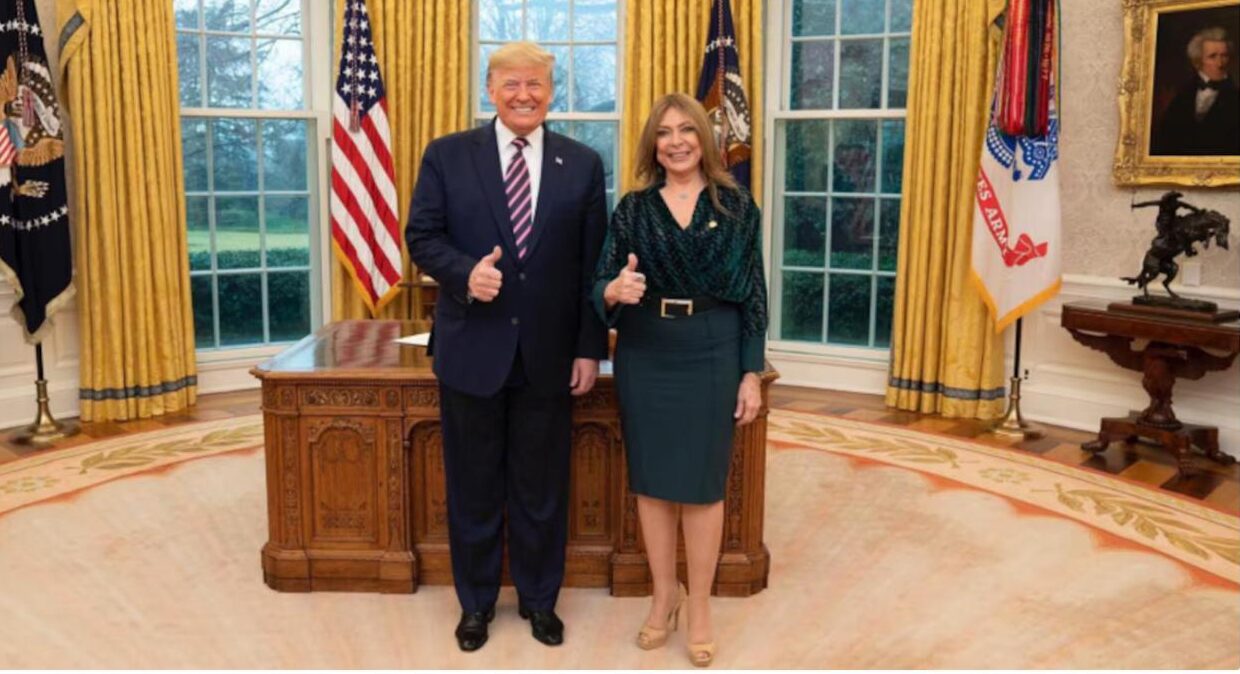
Baki is open about her longstanding relationship with US President Donald J. Trump. The two have known each other for decades, but she did not say if the American president pushed her to run, or encouraged her candidacy in any way.
Their relationship dates back to Baki’s time as Ecuador’s ambassador in Washington. Baki said that following a 2001 oil spill in the Galápagos, she helped establish a conservation initiative to support restoration efforts. Baki has said Trump helped her mobilize support after the spill and establish the Galapagos Conservancy Foundation.
She added that Trump also supported Baki’s campaign for Ecuador’s presidency in 2002.
“I never knew that he would become president afterward,” she said. “And when he became president, I came back to Washington also as ambassador. So this is the relationship.”
As a former Ecuadorian ambassador to the US, Baki said she’s built friendships with several high-profile political figures in Washington.
“I’ve been with President Clinton. I’ve been with President Bush. We were very good friends with them too,” she said.
Baki comes to the race not only as a latecomer, but also as an outsider. She has represented her country, Ecuador, in several countries and was an artist-in-residence at Harvard University and eventually created the Arts for Peace Foundation. Unlike several of her rivals, Baki has never held a senior post within the UN system, though she served as a UNESCO goodwill ambassador for the Dialogue of Civilizations. Baki points to her role in the rapprochement between Ecuador and Peru ahead of their 1998 peace agreement, when she was an adviser to Ecuador’s president. Her argument is that distance from the UN bureaucracy is an advantage rather than a liability.
“I think the UN needs to change and think more outside the box,” she said. “When you are in, you cannot make change because you understand why the system is that way. It is the only institution that has all the countries of the world in one place. But it’s lost focus; it was created after the Second World War to prevent the Third World War. The P5 worked together for that; for a long time, it worked in that direction, but then I don’t know what happened.”
Born in Guayaquil, Ecuador, Baki spent part of her life in Lebanon, where she lived through the country’s civil war. According to her UN CV, she is fluent in English, Arabic, Spanish, French, and German. She’s lived in the US and France as an ambassador, and considers herself a citizen of the world.
“I’ve been living in different continents, in different countries, with different cultures, with different religions,” she said. “I’m a Druze, which is a neutral religion. I am from Ecuador and Lebanon, but I am also from the United States and from Europe. When I’m there, I become one. So for me, it’s being adapted. We are all human beings. We all have the same needs.”
Baki offered fewer specifics on how she would reform the UN or what her first priorities in office would be. Her broader pitch centers on development and poverty reduction, themes she also emphasized during her 2002 presidential campaign.
“I think Africa is the future,” she said. “Africa and Latin America, they are being neglected, and they are the future. We cannot have problems from those places. And look, the problems that are happening are much simpler. They are simpler: illegal fishing, illegal drugs, illegal everything, illegal mining. Look, Africa has the world’s richness, right? But we have to keep that richness there too.”
About The Author