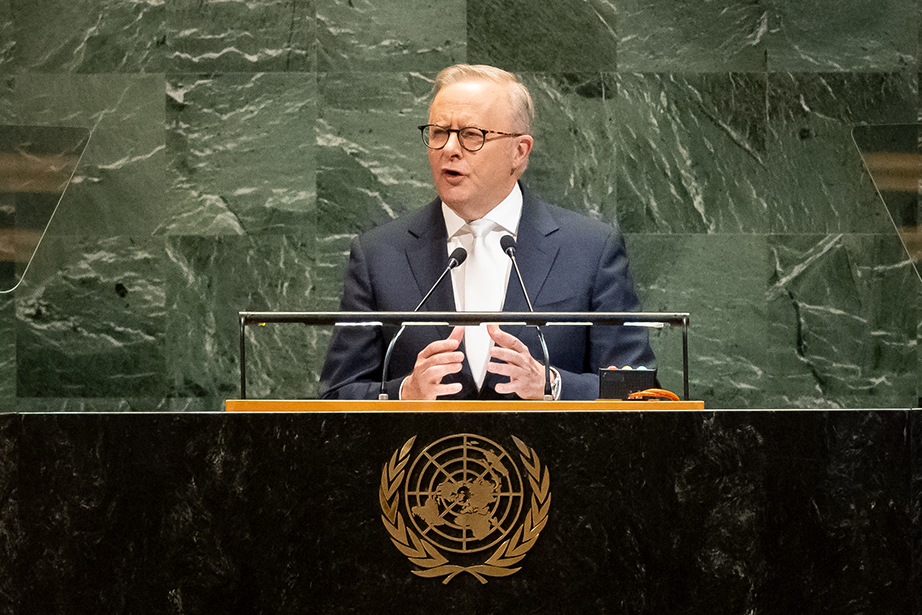
As world leaders prepare to gather at the UN General Assembly, Anthony Albanese is positioning Australia between American security guarantees and Chinese economic power—and choosing reform over rupture.
Anthony Albanese, into his fourth year as Australia’s prime minister, can still be a little prickly when challenged by the media.
Asked recently about Canadian counterpart Mark Carney—who just a year into his own job won applause at Davos for calling out the “rupture in the world order”—Albanese bristled at the suggestion that as Australia’s leader he wouldn’t dare speak with the same frankness.
“Go back and have a look at my speech to the United Nations in New York, the General Assembly,” Albanese told a radio host, pointing to the national statement he delivered in September 2025.
“Mark Carney used some of the exact language that I used.”
And that’s true, to a point. Place the two speeches side by side and plenty of thematic overlap becomes clear.
Middle powers, rules-based order, sovereignty, coercion.
Albanese did warn the gathered UN delegates about the dangers “if we allow any nation to imagine itself outside the rules” —even if Carney’s diagnosis of power with “no limits, no constraints” won far more attention.
Not that Albanese is making any plagiarism claims. He is happy for Australia, population 28 million, to be seen among a vanguard of newly inspired middle powers— paired with Canada, along with others including Japan and South Korea—countries willing to invest in relationships to keep a measure of old global certainties alive. This, Albanese claims, has been the driving motivation of his government since winning office in 2022, by strengthening ties with tiny Pacific nations as well as neighbours in Southeast Asia.
He wants Australia to be seen supporting a “rules-based order” even as great powers cast aside principles of open trade or sovereign jurisdiction.
But in a bid to associate himself with Carney’s acclaim, Albanese undersells points in the story where their stated views diverge.
The differences are shades of grey, not black and white. Carney wants to “stop invoking rules-based international order as though it still functions as advertised”—declaring the patient already dead – and talks of “different coalitions for different issues based on common values and interests.”
Albanese calls for revival, starting at the top.
“It is up to all of us,” Albanese declared in New York, “to bring new strength to the United Nations’ enduring mission … that peace is both our common cause and our collective responsibility.”
Carney sees “the end of a pleasant fiction”, that “the old order is not coming back” and “this bargain no longer works.”
But Albanese warns “if the United Nations steps back, we all lose ground.”
Albanese can afford to favour working through established mechanisms, given that Carney’s “rupture” was supercharged by the shock of neighbouring America under President Donald Trump suddenly calling for Canada to become the 51st state. Australia likewise shares an alliance with the United States, but occupies a continent to itself.
The contrasting approach is instead telling of Australian attitudes about modern global challenges—from a country in Asia with a close-up view of the upheaval caused by China’s dramatic economic and military rise, yet with historical faith in a global system founded on Western powers.
For Australians, trust in the multilateral system is still holding, even as faith in great powers slides. Polling of public attitudes bears this out. Seven in ten believe the United Nations to be important to Australia’s interests, according to the 2026 edition of a long-running survey by the Lowy Institute, where I work. Only 31% of Australians trust the United States to act responsibly in the world—and just 28% for China.
Twenty years earlier, Australians’ trust in both the US and China was tied at 60%.
Albanese is a wily enough politician to weigh these public views when shaping his foreign policy.
Carney, for his part, is loved by Australians. Two-thirds have confidence in Canada’s leader to do the right thing in world affairs—a higher rating than Australians give their own prime minister, whose standing slipped seven points in the last year from 60% to 53%. But views of Trump run the opposite direction, with just 21% of Australians reporting faith in his approach. China’s Xi Jinping fares as badly, at 20%.
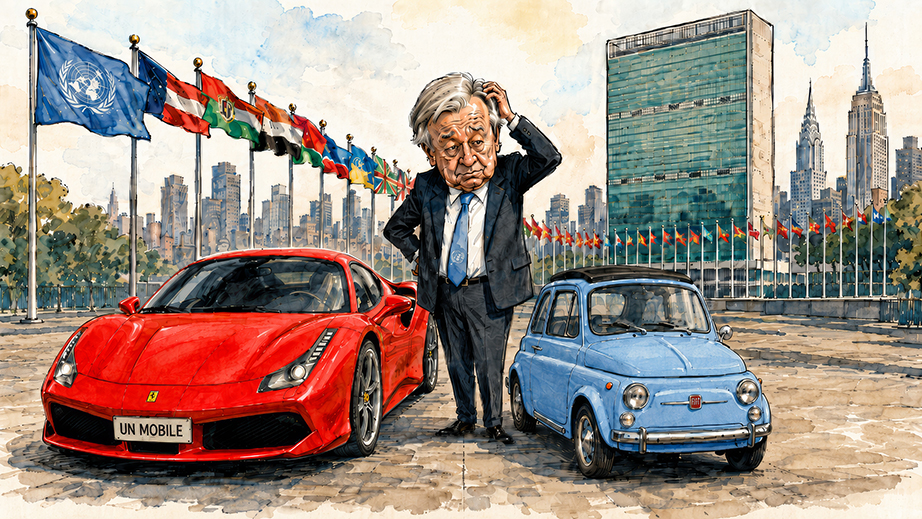
But Australians are also pragmatic – a polite term for wanting to have it all ways. Nearly three-quarters back the military alliance with America, which stretches back to 1951, even as a shrinking number believe that a decade from now the United States will remain the most powerful country in the world. Australians bestow that title on China, which they see more as an economic partner than a security threat—except in 20 years, when a majority expect Beijing to turn hostile.
This awkwardness is not unique to Australia. Canada and other middle powers are trying to figure out life with the United States as a primary security ally and China as a valuable trading partner. For Australia, the challenge is amplified by volume. The national economy is built on trade, with China accounting for more than 30% of Australia’s exports. Huge shiploads of gas, iron ore and other minerals cross crowded seas north to Asia. At the same time, the Trump administration is demanding Australia, and other US allies, lift military spending, pointing to concern about China’s intentions. Grumbles can occasionally be heard in Washington about Australia’s profit from China’s success.
Australia has made a choice. The previous conservative government, having brawled with Beijing during the pandemic over the origins of COVID-19, convinced the United States and United Kingdom in 2021 to share nuclear-powered submarine technology. Albanese’s government has pushed ahead with the deal—known as the AUKUS pact —in the face of doubts at home about cost, need and future independence of action.
If successful, AUKUS will see Australia join a select group of countries with one of the most lethal military capabilities. But the plan jars with Carney’s warning that “a world of fortresses will be poorer, more fragile and less sustainable.” Should the submarine deal fail due to an unpredictable America, with doubts about the Trump administration’s ability or willingness to supply boats, Australians would experience their own rupture in assumptions about the reliability of allies. That would mark an epochal change for a country that has long debated its place in Asia and the Pacific.
Albanese is not known as an orator and rarely reaches for lavish prose. But the strongest line in his speech at the UN was the best justification for his broader foreign policy philosophy.
“If our only response to every crisis is to insist that there is nothing we can do, then we risk being trusted with nothing,” he said. This captures an approach Australians like to believe they bring to diplomacy —a willingness to contribute even in trying times.
Daniel Flitton is one of Australia’s most experienced foreign affairs journalists and is Managing Editor of the Lowy Institute’s international magazine, The Interpreter. [dflitton@lowyinstitute.org]
About The Author