The next UN chief’s first year will be a test of whether the institution can still deliver in an age of conflict, financial strain and geopolitical paralysis.
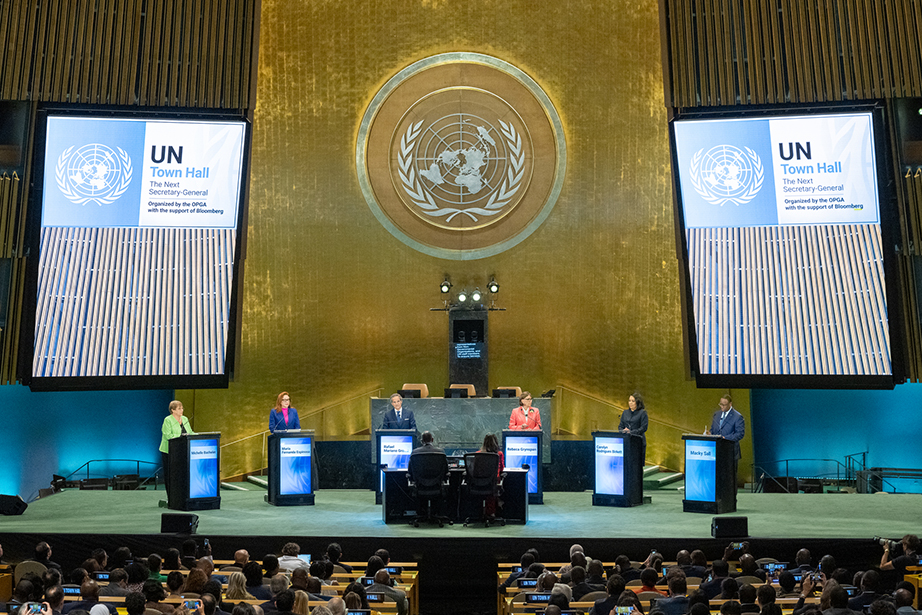
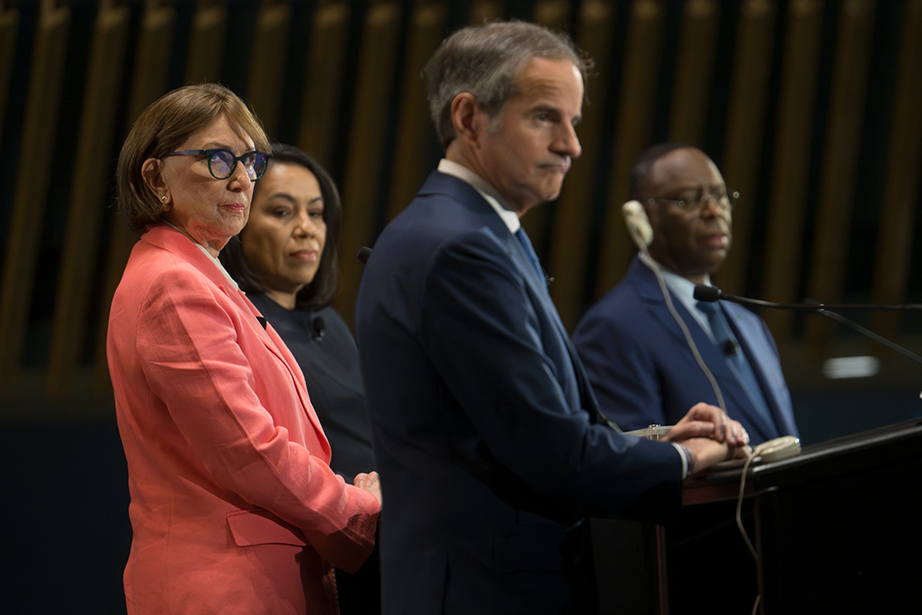
Over the past months, the candidates vying to become the next UN secretary-general have fielded hundreds of questions across a series of debates and public appearances. But perhaps the most important was the last before they faced the first informal vote in the Security Council. In a UN town hall—styled like a US presidential debate—each candidate was asked what they would do in their first 100 days in office. A leadership transition is always important for the United Nations. There have been only nine secretaries-general in the UN’s 80-year history, but the 10th will take office at a defining moment for the institution. The new leader will inherit an organization that is starved of funds, weighed down by accumulating mandates that have fragmented its focus, and worryingly inconsistent in delivering its core priorities.
Even the fundamental premise of the UN is under threat. Since its creation, it has provided its member states with a universal forum that believes that rules governing the behavior of States should apply equally to all and that power must be exercised with restraint.
These principles have often been honored in the breach, but as geopolitical and geoeconomic tensions rise, even the most fundamental international norms face a growing threat.
When the UN is criticized, its reflex is to look inward and launch a structural reform agenda. As important as internal reform may be, a new secretary-general cannot afford to spend too much time on this in their first year.
Instead, they must prioritize visibility and results, demonstrating the UN is back on the front lines of global crisis management and prepared to be a clarion voice for international cooperation as the essential “operating system” for a livable world.
Securing early wins is the only way to rebuild trust and generate the political support required for the longer and harder institutional battles to come. The candidates understand this. Our analysis of their public statements reveals a consensus across the field.
The UN excels at creating norms and setting goals, but implementation seldom matches the scale of collective ambition. The system also often gets dragged into delivery at a low level that distracts it from the bigger picture.
Rather than treating Security Council gridlock as an excuse for inaction, contenders view it as an opportunity for a new secretary-general to pioneer more flexible approaches to conflict prevention.
They see economic equity as a security imperative, believing the Global South’s allegiance to the multilateral system can only be maintained if the exclusionary nature of the international financial architecture is confronted. And they want the UN to regain its leadership as a platform for the creation of a new generation of essential global public goods, without which an interconnected world cannot fairly or stably function.
When asked in the town hall to set out their plans for the first 100 days, a hierarchy of priorities emerged: Assemble a senior leadership team defined by competence, integrity, and geographic and gender balance.
Deploy flexible mediation and conflict prevention capabilities, backed by a new readiness of the Executive Office to tackle active conflicts. Address the UN’s liquidity crisis by continuing to reap efficiency gains through the UN80 reform process, while going beyond to build support for further investment through direct engagement with Member States in New York and in capitals.
That is the public line. But behind closed doors, more detailed transition planning has started, at least in the teams supporting frontrunner candidates.
In a world grappling with the highest number of armed conflicts since World War II, peace and security must be the first priority. The incoming leader may find their most viable quick wins in “forgotten” conflicts—regional crises that are starved for diplomatic attention and where the Security Council is less likely to be deadlocked.
By stepping into these voids to negotiate humanitarian access or broker local peace agreements, the secretary-general can demonstrate the UN’s ability to save lives when the rest of the world has looked away.
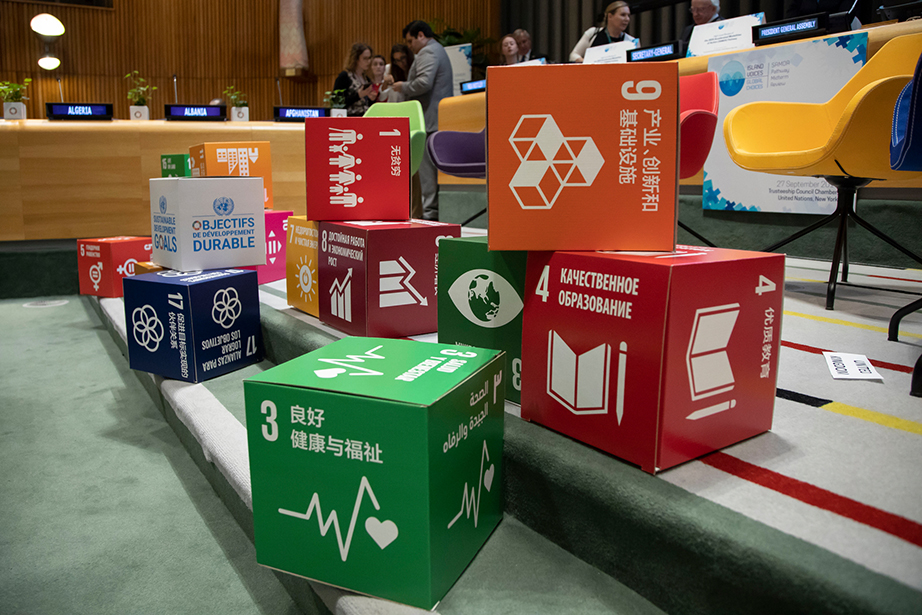
On development, the new secretary-general needs a strategy for the final SDG Summit in September 2027. With few of the 169 targets on track, the incoming leader should prioritize delivery around core transitions with geopolitical resonance — such as energy and food systems, or digital transformation — while speaking with new candor about impediments to progress and what it would take to overcome them. They can also set the tone and direction of debate for what comes next after 2030, not least ensuring that a “delivery first” standard keeps pace with rhetorical ambition.
The first 100 days can also signal a pivot toward the governance of frontier domains. For artificial intelligence, the new secretary-general faces an immediate test at the UN Global Dialogue on AI Governance in May 2027.
The UN will not become a dominant actor on AI, but it can provide all countries with a level playing field for debate to ensure AI ‘s benefits outweigh potential harms and that technological advance accelerates development rather than widening the digital divide. This would help correct the imbalance where AI rules and behaviors are predominantly shaped by only a few countries and companies.
A similar strategy applies to outer space. Ahead of the anticipated UNISPACE IV summit in July, a new secretary-general can support moves to protect infrastructure that is now critical for any modern economy, while preventing space from becoming an arena for further conflict.
While the calendar offers predictable milestones, the new secretary-general must also prepare for the shocks whose timing cannot be foreseen. Historical patterns suggest that the incoming leader will confront at least one global emergency during a five-year term.
In a complex crisis, the world expects the UN to step up, but the system is typically slow to react. The 10th secretary-general must prepare the system to act as an emergency platform, putting the right protocols and people in place before disaster strikes. As their predecessors have found, a secretary-general’s success in office will be disproportionately judged by how well they play the role of crisis leader.
To borrow Dwight Eisenhower’s maxim, the new secretary-general should act on the belief that “plans are worthless, but planning is everything.” Arriving on day one requires a playbook to enforce focus and prioritize results that matter to the UN’s membership.
Yet a playbook is a baseline and success requires improvisation. To thrive, the next leader will need an innovator’s mindset, constantly on the lookout for fleeting openings and always working to build coalitions that can drive change.
Former Deputy Secretary-General Mark Malloch-Brown has called these first 100 days a “sprint.” Early, visible wins will force the world to sit up and realize the UN is back in business, providing the space for the harder slog of securing deeper change.
By pairing a relentless focus on delivery with an unyielding defense of the Charter’s bedrock principles, the 10th secretary-general can prove the multilateral system is not stuck in survival mode, but is again actively fighting for the people it was built to serve.
Elizabeth Cousens is the President and CEO of the UN Foundation, leading initiatives to reimagine the UN and future of global cooperation. Before joining the Foundation, Elizabeth was U.S. Ambassador to the UN Economic and Social Council and has shaped global policymaking and innovations for over 20 years, from peacebuilding to the Sustainable Development Goals. She has written widely, including as a contributor to [Re]Group: A Playbook for Turbulent Times
About The Author