From Brazil’s election-season diplomacy to Venezuela’s return and a crowded UN leadership race, Latin America arrives at UNGA81 with unusual geopolitical weight–and a potential UN office to fill.
Latin America is carrying more weight at this year’s high-level week than it has in previous years. From Brazil’s Luiz Inácio Lula da Silva opening the debate 12 days before a highly contested presidential election, to Argentina’s Javier Milei coming fresh from an escalation of the Isla Malvinas/Falkland Islands debate with the United Kingdom, to four candidates vying to lead the UN, the region is set to make headlines more than once.
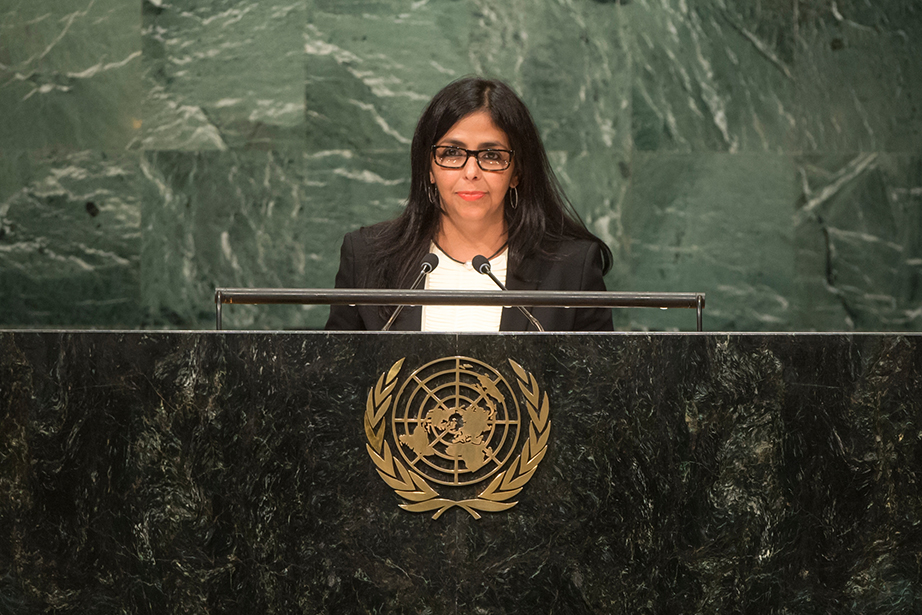
Venezuela’s Acting President Delcy Rodríguez is also set to become the first Venezuelan head of state to come to New York since 2018, following the United States military operation that led to Nicolás Maduro’s removal from power.
But with all this and ongoing geopolitical realignments taking place in the background, what should we actually expect from the region’s leaders as they arrive in New York? These are the storylines to watch as they take the podium.
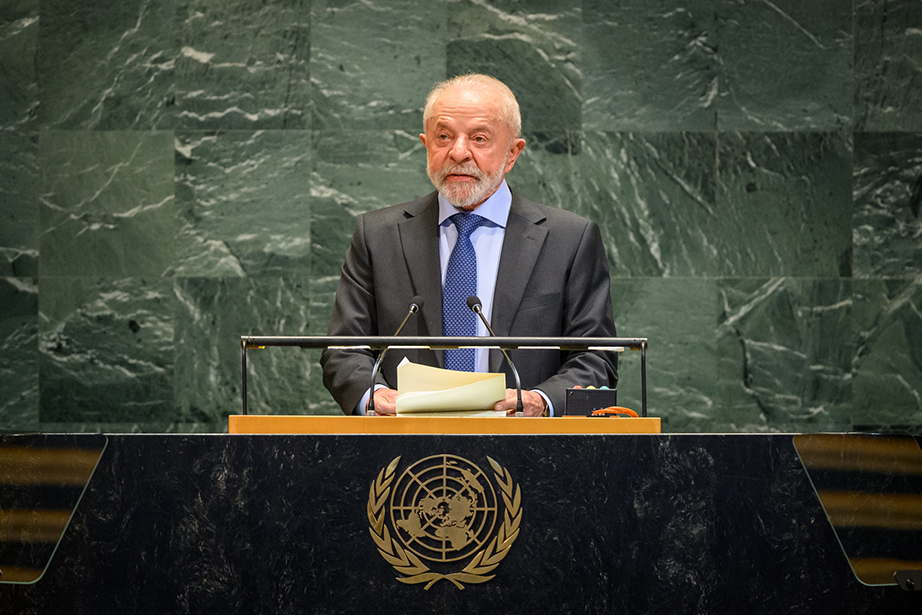
Credit: UN Photo/Loey Felipe
The Campaigner
Following tradition, President Lula is set to open the General Debate on Tuesday morning. The 80-year-old politician is also campaigning at home for a fourth term as president and a second consecutive term, having previously served two terms from 2003 to 2010.
His main rival, Flávio Bolsonaro, is the son of Lula’s predecessor, President Jair Bolsonaro. They are currently statistically tied according to a recent AtlasIntel/Bloomberg runoff poll, giving Lula’s speech an unavoidable domestic political dimension.
Lula will speak right before US President Trump, and the two have clashed over the issue of tariffs, which started last year, contributing to a bump in Lula’s popularity.
Unlike many of Brazil’s neighbors, which have undergone a rightward political shift, Brazil has not joined the US-led Shield of the Americas. The message from Lula’s speech could include references to the need to protect multilateralism, continue work on climate action, and strengthen Global South solidarity.
Brazil, together with Mexico (and originally Chile), nominated and backed former Chilean President Michelle Bachelet in her candidacy for UN Secretary-General. Bachelet, however, withdrew from the race on Saturday after struggling in the latest Security Council straw poll conducted last Friday. Her support had fallen from the previous two rounds, when she had been in the middle of the pack, to just one “encourage” vote and eleven “discourage” votes. It remains to be seen whether Lula will use this opportunity to place his country’s support behind another candidate.
The Newcomers
A new crop of Latin American administrations will make their New York debut this year. Chile, Peru, Colombia, Honduras, Costa Rica, and Bolivia have elected new leaders over the past year. From this list, four presidents will be making the trip to New York: José Antonio Kast of Chile, Keiko Fujimori of Peru, Nasry Asfura of Honduras, and Rodrigo Paz of Bolivia.
The election of Keiko Fujimori in Peru also marks the return of the Fujimori name to the presidency following the authoritarian rule of her father, Alberto Fujimori, in the 1990s. All four countries are members of the right-leaning security alliance Shield of the Americas, with Colombia and Peru among the newest members, following the recent expansion of the initiative. Security could be a prevalent topic raised by many of these leaders. Chile’s Kast has placed border control and public security at the center of his efforts during his first months in office, while Fujimori has likewise promised a strong approach to crime, citing El Salvador’s Nayib Bukele and his security policies as an inspiration. One of Kast’s early foreign policy moves had an impact on the UN Secretary-General race by withdrawing Chile’s support for now-former candidate Michelle Bachelet. It will be worth watching whether these countries announce their support for any of the region’s candidates.
The new governments in Colombia and Honduras also represent a significant geopolitical transition. Both Honduras’s Asfura and Colombia’s new President Abelardo de la Espriella have moved toward closer collaboration with Washington, marking a notable contrast with their respective predecessors, Xiomara Castro and Gustavo Petro, whose relationships with the Trump administration were significantly more contentious. Colombia’s current membership in the Security Council, alongside its recovery from a deadly earthquake that struck the department of Chocó and was felt throughout the country last month, could also shape themes addressed in Colombia’s speech, along with the new government’s emphasis on building a “Miracle Nation” and attracting foreign investment.
Also showing closer ties with the US than his predecessor, Bolivia’s Rodrigo Paz will likely focus on economic stabilization. Paz has seen a sharp decline in approval since taking office, falling by 8.9 percentage points according to a CB Global Data poll published in September. Anti-government protests in the country even led to the declaration of a 90-day state of emergency in June, which has since been extended.
Colombia’s de la Espriella and Costa Rica’s President Laura Fernández will not attend the gathering, with Vice President José Manuel Restrepo representing Colombia and Costa Rica represented at the ministerial level. De la Espriella’s absence corresponds to a campaign promise not to leave the country during his presidency. Fernández’s absence, on the other hand, comes amid an increasingly critical posture by the president towards parts of the UN agenda, particularly the Sustainable Development Goals. Her government continues to back the candidacy of former Costa Rican Vice-President and Secretary-General of the UN Conference on Trade and Development (UNCTAD), Rebeca Grynspan, for the role of UN Secretary-General. Grynspan topped the ranking in last Friday’s Security Council straw poll, having also led the first round in July and placing second in the August round.
The Shield of the Americas
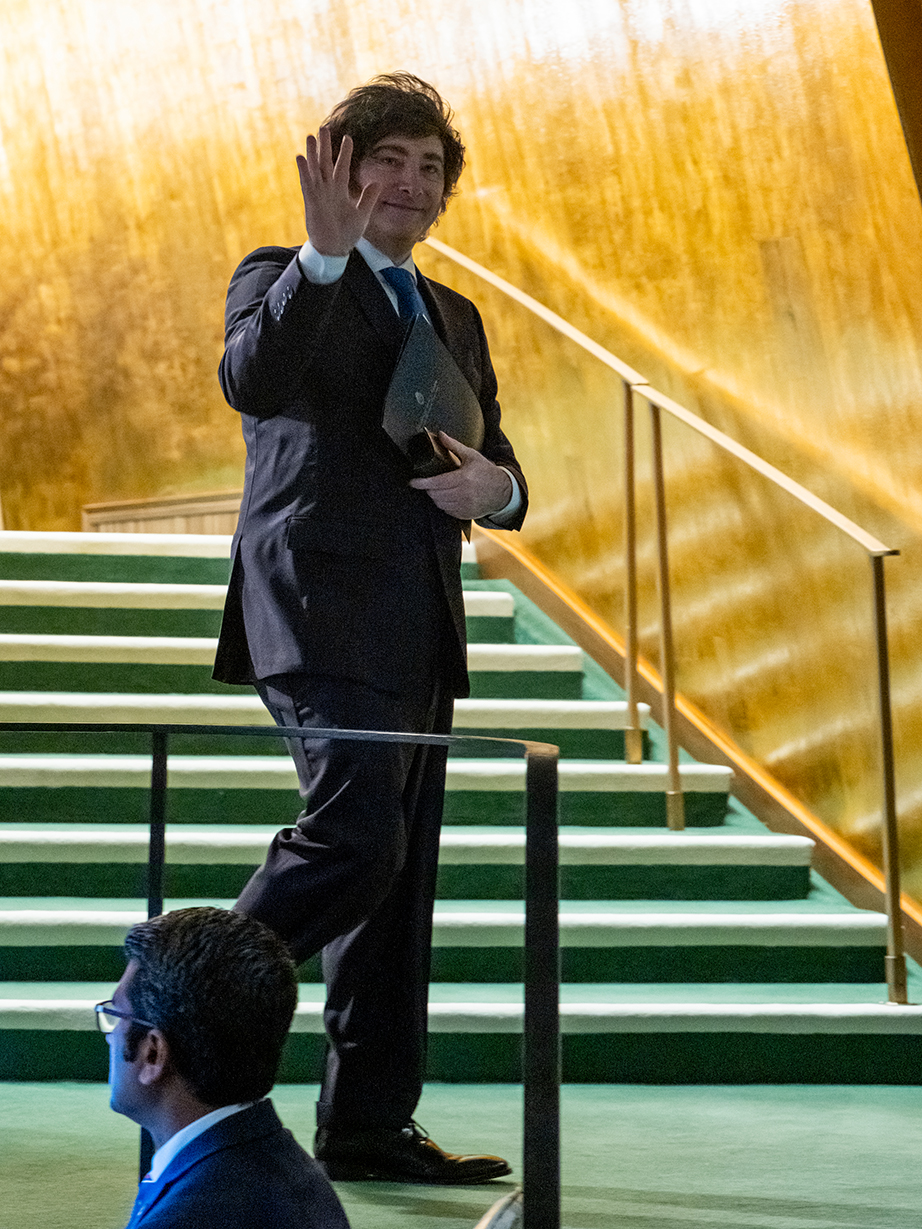
Another group of Member States is returning with a more established foreign policy and strong alignment with Washington. Argentina’s Javier Milei will be one to watch. The Argentine president is set to take the podium amid the escalation of the Malvinas/Falklands dispute after Trump commented on a possible review of US policy on the matter. Milei then gave a nationally televised address on September 3, calling the islands Argentinian by “history and by right” and announcing a new naval base in the southernmost province of Tierra del Fuego. Milei could also express his support for the US and Israeli actions in their conflict with Iran. Argentina is supporting the candidacy of Rafael Grossi, director general of the International Atomic Energy Agency (IAEA), who saw his support decline in the straw poll last Friday, with his “encourage” votes dropping from seven to five and “discourage” votes jumping from two to eight.
President Santiago Peña of Paraguay, a founding member of the Shield of the Americas, will be coming to New York amid health-sector protests that led to the replacement of his health minister, among other local ramifications. His speech could touch upon security cooperation and the fight against narcotics and criminal groups, alongside a trade and investment pitch, and a renewed call for the recognition of Taiwan at the UN, a pillar of Paraguay’s foreign policy. Paraguay’s voting patterns at the UN have increasingly mirrored Washington’s in recent months, including in last week’s vote on the resolution allowing Palestinian leaders to address the General Assembly virtually after their visa denials.
Another of the Shield of the Americas founding members, Ecuador, will take the podium as two of its nationals have been nominated for UN Secretary-General by other countries. This includes former Foreign Minister María Fernanda Espinosa, nominated by Antigua and Barbuda, and former Ambassador Ivonne Baki, nominated by Tonga. President Daniel Noboa could center his message on security, emphasizing Ecuador’s military cooperation with the US in targeting drug cartels on its soil. Earlier in the month, Noboa declared a state of emergency in eight of the country’s provinces, with curfews declared in four. With security being such a prominent topic across the region, the influence of the absent Nayib Bukele will be felt, particularly as his approach to security continues to be cited as a reference by various countries in the region.
Three more members of the Shield of the Americas are also speaking at the rostrum this year: Panama, the Dominican Republic, and Guatemala. Panama’s José Raúl Mulino will participate as his country enters the final months of its elected membership on the UN Security Council, while tensions with the US around the Panama Canal appear to have shown signs of easing, particularly following the country’s Supreme Court decision in January to cancel port contracts with the Hong Kong-based CK Hutchison Holdings. Regional security and the situation in Venezuela could also come up in Mulino’s speech. The Dominican Republic’s Luis Abinader will be attending, and the situation in neighboring Haiti, particularly its impact on his country and on migration, remains high on his agenda, as his government has maintained a hardline position on the issue. President Abinader has also previously publicly supported the idea that the next Secretary-General be a woman from the Latin American and Caribbean region. On the other hand, Guatemala’s Bernardo Arévalo has the lowest approval rating among the leaders, at 28.2%, in CB Global Data’s September poll. His presidency was defined by a confrontation with Attorney General María Consuelo Porras, whose office was accused of attempting to undermine his 2023 electoral victory. With Porras’s departure in May 2026, Arévalo could refocus on his anti-corruption campaign message, while addressing the fuel protests that have also rocked his government at home.
- The Wild Card
Delcy Rodríguez, the acting president of Venezuela, will perhaps deliver one of the most closely watched speeches not just from the region, but from the entire debate. The preliminary UNGA Speakers list still shows Venezuela’s participation at the Head of State level, but elements of her speech may be hard to predict. Will Rodríguez choose to present a Venezuela that is “open for business” and continue to underscore her country’s reengagement with the US, as signaled by the recent oil deal? Or will she choose to use this opportunity to appeal to her domestic base and reaffirm the government’s condemnation of the operation to remove Nicolás Maduro, which Secretary-General Guterres previously described as a “dangerous precedent” for international law? Rodríguez is said to be meeting with President Trump on the sidelines of the General Assembly in what will be her first meeting with the American president since she assumed her role in January.
The Counterweights
Some leaders will be notable by their absence, including Mexico’s Claudia Sheinbaum, who is sending a minister to speak on one of the last days of the debate. In doing so, Sheinbaum continues to follow her predecessor’s pattern of skipping the General Debate. Mexico has stayed away from the Shield of the Americas and continues to follow a foreign policy based on non-intervention and sovereign equality. Mexico’s decision to continue oil shipments to Cuba until early 2026, drawing criticism and economic pressure from the Trump administration, is an example of the country’s stance. At the same time, engaging with the US and securing a stable trade relationship amid ongoing tariff threats remains central to Mexico’s diplomatic efforts.
Uruguay’s Yamandú Orsi, one of the region’s remaining center-left leaders in office, has adopted a pragmatic and institutional approach to diplomacy. Orsi comes to New York holding the presidencies of Mercosur and the Community of Latin American and Caribbean States (CELAC), giving his speech a broader regional dimension, and following a year that also included a seven-day visit to China in February. He will likely emphasize the importance of multilateralism and international law.
Further along the spectrum, two of the nations most critical of Washington’s policy in the region, Cuba and Nicaragua, will likewise be represented at the ministerial level. Speeches denouncing the US actions in the region and beyond are to be expected, particularly in light of the fuel blockade on Cuba and the removal from office of their ally, Nicolás Maduro. Messages on self-determination are likely to be present in these speeches, particularly as the regime of Daniel Ortega and his co-president and wife, Rosario Murillo, continues to consolidate power after extending their terms and going as far as, at one point, declaring that elections would no longer be held.
Ultimately, Latin America’s story at UNGA81 will present a mosaic of competing priorities, including debates over closer ties with Washington, defending multilateralism and diplomatic principles, and the positioning of the region as a potential leader of the UN for the next decade.
The speeches from New York will offer a reflection of the political transformation taking place in the region while emphasizing Latin America’s increasingly important role in the wider geopolitical discussion–and potentially in the UN’s highest office.
About The Author