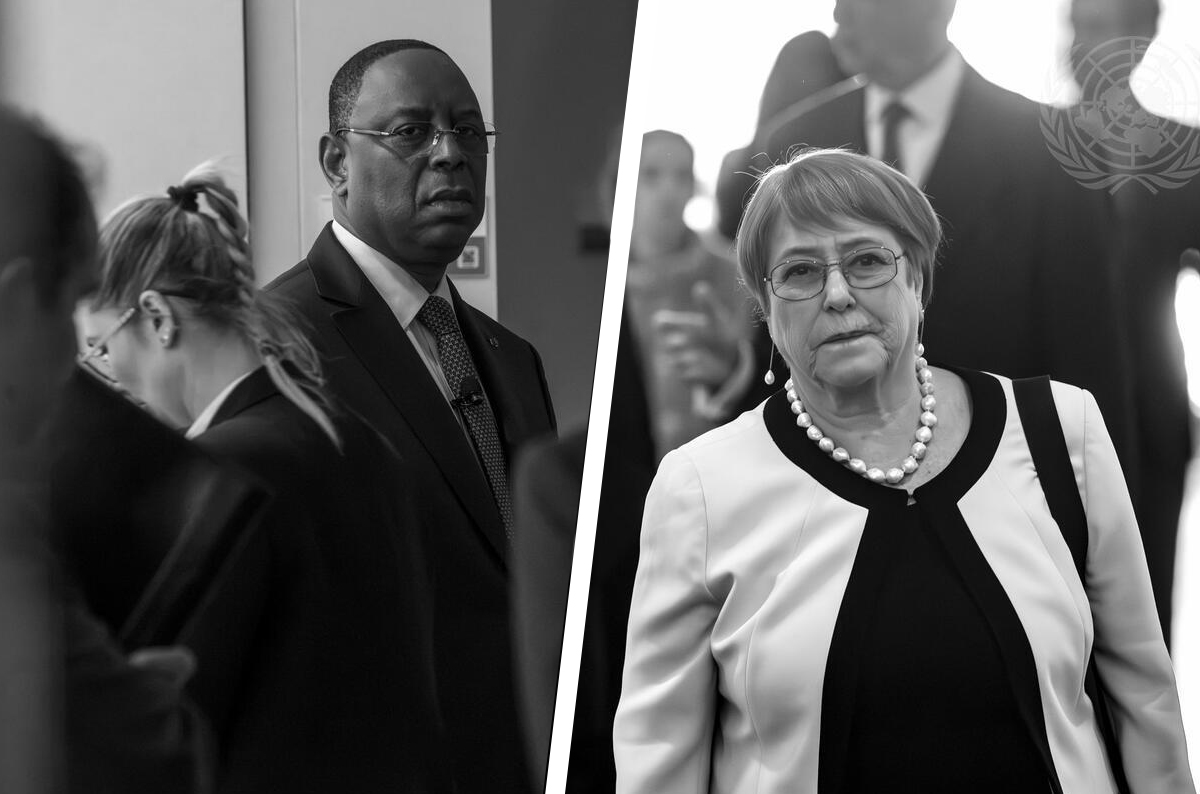
This year, three candidates are backed by countries that are not their own, raising a question at the heart of the UN race: can an “orphan” candidate lead the world?
It plays like a deleted scene from The Terminal. You know the one: Tom Hanks, as Viktor Navorski, stands in an airport lounge, staring at a fuzzy television screen that tells him his country has ceased to exist. He is technically a citizen of nowhere, a man with a valid passport but invalid papers, stuck in the liminal space between where he came from and where he wants to go.
On Tuesday, April 21, Michelle Bachelet walked into the United Nations Trusteeship Council Chamber, and for a moment, the air in the room felt distinctly Navorskian.
The former Chilean president sat down to face the world’s diplomats. She had the résumé: two terms as head of state, a stint running UN Women, and a tenure as high commissioner for human rights. She had the regional backing: Brazil and Mexico were loud in their support. But she was missing the one thing that has, for 80 years, been the admission ticket to this specific show: her own flag.
On March 24, Chile’s newly inaugurated president, José Antonio Kast, had issued a diplomatic cable that effectively ghosted her candidacy. The support offered by the previous administration was withdrawn, cited as inviable and driven by political reasons. Bachelet was still in the race, but she was walking alone.
By the next afternoon, she wasn’t the only one. On April 22, Macky Sall, the former president of Senegal, took the same seat. Nominated by Burundi but met with a deafening neutrality from his successor in Dakar, Sall faced the General Assembly as another diplomatic anomaly. On May 12, María Fernanda Espinosa, Ecuador’s former foreign minister and a former president of the General Assembly, also entered the race under the flag of Antigua and Barbuda, despite the absence of support from her own government. [Update: In July: after receiving Sall in Dakar, Faye formally threw Senegal’s support behind his predecessor and instructed the government and the country’s diplomatic network to campaign on his behalf. Sall therefore entered the final phase of the race with the endorsement of his home country, even as the African Union remained divided over his candidacy.]
Welcome to the era of the orphan candidate. In the race to lead the United Nations, the most dangerous opposition isn’t coming from the Security Council vetoes of Russia or the United States; it is coming from home.
The Iron Law of Turtle Bay
To understand why Bachelet and Sall are swimming upstream, we must look at the unwritten constitution of UN elections. For eight decades, there has been an “Iron Law” of the Secretariat: You cannot lead the parliament of nations if you cannot command the support of your own. History is littered with the political corpses of those who tried.
The most haunting precedent comes from the chaotic 2016 selection process. That year, the orphan scenario played out in real time with the Bulgarian delegation. Irina Bokova, the director-general of UNESCO, was the official Bulgarian candidate. She was a front-runner. But midrace, domestic politics in Sofia shifted. The Bulgarian government, sensing the winds changing, brutally withdrew its support for Bokova and nominated Kristalina Georgieva instead.
It was a moment of unprecedented diplomatic cannibalism. Bokova, defiant, refused to withdraw. She stayed in the race, effectively running as an independent. The result? Disaster. The Security Council, faced with a confused split ticket from a single nation, chose neither. The lack of a unified home team signaled weakness, and the prize went to António Guterres, a man whose Portuguese government, despite including his domestic political rivals, had united behind him with military discipline.
Then there is the case of Kevin Rudd. In that same 2016 cycle, the former Australian prime minister sought to run. He was a global heavyweight. But his domestic rival, Prime Minister Malcolm Turnbull, refused to sign the nomination letter. Rudd didn’t try to shop for a flag of convenience from a friendly Pacific neighbor; he knew the rules. Without Canberra’s logistical machine, a campaign was impossible. He folded before the first straw poll.
It might be a brutal lesson, but most definitely it’s a clear one. The secretary-general is a commander without an army, but to get the job, you need an army to get you elected. That army is your national diplomatic corps.
The Santiago Switch
This historical context makes the Santiago Switch all the more perilous for Bachelet. To understand the awkwardness of last week’s interactive dialogues, you have to rewind to February. The administration of Gabriel Boric, then in its final days, formally nominated Bachelet.
It was a standard move, as what was happening was a simple case of a country rallying behind its most prominent global figure. The logic was that a Chilean secretary-general is a win for Chile, regardless of ideology.
That logic expired on March 11, the day José Antonio Kast moved into La Moneda. Kast, a hard-right leader who has spent years acting as Bachelet’s ideological foil, didn’t just let the nomination expire; he actively killed it. On March 24, his Foreign Ministry issued a statement that stripped Bachelet of her national sponsorship.
Technically, Bachelet survived because the UN Charter doesn’t explicitly require a home nomination, only a nomination. Brazil and Mexico stepped into the breach, adopting her candidacy like divorced aunts swooping in to save a favorite niece. But the optics on April 21 were undeniable. When Bachelet spoke of renewing trust in multilateralism, the subtext was screaming: How can you build trust among 193 nations when you can’t secure the trust of the one that issued your passport?
Without the Chilean mission in New York acting as her whip, who is trading favors for her in the Security Council? Brazil can lobby, but Brazil has its own interests. They cannot trade Chilean legislative favors or bilateral trade concessions to secure a vote for Bachelet. She is asking the world to hire her as CEO, but she has lost the proxy votes of her own shares.
The Prophet Rejected in Dakar
If Bachelet’s situation is a tragedy of ideological polarization, Macky Sall’s is a study in the brutal speed of political obsolescence.
Sall left the Senegalese presidency in April 2024, handing power to Bassirou Diomaye Faye, the 44-year-old opposition firebrand who swept the election on a wave of anti-establishment fervor. For two years, Sall has pivoted to the global stage, banking on his credentials as a former African Union chair to propel him to the 38th floor of the UN Secretariat.
But the Dakar he left is not the Dakar that exists today. Sall’s nomination didn’t come from Senegal. It came from Burundi, a maneuver orchestrated through the African Union’s complex internal machinery. President Faye’s response has been a master class in diplomatic shade. He hasn’t explicitly vetoed Sall (doing so might look petty), but he has declared a posture of neutrality.
“Macky Sall did not approach us,” Faye told local media on May 3, twisting the knife. “We were presented with a fait accompli.”
The result was palpable during Sall’s interactive dialogue on April 22. While other candidates, like Argentina’s Rafael Grossi and Costa Rica’s Rebeca Grynspan, enjoyed the fierce whipping operations of their home missions, Sall was effectively freelancing.
The questioning he faced was less about future UN reform and more about his past domestic record. Civil society representatives probed the crackdowns that marred his final years in office.
In a normal cycle, a Senegalese diplomat would be interrupting, raising points of order, or smoothing over the rough edges with side deals. Last Wednesday, Sall stood alone at the podium.
The Flag of Convenience Myth
There is a desperate hope among the Bachelet and Sall camps that the old rules no longer apply. They want to believe that in a polarized world, a candidate can float above their nationality. They point to the backing of regional blocs as a substitute for national support. But recent history suggests this is a mirage. We have already seen the failure of the flag of convenience model in this very cycle. Earlier this year, Virginia Gamba, a veteran UN official, was nominated by the Maldives, a country she had no evident connection to. It was a clear attempt to bypass the need for a home-country endorsement.
The result? The Maldives withdrew the nomination just two weeks later, realizing the futility of backing a candidate who brought no national political capital to the table.
The Security Council is, at its heart, a transactional body. When the P5 (China, France, Russia, UK, US) meet to select a leader, they are not looking for the best global citizen. They are looking for a candidate who is predictable. A candidate at war with their own capital is the definition of unpredictable. If the US needs to send a message to the secretary-general, they want to know that the secretary-general’s home government isn’t going to undermine the message.
Kast didn’t withdraw support for Bachelet because he thought she couldn’t do the job; he withdrew it because supporting her would alienate his base. Faye isn’t ghosting Sall because he lacks qualifications; he is ghosting him because Sall represents the system Faye was elected to destroy.
The Lonely Walk
As the delegates filed out of the General Assembly Hall on Wednesday evening, the difference was stark. The supported candidates were surrounded by phalanxes of aides and countrymen, debriefing, laughing, planning the next cocktail reception.
Bachelet and Sall moved differently. They had teams, quite all right. Bachelet has the formidable backing of Brazil’s diplomats, who are treating her as an honorary daughter of the Itamaraty, but the center of gravity was missing. There is a specific kind of loneliness to a politician who has outlived their utility to their own electorate.
This may be the future of international leadership in a polarized age. As nations swing violently between populism and progressivism, the figures who rise to global prominence will increasingly find themselves politically homeless. They will be too international for their nationalist governments, too yesterday for their revolutionary successors.
Can an orphan lead the world? Dag Hammarskjöld famously said the secretary-general serves the Charter, not a country. Ideally, the lack of national strings should be an asset, a guarantee of true independence.
But the UN is not an ideal place; it is a political one. The historical graveyard of the Security Council straw polls suggests that without a home flag, you are just a tourist in the Trusteeship Council. As Bachelet and Sall walked out into the cool New York spring, they looked less like the leaders of tomorrow and more like Viktor Navorski, waiting for a stamp of approval from a world that isn’t quite sure where they belong anymore.
They are running for the highest office on Earth. It’s just a shame they can’t go home.
Favour Amoye is a poet, a freelance writer and a lover of humanity. A writer by heart, he loves to write on topics that have people at their center. When he is not writing scripts, essays, or articles, he is somewhere playing chess. He is a lover of God and is currently based out of Lagos, Nigeria. He can be reached via X at his handle, @amoyef.
About The Author