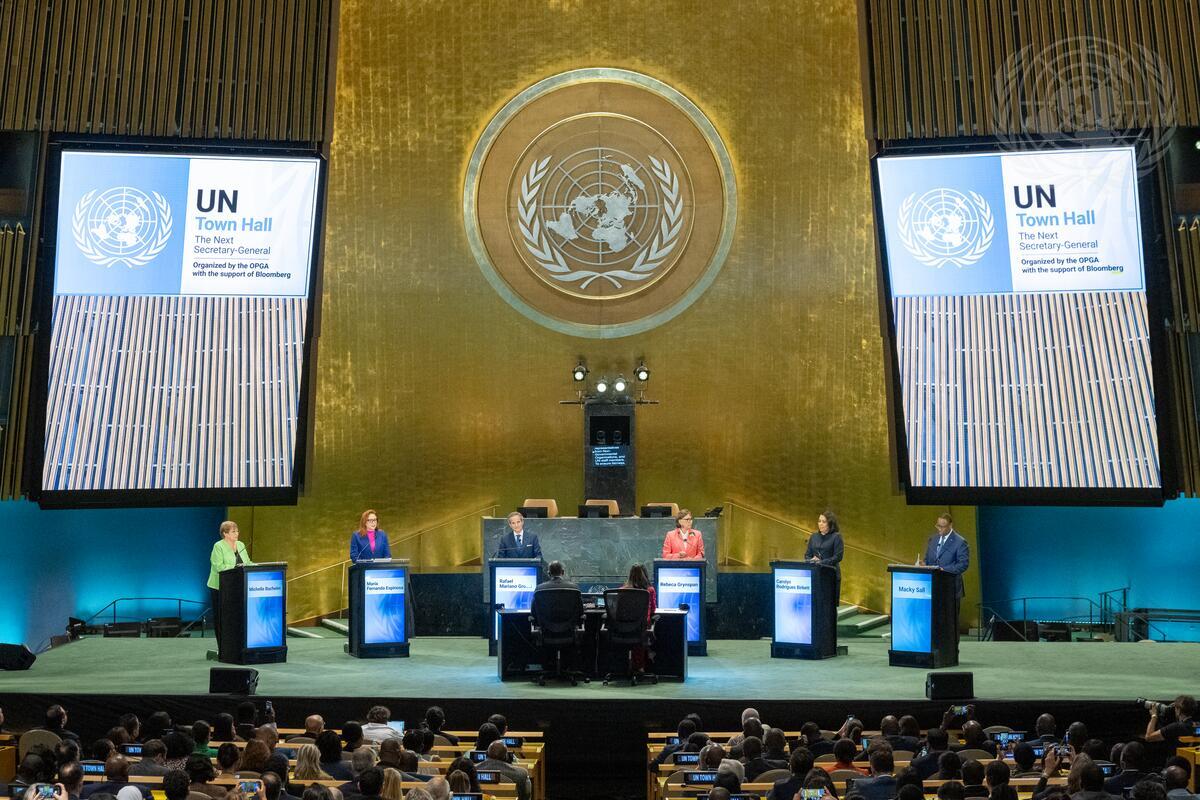
As the field of candidates grows, their competing visions for reform, development, representation and the UN’s financial future offer an early glimpse of how each would lead an organization in crisis.
As Manhattan’s sidewalks filled with bleary-eyed morning commuters, many carrying piping-hot cups of coffee, and city buses wobbled along traffic-packed streets, four candidates arrived at UN headquarters, along the East River, to make their pitch to become the next secretary-general.
Over two days in April, Michelle Bachelet, Rafael Grossi, Rebeca Grynspan and Macky Sall each sat for a three-hour interactive dialogue hosted by General Assembly President Annalena Baerbock. There, they outlined their visions and fielded prerecorded and live questions from member states and civil society groups on a wide range of topics, including the UN’s finances, climate, peacekeeping and multilateralism. Bachelet and Grossi appeared on April 21, followed by Grynspan and Sall on April 22.
In a phone call with Envoy, Rita French, the director of policy and diplomatic engagement at Article 109, an international nonprofit coalition working with member states to update the UN Charter, described the dialogues as “theater” but an important exercise “in terms of transparency and accountability.”
She added, “I think it does kind of reveal a little bit about what you’d expect a future SG to be able to do, to be able to deliver for the full membership of the UN and not just the members who are essentially going to be responsible for selecting the successful candidate.” In effect, it’s the five permanent members of the Security Council—the US, the United Kingdom, France, China and Russia—who will have the last word on the next secretary-general selection. And with a nomination from a member state or group of member states, additional candidates can enter the race at any time during the process.
“I find it hard to imagine that the race will be confined to these four candidates,” Eugene Chen, a nonresident adviser at the International Peace Institute (IPI), a nonprofit based in New York that works to develop multilateralism, said. Chen, who spoke with Envoy on Zoom, added that he expects two other sets of candidates to enter the race at a later date.
As it turns out, Chen was right. Three weeks after the dialogues, María Fernanda Espinosa announced her bid to lead the UN. Nominated by Antigua and Barbuda, Espinosa, who is from Ecuador, served as her country’s foreign minister and minister of national defense, and later as president of the 73rd session of the UN General Assembly in 2018–2019. In addition to Bachelet and Sall, Espinosa is the third candidate to be nominated by a member state other than her own. The field expanded again in June when Guyana nominated Carolyn Rodrigues-Birkett, its permanent representative to the UN and a former foreign minister, to become the organization’s first secretary-general from the Caribbean.
This is happening as the Security Council remains deadlocked over Ukraine, Gaza and Sudan. While the UN’s financial crisis boils over and pages of the Charter get shredded from the rostrum of the General Assembly. In this context, the next secretary-general election feels more consequential than any in recent memory—begging the question of whether the organization can survive this moment.
Ellen Ravndal, associate professor of international relations at the University of Stavanger in Norway, told Envoy it can. “I would say that the fact that we are now 80 years on is a testament to the strength of the UN. It’s lasted a very long time through many different crises.”
Still, the stakes require the next top diplomat to not only “embody the highest standards of efficiency, competence and integrity, and a firm commitment to the purposes and principles of the Charter,” as stated in General Assembly Resolution 79/327, but also possess, according to Augusto Lopez-Claros, the executive director of the Global Governance Forum, “moral courage,” the “willingness to speak uncomfortable truths to power” and be politically resilient enough “to withstand criticism and isolation.” As a nonprofit, the forum’s goal is to “promote research on improved or alternative models of global governance,” according to its website.
Whether Bachelet, Grossi, Grynspan and Sall embody these qualities was difficult to gauge from the interactive dialogues. Too often, the candidates gave vague answers to questions from member states who requested specifics or overused substanceless words such as “empower,” “strengthen,” and “mobilize” in their responses. And while the candidates praised the power of preventive diplomacy, none directly addressed how they would handle the pressure and politics around the deadly conflicts that could still be raging when the next secretary-general—whether a man or, for the first time, a woman—takes office on January 1, 2027.
The dialogues are a way for the candidates to introduce themselves “but they were never going to go into any detail about any issue that member states really care about,” explained Chen. “Really, the exercise was about managing risk” and not saying anything that would disqualify them “in the eyes of the P5.”
“Playing it safe is not ideal in these engagements,” added Lopez-Claros in a phone interview. But generally speaking, you have to “put yourself a little bit in their position.” He added, “One would wish that we were in a world in which the candidates can answer the questions candidly and forthrightly…because we need a strong leader.”
Relatedly, during a panel discussion in Madrid, Spain, in December 2025, when asked about the UN, candidate Rebeca Grynspan jokingly yet candidly responded with caution. “I am a good politician,” she said. “Before I will launch my vision statement, I won’t answer any specifics.”
The April dialogues initially featured Bachelet, Grossi, Grynspan and Sall. Espinosa, whose candidacy was announced later, spoke with Envoy for roughly 35 minutes on May 15 and subsequently appeared before member states for her official interactive dialogue on June 15. Rodrigues-Birkett, of Guyana, completed her dialogue three days later, after entering the race as its sixth candidate.
More recently, on July 26, Uganda announced its nomination of veteran Ambassador Olara Otunnu for secretary-general. The Ugandan enters the race as the seventh contender. The date for his interactive dialogue has yet to be announced.
UN80 and the Organization’s Crumbling Reputation
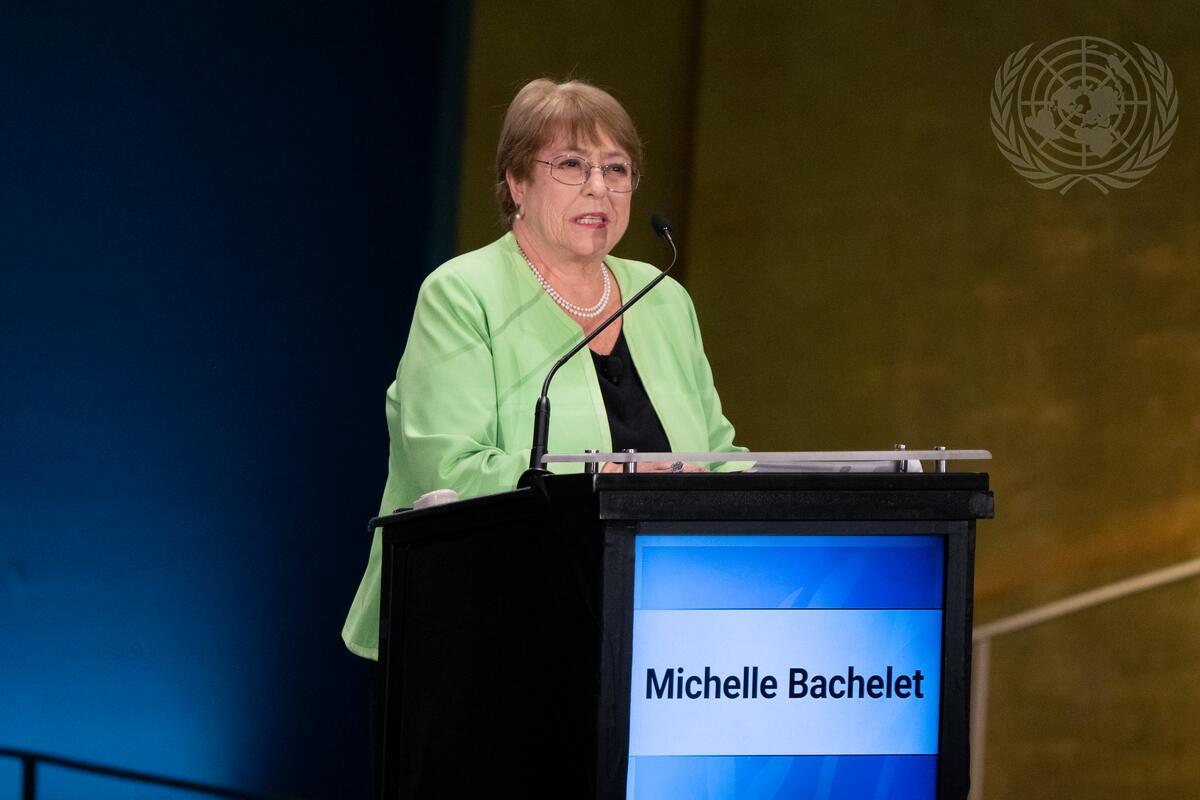
Bachelet, the first of the four candidates to pitch her vision, called UN80 “a must” that she will pursue with “full determination.” The initiative, spearheaded by Secretary-General António Guterres in March 2025, is a systemwide reform strategy to lean down the organization and make it more “responsive and resilient,” according to its website. She said “that any reform should preserve the balance among the three pillars,” peace and security, sustainable development and human rights, to ensure that certain mandates related to development and human rights don’t get hollowed out. To rebuild trust and respect for the UN, Bachelet said, “you have to deliver results.”
Grossi framed the UN’s sinking reputation as a bad trend but one that could be mended by making the organization more efficient, a priority of UN80. He said the initiative is a “first step” and that the next secretary-general will deal with implementation. Overall, “Grossi was very much in this space of kind of technical reform over kind of ambitious political reform,” said French. He sees the role as “delivering on the UN80 and right-sizing the UN“ but is “furthest away from recognizing the scale of the challenges and from referencing the need to deliver structural change.”
Easily the most energetic of the four candidates, Grynspan said she would continue “to build” on the work of UN80, but warned that while some organizations have cut costs, they have not reformed “to be fit for purpose.” She argued that any reform should not “weaken the support and the presence of the UN in the most vulnerable countries.” Grynspan repeatedly emphasized the need for greater dialogue with member states and civil society to restore trust and respect. In a lighter moment, she said, “Let me tell you that I have two sisters. I never get tired of discussing.”
Frequently switching between French and English and keeping the interpreters on their toes, Sall vowed to continue with UN80 in a manner that is “transparent” and “rigorous,” guided by the imperative to “rationalize, simplify and optimize.” As a “bridge builder,” he said he would rebuild trust among UN members and the general public “through consistency, fairness and results.” This is how the UN will remain relevant, he added. Notably, Sall was nominated for the job by Burundi, not his home country, Senegal. This is one of the reasons Thomas Weiss, a professor emeritus at the CUNY Graduate Center in New York, thinks Sall’s candidacy is “not at all serious,” as he lacks support from his own country. Weiss, whom Envoy interviewed by phone, also noted that it’s not “Africa’s turn,” referring to the informal custom of regional rotation of the secretary-general. In this election, it’s expected that the next leader will be from Latin America.
For Espinosa, UN80 is an “inevitable first step” that should be implemented with clarity and caution and not be treated as a cost-cutting exercise. “We cannot speed up and just simply say we need to merge, we need to delete, we need to cut…because in my opinion, form follows function and not the other way around.” She added that member states should “own the process” and work in “consonant with the advice and the technical input from the secretary-general and her office.”
In her remarks, a composed Rodrigues-Birkett emphasized the need for the next secretary-general to advance UN80 initiatives while giving member states the room they need to lead reform efforts. The process must be “member-state driven,” she said. In her vision statement, Rodrigues-Birkett added that if elected, she would work in partnership with member states to reassert the UN’s Charter, reform its systems and practices, and rally towards the shared objective of a more agile and effective UN.
Gender, Geographic Parity and Representation
When asked by Aditi Gorur, campaign coordinator for 1 for 8 Billion, about confronting national monopolies on senior leadership, Bachelet recognized the need for the secretariat to reflect the diverse world that it serves, even if it comes at a “political cost.” She said it’s not only necessary but that it’s her “conviction” and “commitment.” French, the director of policy and diplomatic engagement at Article 109, said that Bachelet “comes across as very principled and very driven by moral authority and purpose.” According to its website, 1 for 8 Billion “is a global campaign advocating for a fair, transparent, and inclusive selection process for the UN Secretary-General.”
In her opening remarks, Bachelet, who at times appeared nervous but confident, shared a story about her father, Alberto Bachelet, a member of the Chilean air force, who suffered during the 1973 coup d’état led by dictator Augusto Pinochet in Chile. “My story is about one among millions that bear witness to what happens when law-based order falters,” she said. Bachelet and her mother were also arrested and tortured by the regime.
Grossi stressed the importance of recognizing the benefits of a balanced approach to gender and geographical representation, but in his vision statement, he emphasized equal opportunities for both men and women based on talent, not “image or political correctness.” At the dialogue, he didn’t provide specifics about his decision-making process or strategy, but instead emphasized his credentials as head of the IAEA. “You have in me the advantage of knowing what I’m doing in Vienna,” he said.
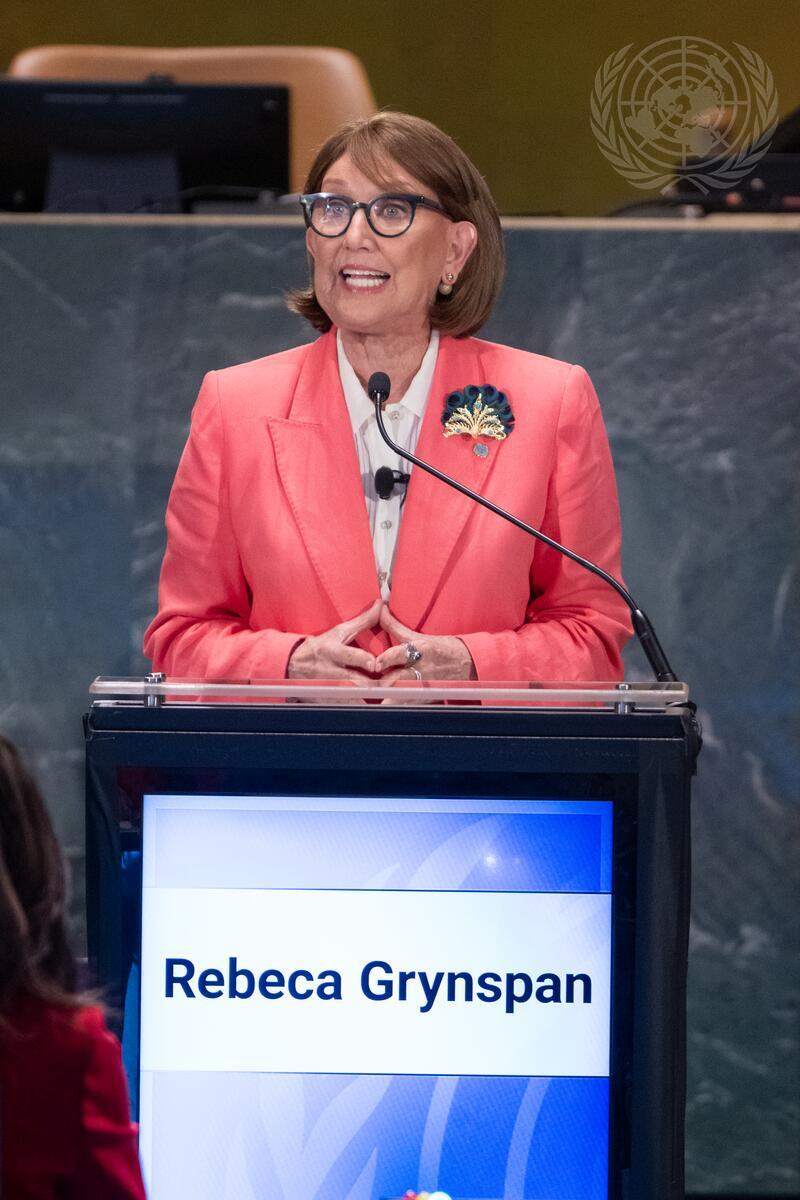
Grynspan positioned herself as a fierce advocate for women and, like Grossi, drew on her leadership at UN Trade and Development (UNCTAD), where she said the organization has, for the first time in history, achieved “parity at the highest levels of management.” Women are half of the population, she added. “We are not an afterthought…we are transformers.” A closer analysis of her remarks by 1 for 8 Billion suggests that, while Grynspan supports women’s rights, she “has not made an explicit commitment to parity” if elected.
According to French, of the four candidates, Sall has “probably been the most vocal in terms of talking about greater representation in the UN,” but has done so without “any plan or proposal around how that will be achieved.” In his dialogue, Sall said that geographical distribution will be considered when hiring staff, especially for high-level posts within the secretariat, and that it will be done in a “very equitable manner.” Additionally, when asked by Norway about his senior leadership team, Sall announced that his deputy would be a woman from the Northern Hemisphere, as “I’m from the South,” he said.
Regardless of how great of a leader you are, “you have to be surrounded by the best,” Espinosa said. Therefore, her overall approach respects regional representation, rotation and gender parity while also respecting the “capabilities and the merits” of people. “Again, form follows function.”
Rodrigues-Birkett told member states that Article 101 of the UN Charter, which highlights “the importance of recruiting staff on as wide a geographical basis as possible,” would be her “first point of reference” when hiring in addition to selecting candidates with “the highest standards of efficiency, competence, and integrity,” as mentioned in Article 101. Notably, as a national of Guyana, recognized as a small island developing state (SIDS), Rodrigues-Birkett placed extra emphasis on the representation of these countries at higher level positions at the UN where applicable. “I think that if I’m appointed as secretary-general, it would affect the SIDS ratio in the secretariat,” she said.
Development and the SDGs
To address the development needs of the least developed countries (LDCs), such as SIDS, Bachelet highlighted the need to address the “historical dimensions” of development, including “structural inequalities” rooted in colonialism. High on Bachelet’s list of priorities was the Multidimensional Vulnerability Index (MVI). The MVI is a tool that assesses a state’s unique climate and financial vulnerabilities to ensure fairer access to concessional funding. To reinvigorate the development system at large, she said more could be done at the country level to empower resident coordinators with “real authority, adequate resources,” and “clear accountability for results.”
As a pragmatist, Grossi focused on implementation rather than political or structural reform of the current system (in his opening remarks, he said the UN “was not created to be an institution propelling messages from an ivory tower” but rather “solving problems on the ground”). In response to a question from the European Union about progress on achieving the Sustainable Development Goals (SDGs), Grossi called for “constructive and complementary” relationships with international financial institutions. Without a unified vision, he argued that it would be difficult to make headway on the SDGs. On development mandates for Africa, he said, “it’s time for implementation… if there is something the UN doesn’t need is more conferences.”
Like Bachelet, Grynspan advocated for reforming the current financial structure to increase access to finance for countries stuck in a vicious cycle of debt. To accelerate progress on the SDGs, she stressed the need for implementation at the country level and better coordination to meet each country’s needs and priorities. “When I was in charge of international cooperation, many times I felt that what I needed was not offered [and] what was offered I didn’t need. And so let’s try to close that gap.”
For Sall, progress on development initiatives such as the SDGs hinges on reforming access to public financing, which he described as “insufficient” and “difficult to mobilize.” He said financing for development should be driven by “partnership, investment, trade,” and “better access to credit.” If elected, he vowed to “ensure the proper implementation” of the SDGs, but did not explain how he would do so.
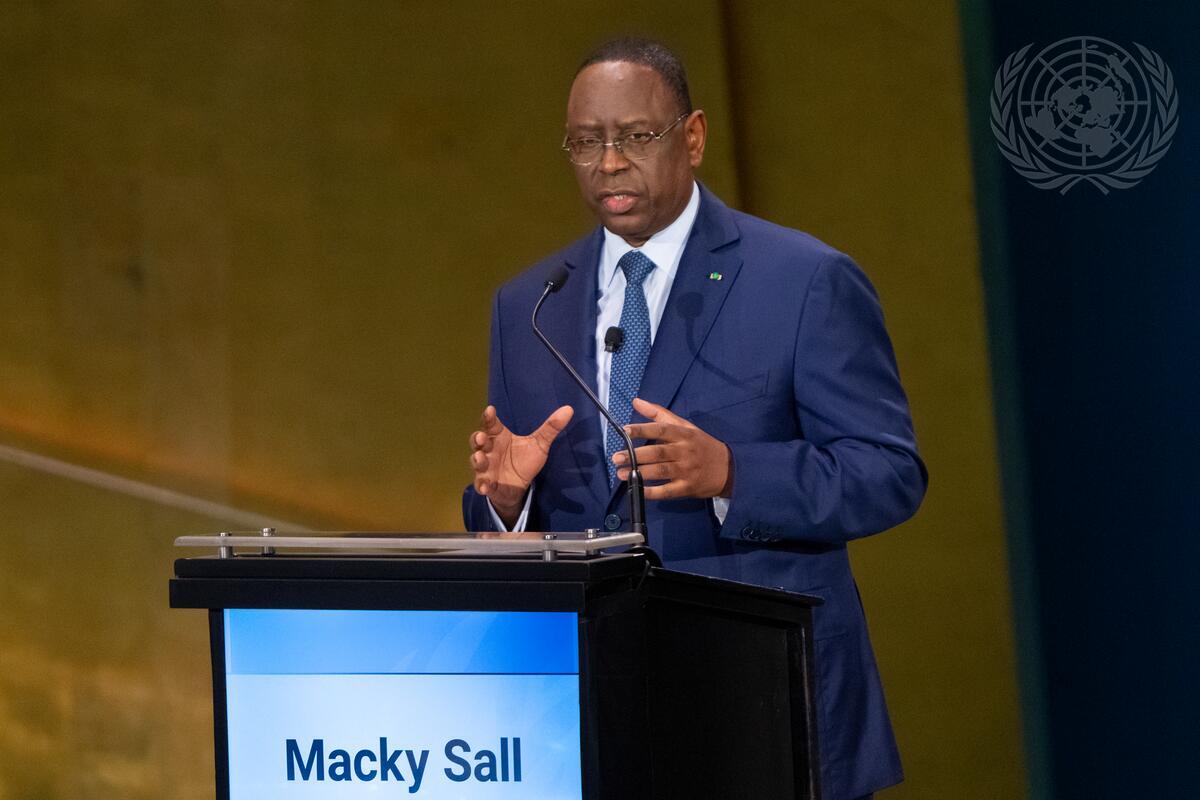
Overall, Sall presented as the least prepared for his dialogue, often getting lost in his answers and at times appearing overwhelmed by member states and groups that asked multiple questions. Notably, both candidates and member states were held to a strict time limit to answer and ask questions before their microphones were cut off.
Meanwhile, on Zoom, Espinosa described what she called the “development imperative” as being the “biggest challenge we have ahead of us.” She suggested a new approach that gives national and local entities ownership of implementation, as she’s convinced that the UN should not replace the authority of sovereign countries to “choose their own development pathways.”
On the development “deficit,” Rodrigues-Birkett, like the other candidates, emphasized the need to strengthen the implementation of current development “blueprints,” such as the SDGs and the Pact for the Future. If elected secretary-general, she said she would use the office to advance reforms of the current global financial architecture and advocate for the adoption of the MVI.
During her interactive dialogue, Rodrigues-Birkett received notable support and recognition for her candidacy from some member states. The representative of Australia, speaking on behalf of Canada and New Zealand, offered her their personal congratulations “from all of us,” adding, “I don’t think there’s anybody in the room here or our community in New York who didn’t let out a little cheer on your nomination.”
Addressing the UN’s Financial Crisis
Bachelet struck a firm balance in her approach to getting member states to pay their assessed contributions on time. She vowed to use the secretary-general’s good offices to understand and talk to member states about the crucial work the UN does across all three pillars. However, she did not shy away from reminding them that assessed contributions are not voluntary. “They are by the Charter,” she said. “It’s a legal commitment, so member states have to do it.”
In response to a question from Uruguay on behalf of the Group of 77 and China on the UN’s “shrinking fiscal space,” Grossi kept his answer short. He said, “I am confident that as of the next year, knowing and having a clear sense of direction, the payment situation will improve dramatically.” Without specifics, it’s difficult to understand what Grossi meant. Ronny Patz, a UN expert at the German Institute of Development and Sustainability (IDOS), who spoke with Envoy by phone, thinks Grossi’s response was “probably more hope than reality.” Patz added, “I think all of the candidates have a sense of the financial crisis,” however at the dialogues “none of them displayed the crisis as the urgency that it is.” IDOS is a research institute based in Bonn, Germany.
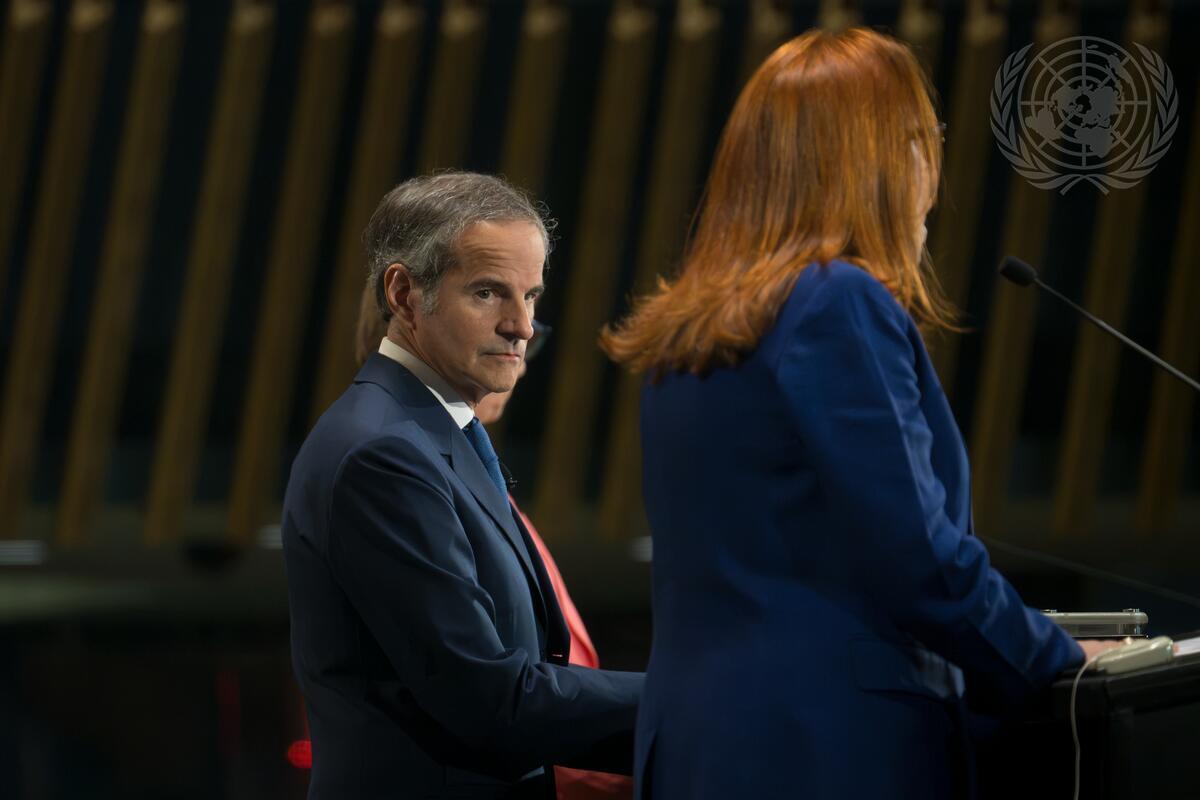
Of the four candidates, Grossi often rushed through his answers to member states’ questions, giving the impression that the dialogue, for him, was merely a box that he needed to tick given the outsized role the P5 plays in selecting the next secretary-general. At one point, Grossi, a father of eight, mentioned being an avid marathon runner, perhaps to make light of his noticeable impatience. “Marathons are good in terms of resilience,” he said, “and they really do something for your character.”
To make financial decisions based on reality, Grynspan said, “The first thing I will do if I am elected secretary-general is to ask for the numbers.” To showcase her ability to mediate, she mentioned her role as a broker of the Black Sea Grain Initiative between Russia and Ukraine in 2022. Eugene Chen with the IPI said this was intentional. “Of the four candidates, she’s the one who has the most managerial experience within the UN and has experience implementing reforms and change and managing,” said Chen. She understands that by focusing on her mediation chops, she can address any concerns about her ability to do the job, he added.
To mobilize member states to fulfill their financial obligations, Sall said he would take a collaborative approach, engaging in dialogue with member states and restoring trust. “Once we have an open book and we see very clearly what the organization can do better in terms of streamlining and optimizing,” then we can do what needs to be done.
When asked by Envoy how she would get member states to pay their dues, Espinosa described the issue as being a “symptom” of a “deeper political credibility crisis” within the UN. To address the challenge, she called for a “renewed” and “strong” UN leadership that prioritizes “greater accountability and transparency” in how resources are used. She mentioned striking a better balance between assessed and voluntary contributions, coupled with a “deep assessment” of the impact of all peacekeeping missions. High on Espinosa’s list is the financing gap for humanitarian initiatives, which she described as the UN’s “hardcore job description.” She added that among all member states “there is a shared responsibility to make sure that the UN is capable of delivering the very fundamentals, which is to make sure that people live free from fear and free from want.”
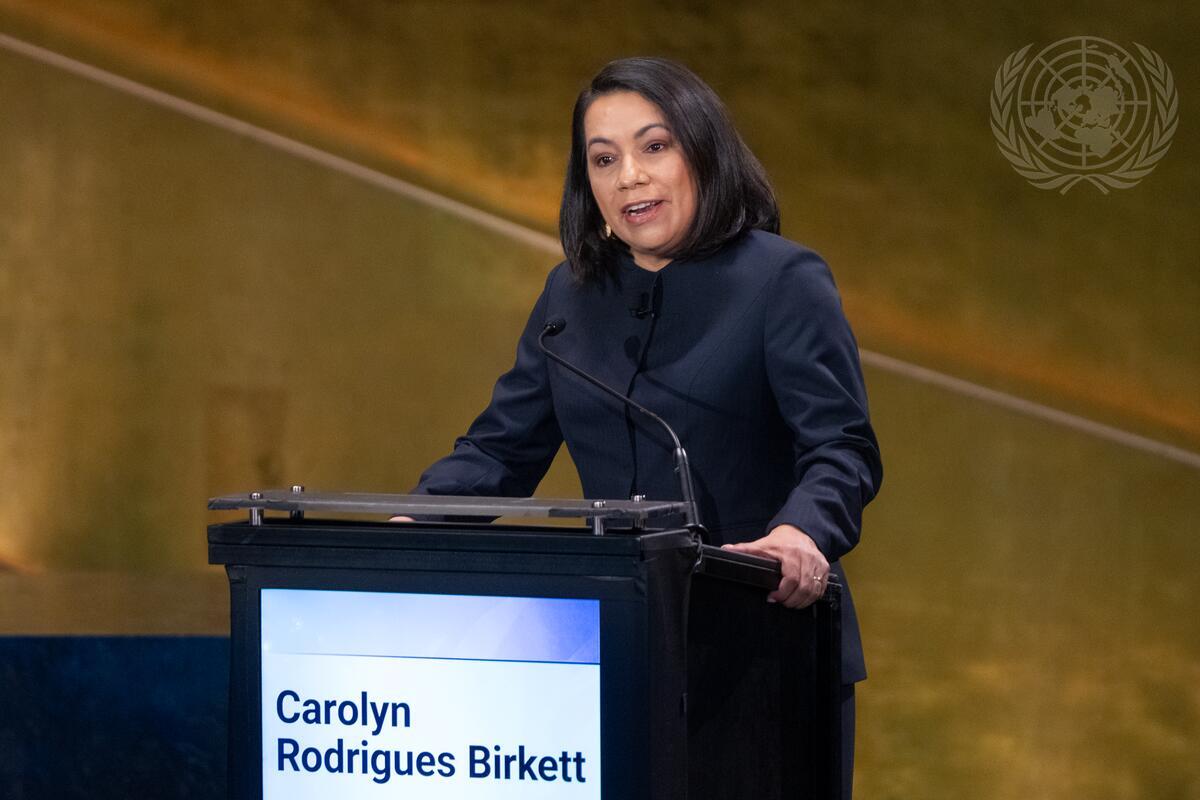
While she recognized the severity of the UN’s current liquidity crisis, Rodrigues-Birkett provided little detail on how she would address it. However, she did note the critical role UN80 can play in righting the UN’s finances and the “good work” member states are doing “on improving efficiencies in the secretariat.” Rodrigues-Birkett added that her approach overall would be “principled, pragmatic, and responsive.”
About The Author