North Korea rejects denuclearization, Antigua and Barbuda makes a disability-rights appeal, and Sudan and the UAE trade accusations.
“We have heard the last speaker of the general debate,” the president of the General Assembly said. And with that, UNGA’s general debate came to an end.
The final day always feels different. As the speaker list gets shorter, security thins out, and the hallways empty. Representation also tends to drop a level, with mostly ambassadors and ministers taking the rostrum. But that does not make the speeches any less consequential.
One of today’s headliners was North Korea’s Vice Minister for Foreign Affairs Kim Son Gyong. Representing one of the world’s most closed countries, he used the General Assembly spotlight to warn of the “threat” posed by the Republic of Korea, Japan and the United States.
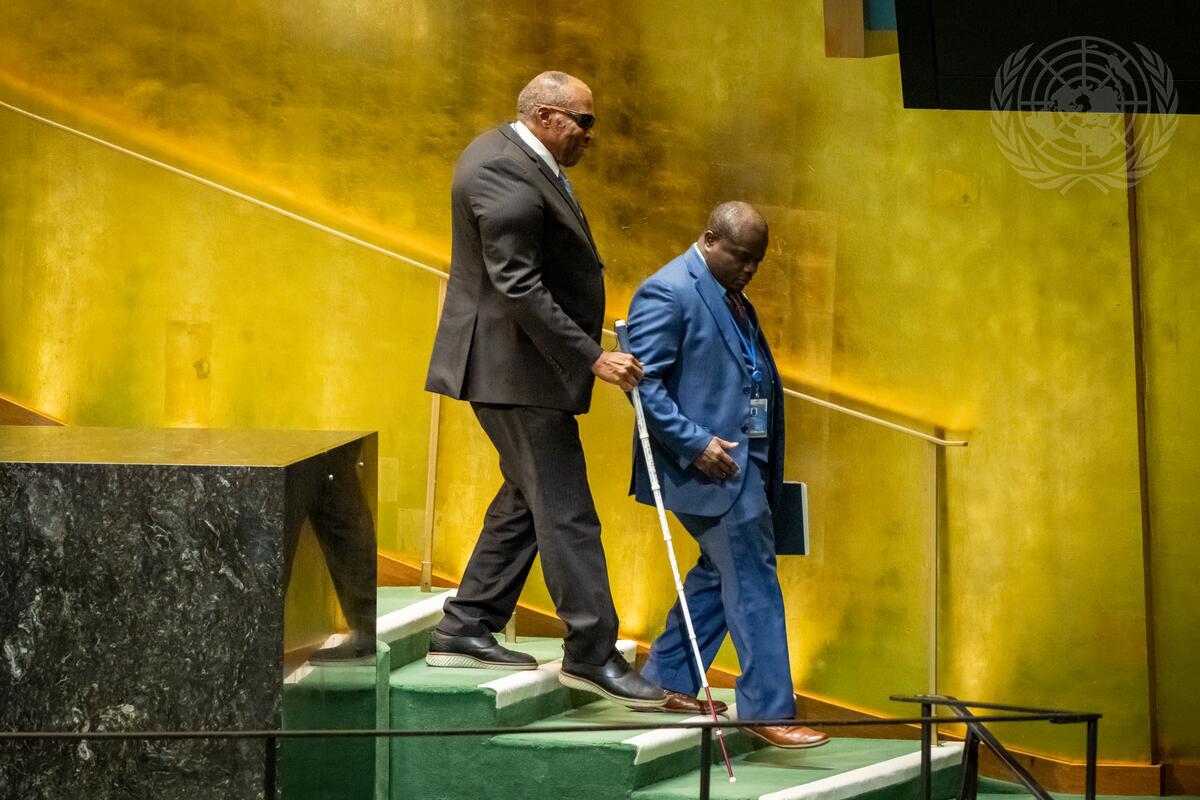
But the speech that really caught our attention came from Antigua and Barbuda’s Ambassador Walton Alfonso Webson. Visually impaired, Webson read Braille from the rostrum as he made an appeal for the rights and inclusion of people with disabilities — one of the day’s most personal interventions.
Also on our watch list: the United Arab Emirates, El Salvador and Costa Rica.
After the speeches ended, Sudan exercised its right of reply to denounce what it described as the UAE’s role in the war ravaging the country. “Members of the [Rapid Support Forces] were critically trained on how to use drones by the UAE,” the Sudanese representative said. The exchange escalated further, with Sudan and the UAE accusing each other of involvement in the use of chemical weapons.
And if you haven’t yet, read Ambassador I. Rhonda King’s opinion piece for Envoy on why the next UN secretary-general should come not merely from Latin America and the Caribbean, but from the Caribbean itself.
Antigua and Barbuda’s Case for Global Eye Health
By Pau Torres Pages
Antigua and Barbuda’s Permanent Representative Walton Alfonso Webson, who has been described as the first visually impaired person to serve as a UN ambassador, delivered his speech by reading Braille. “Preventable vision impairment denies thousands of our people opportunities to learn, work and live independently,” said the long-time diplomat and disability rights leader. In November, his country will host the first-ever Global Summit for Eye Health “to move the international community from advocacy to action,” he added.
The island, which nominated María Fernanda Espinosa for the secretary-general position, also reiterated its support for the candidate despite her trailing in the latest straw poll. “Our case for María Fernanda Espinosa rests on more than gender,” said Webson, “It rests on competence, experience, independence and leadership.”
North Korea won’t give up its nuclear arsenal – to defend itself from the US, Japan, and South Korea
By Stephanie Fillion
North Korea used its General Assembly address to deliver an unequivocal message on its nuclear arsenal: there will be no denuclearization. Pyongyang declared that its status as a nuclear weapons state has been “permanently fixed,” both physically and legally, and “can never be reversed in any circumstances or by any means.”
The speech framed the country’s nuclear deterrent not as a bargaining chip, but as the central guarantee of its sovereignty and security, arguing that military pressure from the United States, South Korea and Japan has only reinforced the need for overwhelming force.
North Korea accused Washington of turning the US-Japan-South Korea security partnership into an increasingly offensive military bloc with a nuclear dimension, pointing to joint exercises, missile deployments and Seoul’s ambitions for nuclear-powered submarines. It also sharply criticized Japan’s military buildup and moves toward expanded strike capabilities.
Despite describing the Korean Peninsula as increasingly unstable, Pyongyang argued that the absence of direct conflict proves its deterrence strategy is working. The broader message: North Korea sees nuclear weapons as a permanent feature of its national defense and intends to strengthen, not negotiate away, that capability.
Security, UN reform, and the SG Race: Latin America in the Last Day
By Camilo Lopez Delgado
Two notable Latin American speeches were delivered on the last day of the General Debate: El Salvador and Costa Rica.
Security remained high on the agenda in both, along with UN reform, the Secretary-General race, regional affairs and, in El Salvador’s case, investment, with the country projecting 4.5% growth in 2026 driven in part by tourism and capital inflows.
On security, El Salvador, represented by Foreign Minister Alexandra Hill Tinoco, highlighted President Nayib Bukele’s policies as a regional benchmark, also noting the IMF’s assessment that improved security has strengthened confidence and economic activity in the country.
Costa Rica was represented by its Permanent Representative to the United Nations, Boris Vasir Marchegiani Carrero, four days after President Laura Fernández dismissed Foreign Minister Manuel Tovar, reportedly over attending a Shield of the Americas meeting without notifying her. Marchegiani pointed to illegal mining by transnational criminal groups on Costa Rica’s border with Nicaragua, prescribing cooperation, stronger institutions and the rule of law to address such threats.
On UN reform, both representatives underscored the need for an organization that is more agile, transparent and effective, and that can produce tangible results.
El Salvador described reform as less bureaucracy, more capacity to act and respect for sovereignty. Costa Rica called for better management, urging the organization to set priorities, eliminate overlaps, use its resources prudently and measure its results.
With regard to the Secretary-General race, El Salvador underscored the need for an SG able to lead with full independence, engage in dialogue and understand today’s international realities. Costa Rica, on the other hand, was clear in its endorsement, calling for a Latin American woman and naming Rebeca Grynspan as the right candidate to lead the organization.
Costa Rica also called for the restoration of democratic institutions in Venezuela and respect for “the people’s will,” and raised concerns about the situations in Nicaragua and Cuba, calling for full respect for human rights and fundamental freedoms.
Lastly, El Salvador spoke about AI, highlighting its role as co-chair, with Estonia, of the UN Global Dialogue on AI Governance while reaffirming how the technology must “expand UN capacities and create opportunities to build environments that can be competitive in the future.”
About The Author