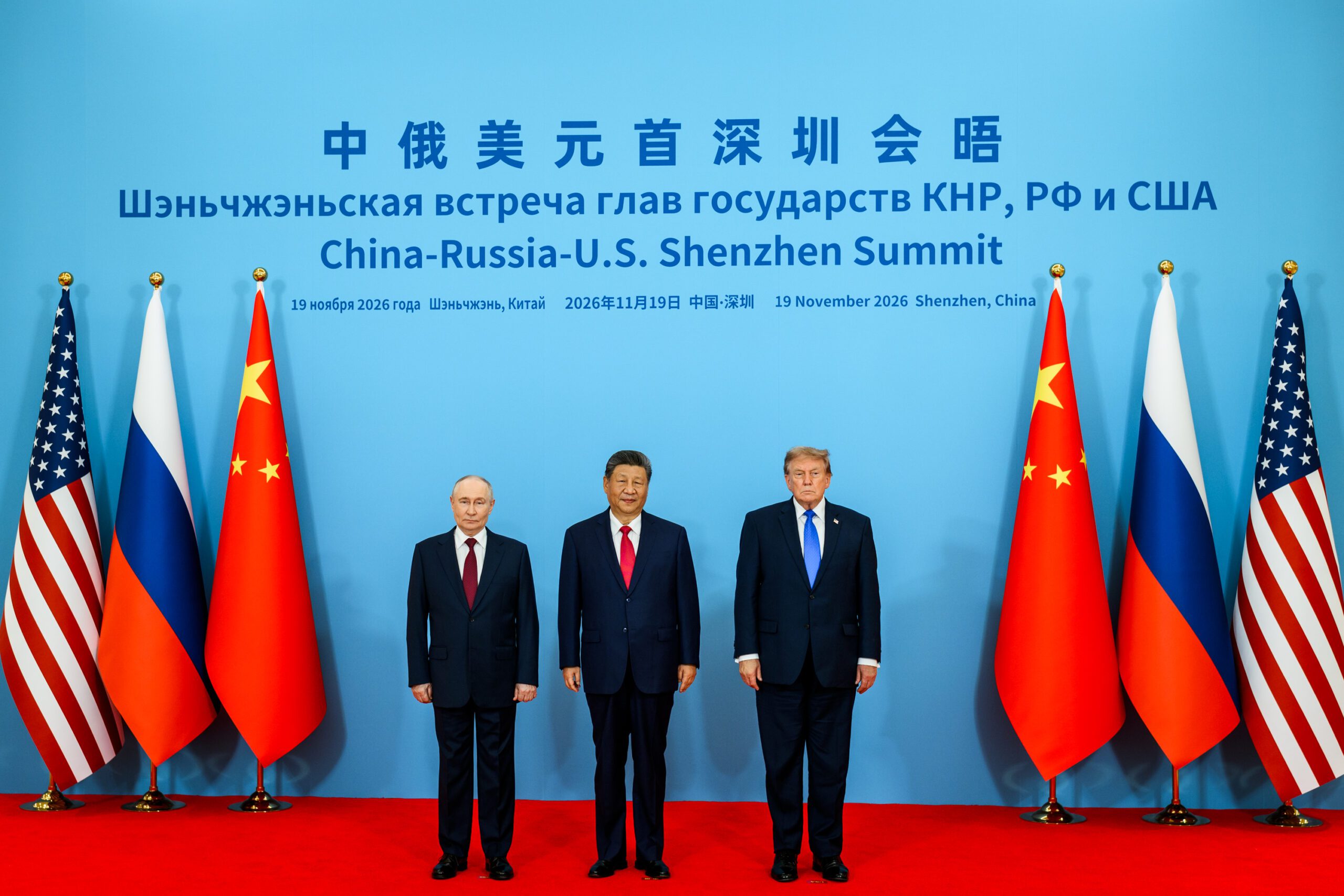
Ukraine and Iran were conspicuously absent from their historic summit declaration. Instead, the three leaders turned their attention to reforming the United Nations and challenging the International Criminal Court.
The Shenzhen summit was meant to make history. It was the first time the leaders of China, Russia, and the United States sat down together to discuss the world’s problems, and the world was waiting for news on Ukraine, Iran, oil, and nuclear weapons. What nobody expected was that the United Nations and the International Criminal Court would steal the show.
In three decades of covering the UN, I cannot recall a summit of this magnitude in which the world body and the Hague court took up so much of the final communiqué. Half of the four-point joint statement that emerged from the historic 80-minute meeting between Donald Trump, Xi Jinping, and Vladimir Putin was about international institutions. One point promised to reform the United Nations. The other was a warning to the International Criminal Court. Ukraine was not mentioned, and neither was Iran.
For anyone who has spent years in the corridors of Turtle Bay, the moment was unsettling. Not because the UN needs no reform. Almost everyone agrees it does. What unsettles me is who was doing the talking. UN diplomats use “P3” for the three Western permanent members of the Security Council: the United States, the United Kingdom, and France. In Shenzhen, a different P3 sat at the table. France and the United Kingdom were not in the room. The three leaders who were do not share a vision of the world, but they do share an interest in a smaller UN. “Reform” had suddenly become code for more cuts and for refocusing the organization on the interests of the three powers. This was not Yalta in 1945 without Churchill, but a new world order was taking shape.
The joint text said that “as permanent members of the United Nations Security Council, the United States, Russia, and China committed to reform the UN so that the UN can respond more effectively to global challenges and conform to its fundamental mission of international peace and security.” It named no specific reform and set no timetable.
The second point was sharper. They “recognized that the principle of state consent and respect for immunities of State officials are of paramount importance,” and warned “that the International Criminal Court and other similar bodies must not abuse their jurisdiction.”
The résumés of the reformers do little to ease the discomfort. Xi scrapped presidential term limits in 2018, a move Trump greeted at the time with open admiration. “He’s now president for life,” he said. Putin rewrote the Russian Constitution in 2020 to allow himself to stay in power until 2036. And Trump, the elected leader of the oldest democracy at the table, has repeatedly flirted with a third term that the US Constitution forbids. “I’m not joking,” he told NBC News in March 2025. These are the three men now seeking to set the terms for the UN and the international court.
Why so much space for the UN at a summit of this weight? The experts consulted by Envoy offer one explanation: it was what the three men could agree on.
“Perhaps one reason that the UN and international institutions figured so prominently in the statement following the trilateral summit is that Xi, Putin, and Trump did not have areas of agreement around other issues that were seen as more prominent on the agenda leading into their meeting,” said Courtney B. Smith, dean of the School of Diplomacy at Seton Hall University.
What kind of reform?
That does not mean they are not intent on transforming the institution into something closer to their interests. But what kind of reform do they mean? The day after the summit, US Ambassador Mike Waltz carried the message to the Security Council stakeout. “I think there is a lot of consideration of how this body can get back to basics, can be more relevant in bringing peace and security to the conflicts we’re seeing around the world,” he told reporters, unsolicited.
China and Russia have long presented UN reform as a way to dilute Western dominance and give more weight to emerging powers, as part of their vision of a “multipolar” world. Washington’s record points elsewhere. Under Trump, the United States has withdrawn from bodies including the World Health Organization, pushed through UN budget cuts of more than $1 billion, and pressed to close some peacekeeping missions.
Brett D. Schaefer, a senior fellow at the American Enterprise Institute (AEI) and former senior research fellow at the conservative Heritage Foundation, previously served as assistant for International Criminal Court policy at the Department of Defense. He describes the US goal as a narrower UN with a smaller budget, “focused primarily on peace and security issues that are led and directed primarily by the Security Council and not independently by a secretary-general.” Leaner, he insists, does not mean weaker. It’s about money. By his account, China and the United States together pay roughly half of the peacekeeping bill, and under the next regular budget, China will soon match the United States at the 22 percent ceiling of the regular budget. He reads the declaration as a signal to the UN of “much more close coordination between the two largest donors to the organization, China and the United States, on downsizing and retrenching the organization and refocusing it on fewer priorities.”
A common enemy
On the ICC, consensus came even more easily. “It is a common enemy that all three share, especially given its actions against Putin and Trump’s close friends (like Netanyahu),” Smith says.
None of the three countries is a party to the Rome Statute, the international treaty that established the ICC in 1998. Putin has been wanted by the court since March 2023 over the alleged unlawful deportation and transfer of children from occupied Ukraine. Washington sanctioned ICC judges and officials after the court issued an arrest warrant for Israeli Prime Minister Benjamin Netanyahu, and in October it imposed broad sanctions on the court itself, calling it “rogue.” In May, according to the Financial Times, Trump had already suggested to Xi in Beijing that the three powers work together against the court. In Shenzhen, that idea was formalized in a joint statement.
Ambassador David J. Scheffer, the first US ambassador-at-large for war crimes issues (1997–2001) and now a senior fellow at the Council on Foreign Relations, notes that the court cannot prosecute the leaders of Russia, China, or the United States for the crime of aggression. “The only thing the United States has to fear from the ICC is fear itself, unless Washington actually intends to commit genocide, crimes against humanity, or war crimes on the territories of states parties to the Rome Statute and our own courts fail to enforce federal or military law,” he said.
Each of the three leaders, in his reading, came to the table with a different stake. Putin welcomed the attack on the court, “as he did with a sly smile in Shenzhen” because “he is an indicted fugitive.” Xi risks nothing. The alleged crimes against the Uyghurs in Xinjiang took place on the territory of a non-party state, beyond the court’s reach unless the Security Council refers the case, which China’s veto makes impossible. “For him, it was an easy ‘give’ at their circular table as China has never supported the existence of the ICC,” he said.
Human rights organizations read the text as an attempt at intimidation. “The Trump administration’s outrageous attacks on the International Criminal Court have one purpose and one purpose only, to allow the US to give a get-out-of-jail free card to whomever it chooses,” said Liz Evenson, international justice director at Human Rights Watch. She recalled that the ICC investigation into the deportation of Ukrainian children “not long ago was met by the strong support of the US government.”
“Let’s keep in mind that the US is targeting the ICC not because it is doing something wrong, but because it is doing something right: upholding the global rule of law and ensuring that no one is above that law,” Evenson said. She urged member countries to protect the court’s mandate and ensure that nobody is above the law.
The view from Washington
Schaefer, the former Pentagon official for ICC policy, offers another perspective, one that aligns with the Trump administration’s position. The three governments, he said, are “very jealous of national sovereignty,” and object to the court asserting jurisdiction over nationals of states that never ratified the Rome Statute.
And they are not alone, he argues. “Any country that sees itself as a rising power is very hesitant about joining the ICC. India is not a member. Pakistan is not a member,” he said. Of the UN’s 193 member states, 125 have ratified it.
That does not mean Washington has given up on accountability, including for Putin, he insists. “It just is going to pursue those crimes or that accountability through other means.” He considers the Shenzhen language a warning shot. “I think this is clearly a brushback pitch,” he said, borrowing the baseball term for a throw aimed close to the batter to make him step back. “The court would be wise to keep its focus on countries that have willingly agreed to abide by its jurisdiction,” he said.
Roland Rich, director of the UN and Global Policy Studies Program at Rutgers University, was less impressed. “The trilateral statement is a damp squib,” he said. “If they actually wanted to reform the UN, they would not undermine it as they so often do.” The pledge to raise output of refined petroleum products, he added, is “completely tone deaf given that the rest of the world is currently meeting to find ways to lower the damage done by those petrol flows.”
The Secretariat’s answer
At the UN, the reaction came the same day in the briefing room. Asked by Envoy about the declaration’s language on the court, UN deputy spokesperson Farhan Haq said: “The secretary-general believes that the International Criminal Court is one of the crucial bodies for international justice in the world. As you know, we have a relationship agreement with the court and we want its work to be supported by member states. The pillar of the rule of law is one of the founding pillars of the stability of the world, and it must be reinforced and not weakened.”
On UN reform, the tone was far more diplomatic. “We welcome the efforts by leaders of countries, including leaders of the permanent members of the Security Council, to work together and find collective solutions to their problems,” Haq said. The contrast says a great deal. The Secretariat drew a line to defend the court and chose not to pick a fight with three of the five permanent members over the future of the organization itself.
The race for the 38th floor
There may be a more immediate reason for the UN paragraph. The summit came one day before the ninth round of informal voting in the Security Council for the next secretary-general, which revealed a standstill. Smith suggests the declaration may have been intended to remind other UN member states who holds the keys to the 38th floor. Schaefer believes the three leaders “probably did discuss it.” As he put it, “UN reform has to involve who leads the organization over the next five years.”
French President Emmanuel Macron said the summit would not “lead to a reorganization of the world.” Perhaps not. The Declaration toward Peace leaves the war in Ukraine unresolved and the UN reform agenda as vague as ever. On one point, though, the three most powerful leaders in the world were perfectly clear. They want a UN that does less and a court that cannot reach them.
About The Author