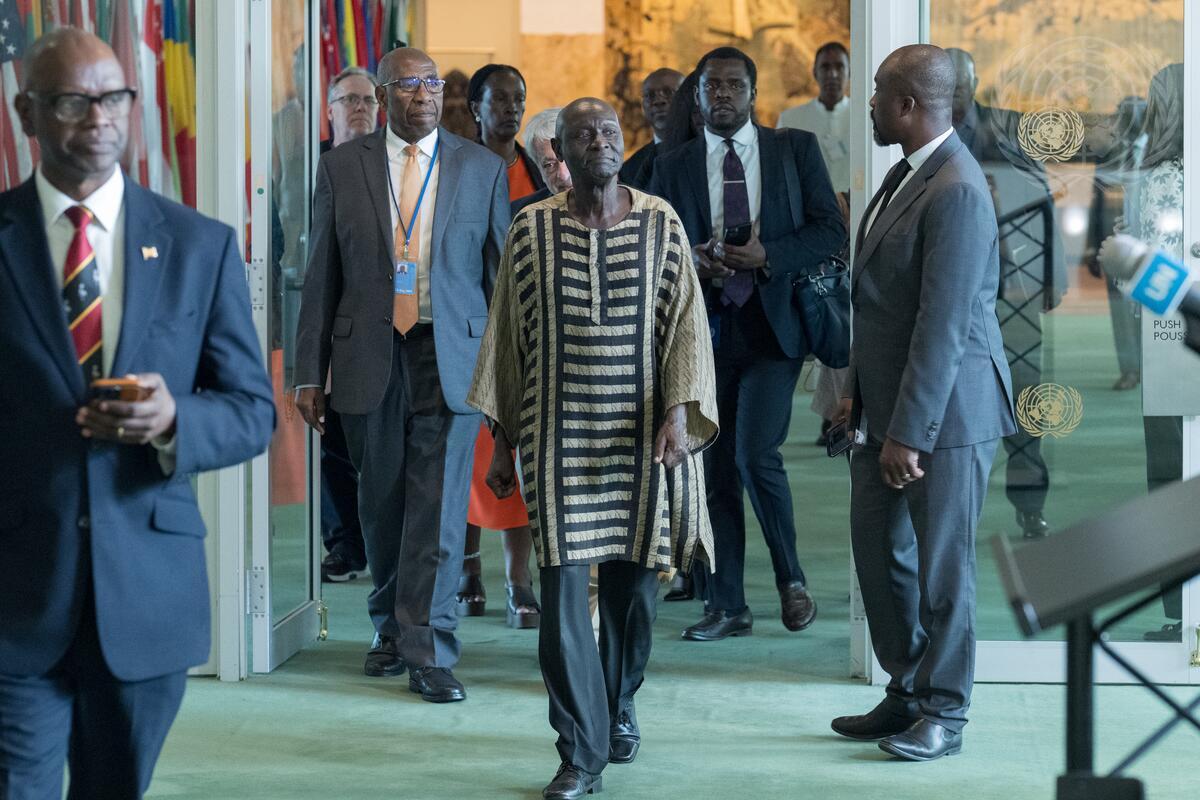
The Ugandan diplomat continues to make a case for his candidacy and says he is still getting “signals” to stay in the race to lead the UN.
Olara Otunnu’s résumé is uniquely built for the role of UN secretary-general: as the man behind the Security Council straw polls, he presided over the Council in the 1980s and was the UN’s very first under-secretary-general for children and armed conflict under Kofi Annan.
A latecomer in the race, Otunnu has, however, struggled to build momentum around his campaign. Some say it’s because his time to run was 30 years ago; others say it is simply time for Latin America and the Caribbean and for a woman. Still, Otunnu isn’t giving up.
“It is the responsibility of members of the Security Council to take on board all the key considerations that are material to this selection: gender, geography, whatever to take everything on board and to make a judgment call,” Otunnu told Envoy in an exclusive interview on October 21. “At this particular moment, where the world is, what is the appropriate and best mix of backgrounds, skills, whatever, to serve the UN and international community, that I leave to them is their judgment call.”
Otunnu entered the race for UN secretary-general in July, and he has struggled to gain traction in the Security Council. In the sixth straw poll, the Ugandan diplomat drew three “discourage” votes from permanent members, and 10 total. Only four countries voted to “encourage” his candidacy. Still, he left the Security Council room more encouraged by the latest results.
“My encouragement went up, not a leap, but a gentle movement forward, and my discouragements went down,” he said. “So I’m grateful.”
The 76-year-old former under-secretary-general for children and armed conflict said he sees his support in the race slowly increasing and intends to stay in the race as long as he can.
“There are ‘signals’ and ‘indications,’ but each candidate has to read their own,” he said. “Discouragement from elected members and discouragement from permanent members. It won’t all be the same. They have to decipher, and then accordingly decide what their next steps would be.”
A résumé built for the job
Few candidates know the UN as well as Otunnu. He recalls that in 1983, after the crisis in Grenada, two rival delegations showed up at the General Assembly and its work ground to a halt. As chair of the Credentials Committee, Otunnu had to find a way out. He drafted a compromise, took it to US Ambassador Jeane Kirkpatrick, Soviet Ambassador Oleg Troyanovsky and the other parties, and got it accepted.
“In my leadership track record, I’ve especially been known for bridge building, for Consensus building, and more than that, for not being shy to come up with innovative proposals and suggestions, even when major actors, permanent members.”
As under-secretary-general, he took on what he calls his pioneering work. When he served on the Council, he said the peace and security agenda was almost entirely about the security of states. He pushed members to treat the protection of children and women in war as a core part of that agenda, “not a footnote.” Some members had reservations at first. The monitoring and reporting system he built, known for naming and shaming, is still in place.
He has also spent long stretches outside the UN. He ran the International Peace Institute (then called the International Peace Academy), taught in France and sat on boards with no link to diplomacy. For the past five or six years, he has lived in rural northern Uganda, where a devastating war forced the population into camps and destroyed communities. He has been working with residents to rebuild their communities.
“For the last several years, I’ve been in a society destroyed by war, working with the community to see what we can do to rebuild that society, to restore it, to resurrect it.”
The wrong profile for this cycle
Otunnu’s lack of momentum may simply be explained by timing: many member states have said they want a woman to lead the UN for the first time from Latin America. When Senegal’s Macky Sall withdrew after the last poll, he said the momentum was moving in that direction.
Otunnu did not push back. After more than 80 years without a woman at the top, he said, the demand for one is “well founded” and “entirely understandable.” He added that every regional group should eventually get “a bite at this apple.”
He argued that regional rotation has never been a firm rule. In 1981, Africa backed Tanzania’s Salim Ahmed Salim, but a permanent member blocked him. In the last race, Eastern Europe was seen as next in line, and António Guterres of Portugal won. In the end, Otunnu said, the Council has to weigh gender, geography and skills against where the world is right now. “That I leave to them.”
He also had a message for people who have lost faith in the UN. The Charter opens with “we the peoples,” he noted, and the secretary-general has to explain to the public why it still matters to have one place where “all the tribes of the earth” gather, argue and work on problems no country can solve alone.
New faces, and an old formula
The race has gotten more crowded since his discussion with Envoy, with Lana Nusseibeh’s entry. Otunnu warned against reading too much into the signals. The straw polls are informal, he said, and each candidate has to work out what a “discourage” vote means, especially when it comes from a permanent member rather than an elected one.
And if anybody at the UN knows about the straw polls, it would be him. In 1981, after the Council had been deadlocked for close to six months, he persuaded Salim and incumbent Kurt Waldheim to step aside temporarily so new candidates could come in. Several Africans, Otunnu among them, were floated, and all declined out of loyalty to Salim. The job went to Javier Pérez de Cuéllar of Peru.
The straw polls Otunnu designed that December—now known as the Otunnu formula—are being used to judge his own candidacy.
“It is very embarrassing. I can’t explain it to my mother,” he said. “Don’t they say no good deed goes unpunished? This is the revenge of history.”
Asked whether he would take a deputy secretary-general or under-secretary-general post if the Council goes another way, he would not commit. “When we reach that bridge, that river, I’ll cross it,” he said.
About The Author