Day three brought a mass walkout, a remote Palestinian address and plenty of old arguments, while the race for the next secretary-general remained eerily quiet.
The decades-old conflict between Israelis and Palestinians took center stage in New York on Thursday, as the leaders of Palestine and Israel both addressed the General Assembly.
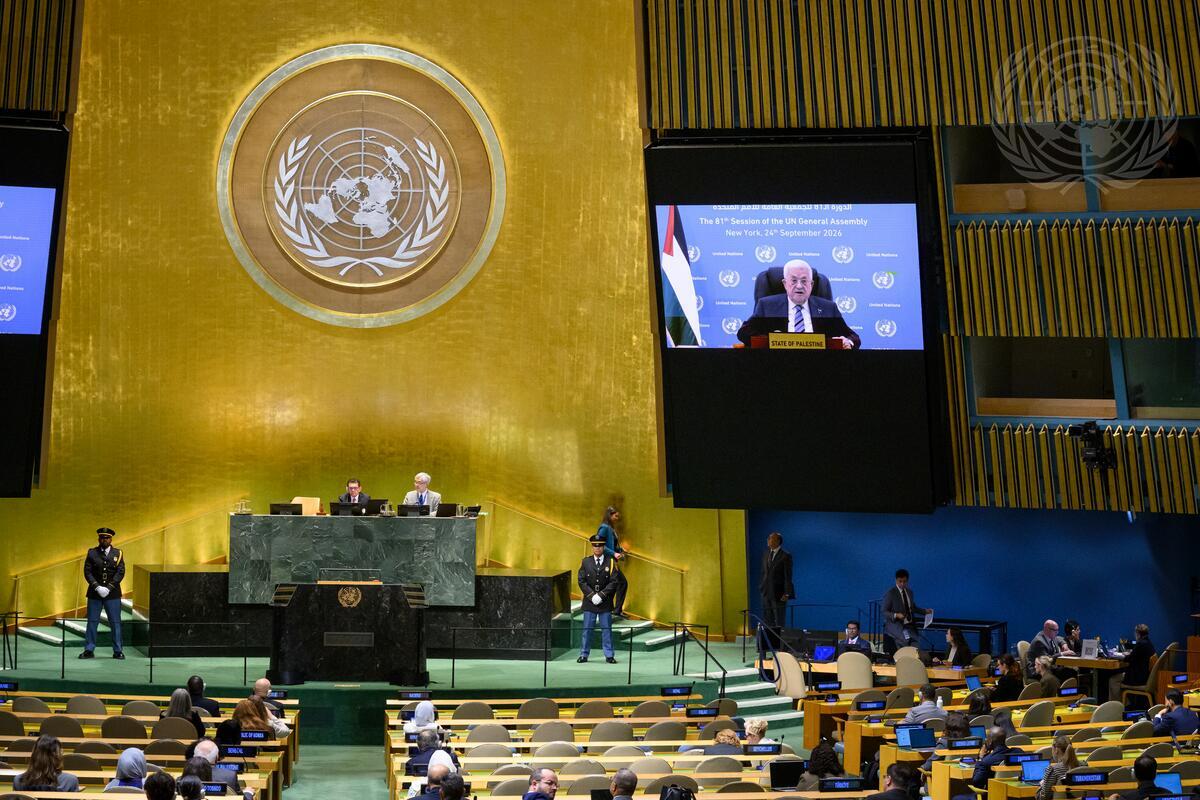
As in 2025, Palestinian President Mahmoud Abbas joined remotely after the US administration denied him and his delegation visas to travel to New York.
As for Benjamin Netanyahu, another mass walkout did not prevent the Israeli prime minister from delivering a combative speech taking aim at the UN, Iran, and New York City Mayor Zohran Mamdani.
Protesters both supportive and critical of Israel’s policy took over the neighborhood, including actress Susan Sarandon, who was detained.
Netanyahu did not meet with UN secretary-general António Guterres, but his ambassador, Danny Danon, was spotted waiting for Iran’s president as he was headed out of the building. Later, in the General Assembly hall, he tried to hand an Iranian diplomat a Starlink terminal.
On the secretary-general front—crickets.
For a week in which the race for the next secretary-general was supposed to be center stage, no new candidate has emerged so far.
That does not mean the race has disappeared from the halls of the UN. Barbados Prime Minister Mia Mottley backed a specific candidate from the rostrum, while Rafael Grossi continued his New York campaign by meeting with Russian Foreign Minister Sergey Lavrov. It looks like the two officially made up.
And while many of the biggest names have already departed Turtle Bay, UN Headquarters is still buzzing with leaders and delegations.
Here’s the latest from the Envoy team:
A Virtual Speech from the Palestinian President We’ve Heard Before
By Dawn Clancy
From giant screens hanging high in the General Assembly hall, Palestinian President Mahmoud Abbas, in a pre-recorded video, called for Israel to end its “malicious colonial scheme” against Palestinians and pleaded for a return to the conditions that support the two-state solution. For the second time under the Trump administration, Abbas and others were denied a visa to the US for “ongoing activities that undermine the prospects for peace,” according to the US State Department.
For the most part, Abbas’s speech paralleled those he’s delivered in previous years, reflecting the decades-long political deadlock that has plagued Israel and Palestine. What else is there for Abbas to say when maintaining the status quo prevails?
Still, on the sidelines of the UN General Assembly on Wednesday, the Board of Peace—a UN-adjacent organization established by President Trump to oversee recovery and reconstruction in Gaza—revealed its six-month plan to kick-start the rebuilding of Gaza. The plan includes 66programs focused on a variety of issues, including building shelters for Palestinians currently living in tents, removing mountains of solid waste, and the safe disposal of weapons and munitions. The plan comes in at around $2.45 billion, according to Nickolay Mladenov, a Gaza executive board member. Media reports say officials admit they don’t yet have the needed funding, only unfulfilled pledges.
Netanyahu: Israel Prevented Genocide, Settlers Only Throw Stones, and the Most Moral Army in the World
By Dawn Clancy
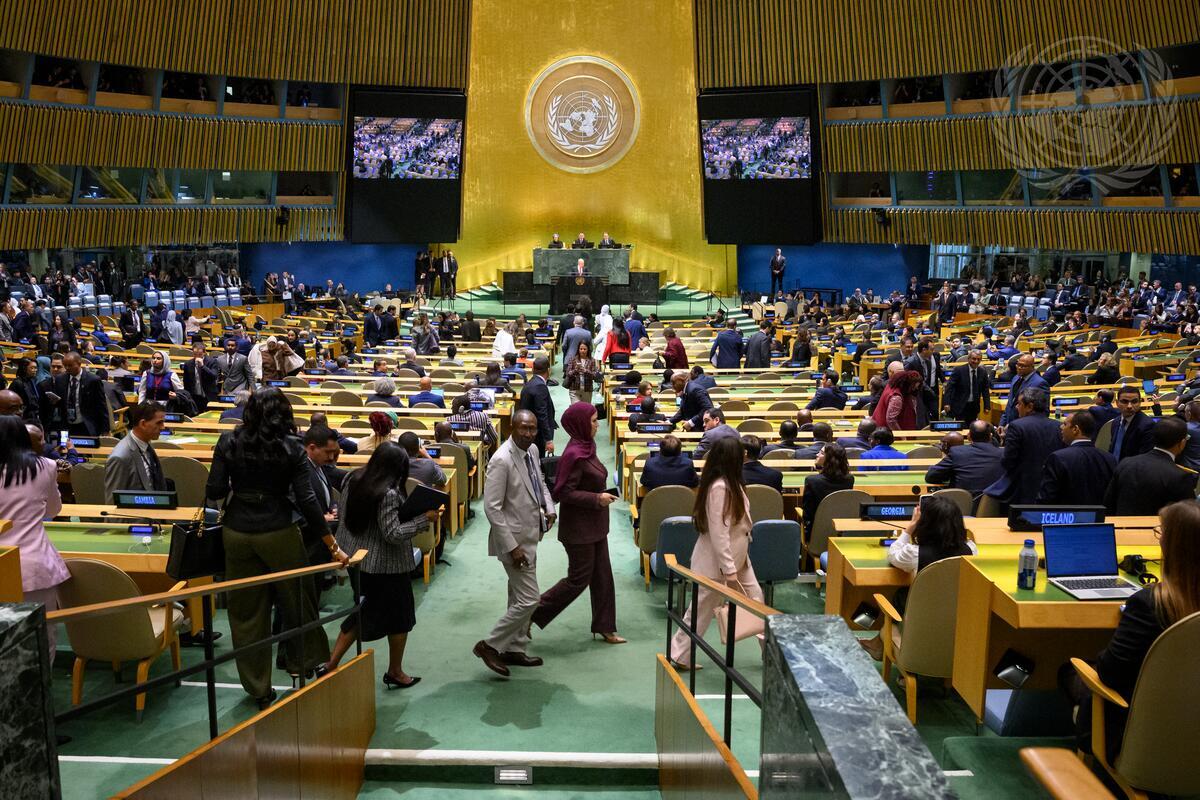
Israeli Prime Minister Benjamin Netanyahu walked into the General Assembly hall as dozens of delegations walked out in protest. However, as in previous years, the balcony of the hall was packed with supporters of Israel, who chanted, “Am Yisrael Chai,” or “The People of Israel Live,” as Netanyahu looked on. Guests invited by the Israeli delegation included lawyer Alan Dershowitz, who served on Trump’s defense team during his first impeachment trial in 2020.
“If there are any other moral cowards who haven’t yet left this hall, please do so now,” Netanyahu said.
Other notable observations in the hall included a lone photo, left behind by the Iranian delegation, of the late Qassem Soleimani, the leader of the Islamic Revolutionary Guard Corps (IRGC), who was killed in a drone strike ordered by President Trump in 2020. Ethiopia’s delegation could be seen on camera standing and applauding Netanyahu alongside the Israeli delegation. Mia Mottley, the prime minister of Barbados, was seen entering the hall to take a seat while other delegates headed for the exits.
Much like the Palestinian president in his remarks, Netanyahu said little, if anything, new in his speech, with the exception of calling New York Mayor Zohran Mamdani “anti-semitic” for accusing Israel of genocide. Given Netanyahu’s ICC warrant – issued by the International Criminal Court (ICC) in 2024 for alleged war crimes and crimes against humanity in Gaza – Mamdani has publicly advocated for his arrest, an obligation for member states who have ratified the Rome Statute, the ICC’s governing document. The US and Israel do not recognize the court.
“Mr. Mamdani, you tried to stop me from coming here. You tried to silence me,” said Netanyahu. “Well, you can’t silence me. You can’t silence the truth.”
Instead of denying the genocide, Netanyahu boldly claimed that “Israel prevented genocide” in Gaza by curbing civilian casualties and taking innumerable steps to protect the civilian population, a claim that does not align with multiple UN agencies’ assessments.
Speaking for roughly forty minutes, Netanyahu lashed out at Britain and France for accusing “tiny Israel” of colonialism when “they invented the term.” Notably, Britain was one of the world’s largest colonial powers when it embraced the Balfour Declaration, the text that called for “the establishment in Palestine of a national home for the Jewish people” in November 1917.
On settler violence in the West Bank, Netanyahu railed against “vigilantism,” as Israel is a “country of law.” He described these settlers as a “handful of young juvenile delinquents, about 150 in number, who go or throw stones, who chop down olive trees.” However, briefing the Security Council on August 11, Ramiz Alakbarov, the UN’s special coordinator for the Middle East peace process, described settler violence in the West Bank as “explosive,” with increased, deadly violence and displacement of Palestinians.
Netanyahu closed his remarks by quoting a line from the Bible: “The eternity of Israel will not falter,” adding, “We have no other choice.”
Mottley Takes a Moral Stand and Endorses a Secretary-General Candidate
By Dawn Clancy
For the first time, from the rostrum of the General Assembly, Mia Mottley, the prime minister of Barbados, endorsed Carolyn Rodrigues Birkett of Guyana as the next secretary-general of the UN. CARICOM, representing the Caribbean Community, endorsed Birkett in July.
“At a moment when the international community is being called upon to renew its faith in multilateralism, we believe that Ambassador Rodrigues Birkett brings to this task the experience, the skills, and the understanding to serve the entire membership of this organization,” said Mottley.
Mottley’s open support for Rodrigues Birkett follows Suriname’s president Jennifer Geerlings-Simons, who did the same a few days ago in her official speech.
In her typical hopeful, inspired, and morally sound approach, Mottley touched on a wide variety of issues, including Security Council reform: “It’s not only about who sits at the table; it is about how power is exercised,” the “accelerating” climate crisis, and reckoning with the “gravest crime against humanity,” the trafficking of enslaved Africans and the racialized chattel enslavement of Africans.
“The mindset that established, justified, and sustained slavery is the same mindset that sustains the iniquities and the inequities within the power structures of this very institution.”
Beyond her words, Mottley’s remarks, in sharp contrast to Prime Minister Netanyahu, illustrate the hyper-polarized state of politics that’s forcefully reshaping the rules-based order and challenging the UN’s role in the world.
“This United Nations must continue to stoke those fires for a transformed and inclusive world,” Mottley said. “I say to you, as I leave this rostrum, let us together ensure that the flames of hope, peace, and dignity burn so bright that in the midst of all the odds against us, that they shine on all of the world.”
Latin America’s Third Act: Between Security and Dialogue
By Camilo Lopez Delgado
On day three of the General Debate, Latin American speeches reiterated three recurring themes emphasized by the region’s leaders in the past days: organized crime, UN reform, and investment in the region.
Specifically, Bolivia’s President Rodrigo Paz and Colombia’s Vice President José Manuel Restrepo aligned their interventions with those of other right-leaning governments in the region, placing a strong emphasis on security and rejecting what they framed as ideological agendas. Meanwhile, Uruguay’s President Yamandú Orsi struck a more conciliatory tone centered on dialogue and peace.
Paz framed the situation of his country as partly a consequence of what he described as a crisis generated by 20 years of “ideological construction” in the region. He emphasized his campaign’s concept of “capitalism for all” and highlighted efforts to restore the economy, including rebuilding central bank reserves.
He criticized how slowly multilateral financing arrives, arguing that this gives organized crime an advantage. Paz also denounced 53 days of road blockades, which he blamed on narco-terrorism and called an attempt to break “the constitutional and democratic framework of our nations.” He further called for agreements with neighboring Amazon countries to conserve the forest and curb destructive activities.
Restrepo read the message on behalf of President Abelardo de la Espriella, who promised not to leave Colombia during his term.
In it, he questioned the UN’s bureaucratic bloat and how it measures results, noting that the UN80 initiative has raised similar concerns. He rejected what he called a “perverse and harmful” globalist doctrine in favor of a multilateralism centered on cooperation among sovereign nations.
He thanked the international community for its support after the 7.4-magnitude earthquake that struck days after he took office on August 7, and laid out his vision of a “Miracle Nation” built on security, trust, investment, jobs, and growth.
The message also emphasized training young people for the technological transformation, including “super intelligence,” echoing the term Trump used on the first day of the debate, referring to artificial intelligence. Finally, he called for a universally agreed definition of terrorism and expressed confidence in a “swift, safe, far-reaching” democratic transition in Venezuela.
Orsi opened his speech by paying tribute to the 250th anniversary of the United States. He then shifted to talk about peace, which he described not simply as the absence of war but as “something that has to be constantly built,” emphasizing here his country’s commitment to contribute peacekeeping missions with “a deep sense of responsibility and solidarity.”
On conflict, Orsi cautioned that taking sides often deepens divisions, and also stressed that no people should be forced to choose “between models imposed from outside.” Later in his speech, amid debates on AI and energy transition, he warned against losing sight of inequality and the struggle for basic needs, while also criticizing the economic blockade on Cuba and calling for a UN that is not “held hostage to the will of a handful of countries.”
Orsi closed by emphasizing that “little is contributed” by using the podium to accuse or attack one another.
Camilo Lopez Delgado and Stephanie Fillion contributed to this story
About The Author