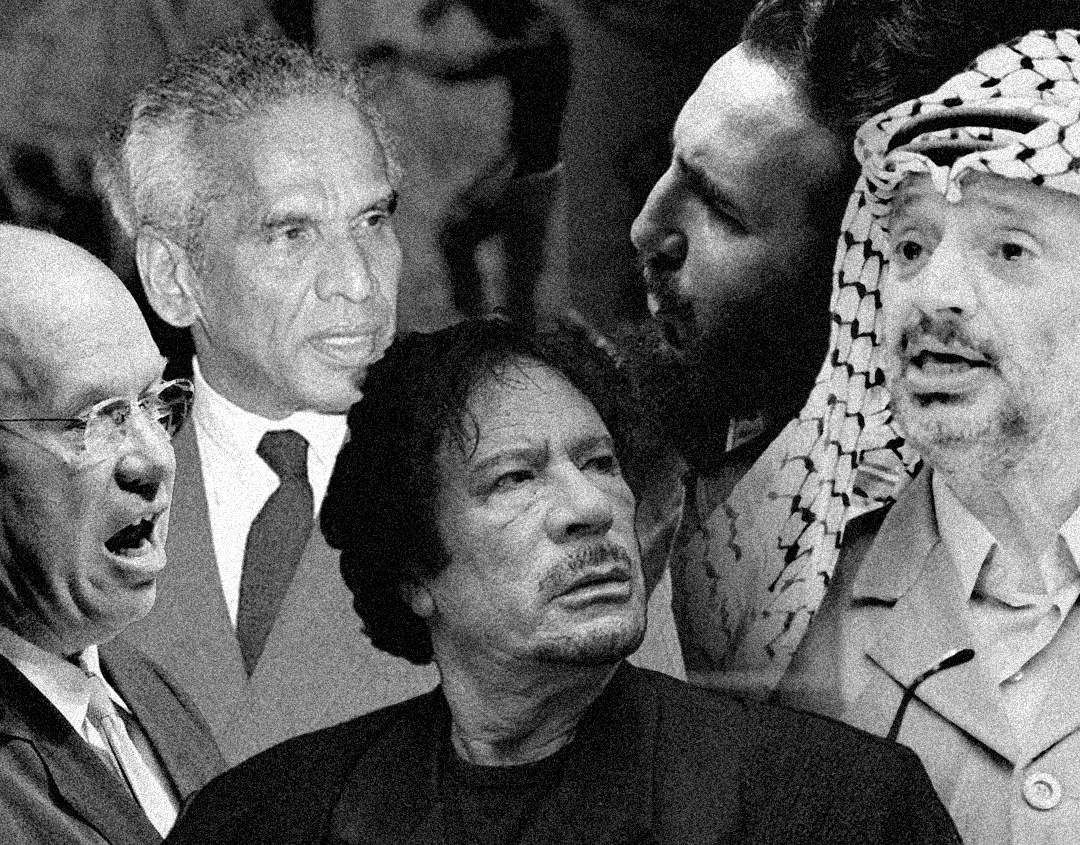
From Khrushchev’s shoe to Arafat’s gun, some of the UN’s most memorable moments remain suspended between history, exaggeration and folklore. But how much of that history is true?
What do we remember from more than 80 years of UN General Assembly gatherings?
If we’re New Yorkers, it may be the gridlock spreading across Midtown Manhattan as hundreds of motorcades descend on the East Side. If we’re visitors, it’s the extra security provided and the lavish leaders’ receptions. Those budgets, thought to be in the millions of dollars, are a closely guarded secret. If we’re journalists, historians, or commentators, it’s the blurring of entertainment and diplomacy—at once nodding towards peace and reconciliation, always with a fear of setbacks.
It’s that tension that we remember most, often heightened by rumors around encounters spread by the media, too often before all facts are known. Were they even facts at all? History, then, becomes mythology, a mixing of fact and fiction into a kind of folklore.
We wonder: Did that really happen? The legends endure not simply because they are entertaining, but because they reduce complicated diplomatic moments to memorable images: a shoe, a gun, a hotel room, a torn Charter. In the process, they can obscure what actually happened—and what those moments meant.
As world leaders prepare to return to New York for another General Assembly, they will enter an institution surrounded by its own mythology.
Here are some examples:
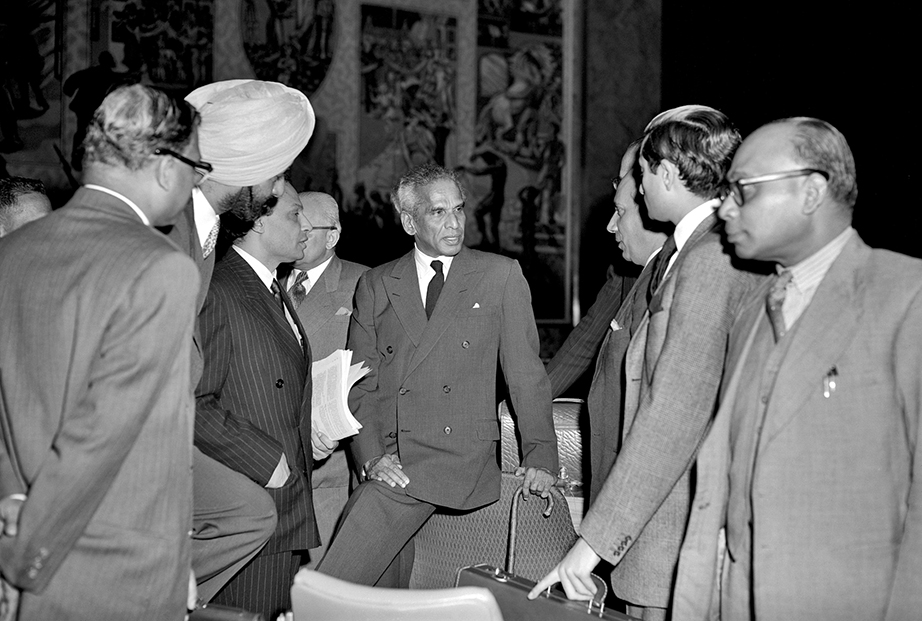
1957 – Was V.K. Krishna Menon’s speech the longest in UN history?
His eloquence was already admired among the UN’s seasoned diplomats, as was his stamina. The London School of Economics graduate assumed command of India’s UN delegation in 1949, a position he held until 1962, while simultaneously leading India’s mission to the United Kingdom. Over a storied career, Menon helped engineer solutions to complex issues, from the 1956 Suez Crisis to the ceasefire in Indo-China to France’s temporary withdrawal from the UN over Algeria.
In January 1957, Menon delivered an epic speech defending India’s stand on Kashmir, a northern province in a territorial dispute with Pakistan.
Covering five hours on January 23rd, and almost three more on the 24th, the filibuster ended that first day with the speaker’s collapse onto the floor. That evening, Menon was hospitalized. Yet he returned in elegant style the following day, mesmerizing his audience by invoking India’s demand that a plebiscite be offered to Kashmir’s inhabitants, while reaching out to Pakistan for its cooperation.
“Our two countries had only just passed through the holocaust of fratricide,” he intoned, recalling India’s bloody partition the previous decade. “Indian people killing Pakistanis, and Pakistanis killing Indians. We had witnessed an orgy of violence … Nothing should be done to rekindle these embers …”
While surely the longest single speech ever delivered at the UN, Menon’s effort came before the UN’s Security Council, not the annual UNGA. It’s been memorialized in books and archives and can be viewed in segments online.
For the record, the longest UNGA speech on record belongs to Cuba’s Prime Minister Fidel Castro, who held the podium for 4 hours and 26 minutes in September 1960.
That same session, at least three more leaders exceeded the customary 15-minute limit, each speaking for more than two hours: Guinea’s President Ahmed Sékou Touré, the USSR’s Premier Nikita Sergeyevich Krushchev, and Indonesia’s President Sukarno.
Fidel made his mark in other ways during the UNGA that year (see below) and spoke globally—often at extraordinary length—until retiring from office some fifty years later. He died in 2016.
1960 – A shout or a shoe or both? And at whom did the Soviet leader direct his ire?
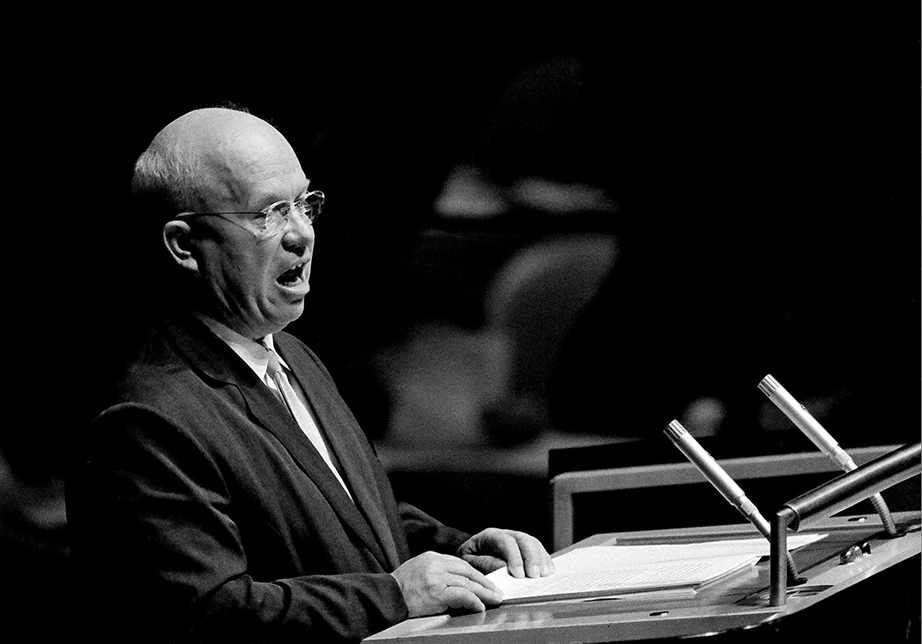
N.S. Khrushchev, then Chairman of the Council of Ministers of the USSR, addressing the General Assembly on September 23, 1960 Photo Credit: UN Photo/Yutaka Nagata
On October 12, 1960, Khrushchev, first secretary of the Communist Party of the Soviet Union, was alleged to have pounded his shoe on his delegate’s desk during a speech by Senator Lorenzo Sumulong of the Philippines.
Although many reported witnessing the incident, there is no mention of it in any UNGA account. Moreover, images never appeared in any news footage shot that day.
Hence, a debate. And history turned into mystery.
It started, allegedly, when the Filipino delegate claimed “the peoples of Eastern Europe and elsewhere have been deprived of the free exercise of their civil and political rights, and have been swallowed up, so to speak, by the Soviet Union.”
Khrushchev, in the audience, rushed to the podium and rather brusquely pushed the speaker aside. He then denounced the Filipino diplomat as “a jerk, a stooge, and a lackey,” and as a “toady of American imperialism.”
Khrushchev was ordered back to his seat and was later seen pounding his fists on his desk as Sumulong’s speech resumed. Some delegates also remembered seeing him banging his shoe with rage.
But others saw things differently: Khrushchev first banged his shoe, then mounted the rostrum in protest before chaos ensued. Major media reported these events, but as to when (or whether) a shoe was deployed remained unclear.
Later historians debated whether Khrushchev used his shoe to interrupt the Filipino diplomat or to protest the recent coup d’etat in the Congo, Belgium’s former colony, a few days earlier. Adding to the confusion, Khrushchev’s own memoirs recount a different version of events. Rather than interrupting a Filipino or Belgian delegate, he claimed to have banged his shoe to taunt the representative of Franco’s Spain.
Two supposedly doctored photographs showed the Soviet leader with an upraised shoe either airbrushed out or deceptively inserted.
Certainly, one image was faked. But which one?
Many years later, history remains unsettled, especially after the Soviet chief’s great-granddaughter, Nina L. Khrushcheva, weighed in with her own family memories. She told a British publication in 2000 that her ancestor simply had on new shoes that were tight, so he removed them.
While pounding his desk in protest, she explained, Khrushchev’s watch fell off, and as he bent down to retrieve it, he grabbed one of his shoes to amplify his harangue. Khrushchev’s interpreter agreed, partially. Viktor Sukhodrev reported his boss hit his desk so vigorously that his watch stopped, which made him angrier still. So, he switched to his shoe.
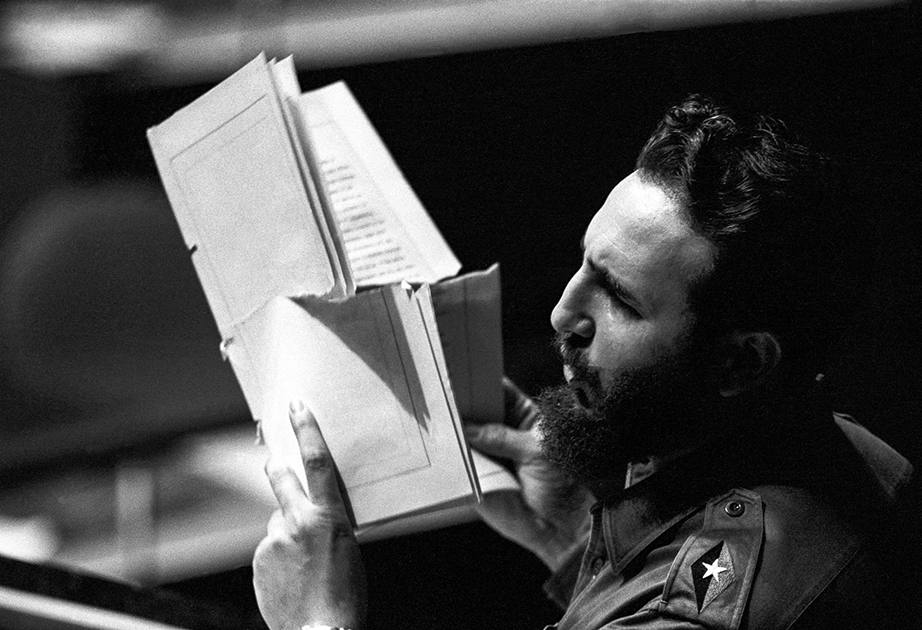
1960 – A hefty hotel bill, chicken feathers, and a sudden exodus to Harlem.
A slightly less controversial legend of that same 1960 UNGA involved one of Khrushchev’s revolutionary protégés, Cuba’s Castro, already regarded as the United States’ principal adversary in Latin America.
During his record-length speech to the UNGA, Castro complained of the scorn his team received. “Do we, the representatives of the Cuban delegation, deserve the maltreatment we have received?” he demanded. “And why our delegation? Cuba has sent many delegations to the United Nations, and yet it was we who were singled out for such exceptional measures: confinement to the Island of Manhattan, notice to all hotels not to rent rooms to us, hostility, and, under the pretense of security, isolation.”
Castro complained the delegation was evicted from one Manhattan hotel, The Shelburne, while threatened with “extortion” by another. He was apparently referring to a demand for advance payment of approximately $10,000, a substantial sum in 1960, as a bond against damages before Cubans were allowed to check in.
Claiming his team’s revolutionary experience in Cuba’s mountains hardened them against physical discomfort, Castro said he was ready to pitch tents in Central Park. Instead, he decided to occupy forty rooms in Harlem’s Hotel Theresa, where he gave a press conference to Black media and welcomed another revolutionary leader, Malcolm X, to his suite.
For its part, The New York Times reported that the US government had offered free hotel rooms nearby at The Commodore, but Fidel spurned the offer. The New York Daily News noted: “Back at The Shelburne, hotel officials complained of trashed rooms. Chambermaids gave accounts of the Cuban delegation cooking steaks and chickens in their suites, leaving behind moldy meat, chicken bones, and feathers.”
The chicken feathers added to Fidel’s New York mystique, referenced by newspaper columnists and late-night comedians for decades thereafter. Castro would return to the UNGA at least twice more—in 1974 and 1979, when he championed other revolutions, especially in Africa.
It would be unwise to suggest that Fidel’s commitment to Black liberation stemmed from his encounter with Malcolm X. As a Caribbean nation with deep historical ties to the transatlantic slave trade, Cuba has a population with substantial African ancestry.
Whether the hotel truly demanded a $10,000 security deposit, or whether chambermaids actually found chicken and beef leftovers in any of those hotel rooms, remains somewhat speculative.
The record-breaking speech, however, was well documented.
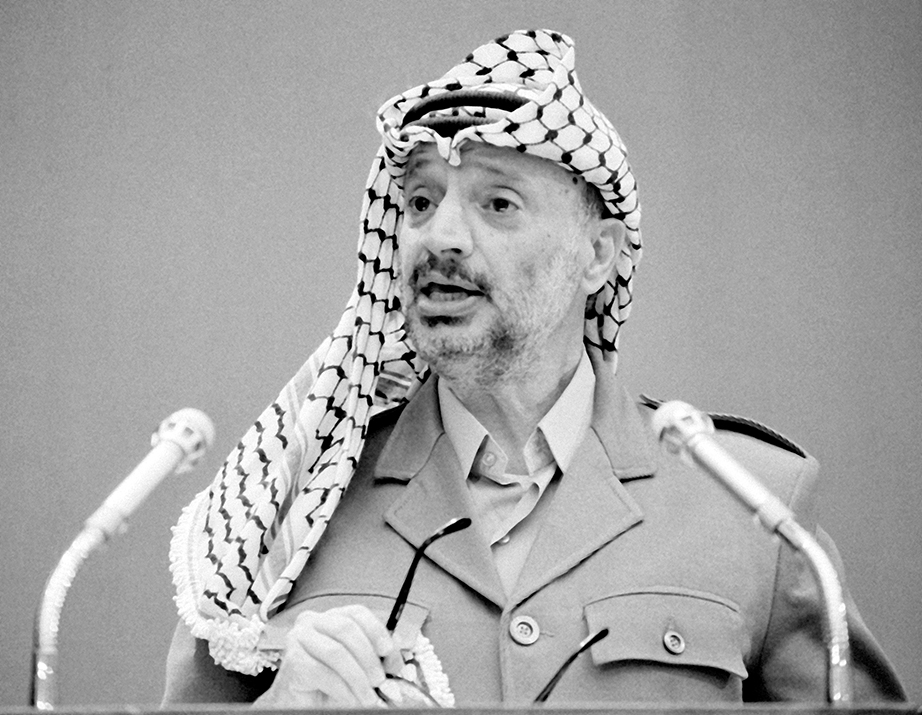
1974 – Was that a handgun in the speaker’s belt … or simply a metaphor?
Yasser Arafat, chairman of the Palestine Liberation Organization (PLO), gave an address to the UN General Assembly on November 13, 1976 that marked a turning point in Middle East diplomacy. He spoke from a platform usually reserved for heads of state. Arafat was head of no state, but as an activist for a people living almost entirely in exile. He was a rebel, dressed in his familiar keffiyeh and wearing a khaki uniform. The invitation was historic, and so were the efforts to deliver him to his rendezvous. Arafat arrived at five o’clock on the morning of his speech, transported by a US military helicopter to the UN building in Manhattan. Police snipers were stationed on the roof of the Waldorf Astoria hotel, where the PLO delegation occupied three floors. Bomb disposal trucks were on standby nearby.
Where history meets mythology has to do with two things: what he said, and how he chose to say it. “Today, I have come bearing an olive branch and a freedom fighter’s gun,” he said, repeating three times a line attributed to the Palestinian poet Mahmoud Darwish. “Do not let the olive branch fall from my hand.”
The olive branch was rhetorical. The gun was not. At the conclusion of his speech, Arafat raised his arms in triumph, lifting his uniform tunic above his waistline and exposing what appeared to be a pistol in a holster on his right hip. The image of a weapon made headlines worldwide the following day. The gesture seemed to confirm what many feared: that the threat of gunfire lurked behind empty words of peace.
More than 50 years later, the uncertainty persists. Arafat would insist he left his pistol behind, though reluctantly, when he mounted the podium. However, at least one member of his entourage may have inadvertently confirmed to a newsman that, yes, what he saw was indeed a weapon. A misunderstanding due to a language barrier? Or a moment of candor? To this day, historians are divided.
In December 1988, Arafat delivered an address to the 43rd session of the UNGA in Geneva, coming on the heels of the Palestinian National Council proclaiming the previous month it was renouncing terrorism to seek a negotiated peace. Arafat requested the UN session be moved from New York to Geneva, after an American visa refusal blocked his travel to New York
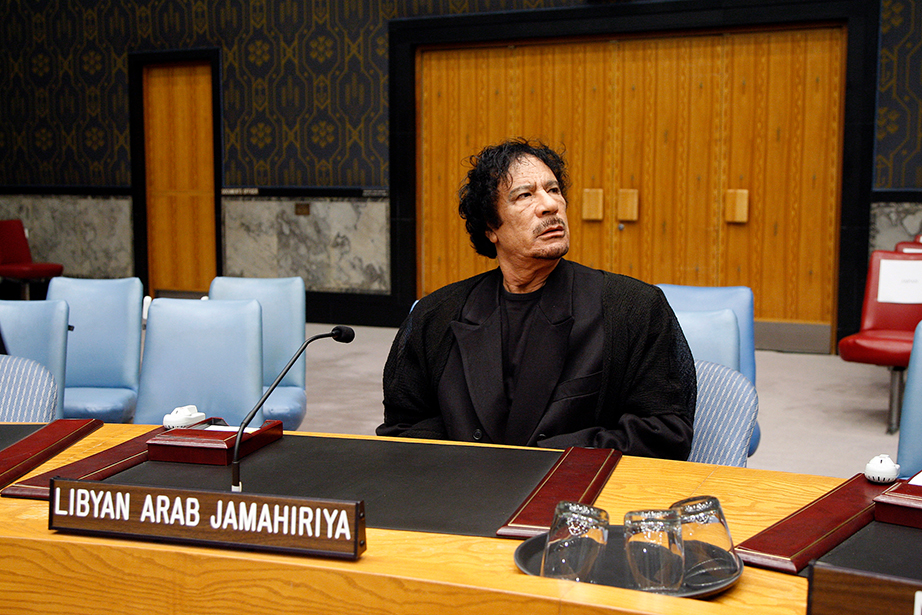
2009 – Libyan leader Muammar Gaddafi rips the UN Charter and orders $7.7 trillion in African reparations
Here’s how a British journalist remembers that day: “… a short man, swathed in saffron robes and a black felt hat waving his arms around and shouting: ‘Terrorism!’
Muammar Gaddafi—for it was he—grabbed his 15 minutes of fame at the UN building in New York today and ran with it. He ran with it so hard he stretched it to an hour and 40 minutes.”
The report continued: “He tore up a copy of the UN Charter in front of startled delegates, accused the Security Council of being [a] terrorist body, called for George Bush and Tony Blair to be put on trial for the Iraq war, [and] demanded $7.7 trillion in compensation for the ravages of colonialism on Africa.”
All in all, he concluded, it was “a pretty ordinary 100 minutes in the life of the colonel.”
It was Gaddafi’s first UNGA speech, following the well-received US Head of State Barack Obama, also making his first UNGA appearance as a newly elected president. It was also Gaddafi’s last appearance at the UNGA. Two years later, during an insurrection in Libya, Gaddafi was captured by a mob and executed.
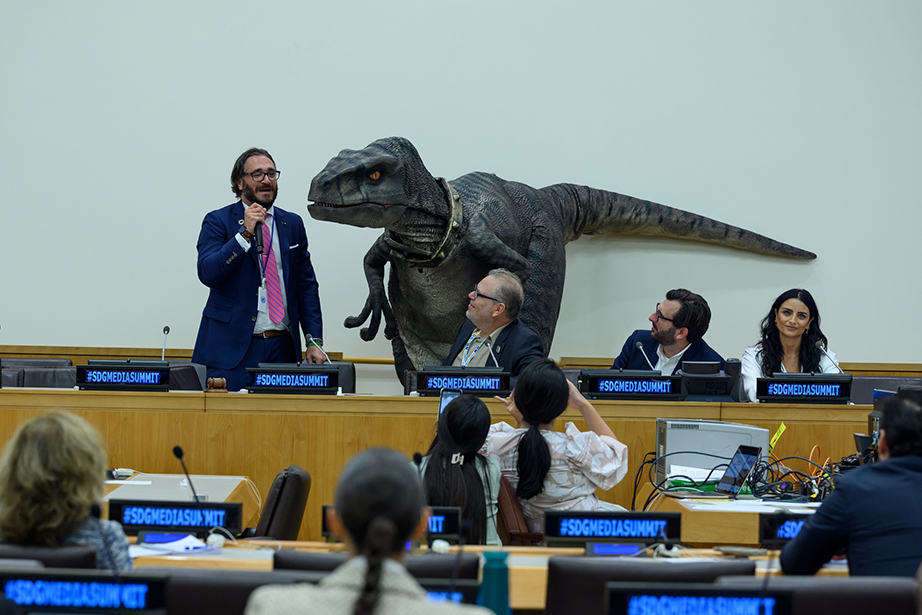
2021 – Frankie the Dinosaur delivers a warning
Using computer-generated imagery, the UN Development Programme (UNDP) unleashed an animated speaker at the 2021 UNGA: an ersatz Utahraptor Rex named “Frankie.”
He admonished diplomats from some 200 states to steer Earth away from its path towards global warming and, Frankie insisted, humankind’s extinction. “At least we had an asteroid,” the Jurassic speaker taunted. “What’s your excuse?”
The UNDP released research showing the world spends $423 billion annually “just to subsidize fossil fuels,” adding that would be enough “to cover a COVID-19 vaccination for every person in the world or three times the annual amount needed to eradicate global extreme poverty.”
The animated speaker agreed.
“Think of all the other things you could do with that money,” Frankie concluded. “Around the world, people are living in poverty. Don’t you think that helping them would make more sense than … paying for the demise of your entire species?”
When leaders return to the General Assembly this September, nearly every gesture will be filmed, edited, and circulated within seconds. That may make future legends easier to investigate, but not necessarily easier to prevent. The UN’s mythology has never depended solely on what happened. It depends on which image survives—and which version of the story the world chooses to remember.
About The Author