The EU’s landmark refugee reform promises fairness and solidarity. At the borders, lawyers and rights monitors see something else entirely.
In March 2025, a woman arrived at the Closed Controlled Access Centre (CCAC) on the Greek island of Samos. She had survived human trafficking and sexual violence. Upon arrival, she was placed in a quarantine zone—a fenced area of containers near the entrance of the camp. She was held there alongside 20 other people, with no running water. The toilets, she later told researchers documenting conditions at the camp for I Have Rights and the Border Violence Monitoring Network, were “very disgusting.”
Emma Musty, project coordinator at I Have Rights, told Envoy in a video call that she described the same scene playing out again and again. “People were sleeping on the floor,” she said. “There were no beds, no mattresses. Pregnant people were sleeping on the floor. There were not enough toilets, there was no shower. You arrived in wet clothes, and you stayed in those clothes.” The nearest town—where lawyers and NGOs are based—is seven kilometers away. The bus cost one euro and 90 cents each way. There is currently no cash assistance available to asylum seekers in Greece. “Not everybody can afford the bus,” Musty said. I Have Rights did not mince words about what the facility represents. “We describe it as prison-like,” Musty said, “because that’s how it’s designed.”

The Samos CCAC opened in September 2021, equipped with air conditioning and inaugurated by European Commission President Ursula von der Leyen—designed as the blueprint for the new European asylum system, a clean break from the squalor of Moria, the camp on the island of Lesvos that burned to the ground in 2020. For critics, Samos is the model. In June, that model is set to become law across the European Union.
For nearly a decade, the European Union struggled to agree on a common approach to asylum. The result—the New Pact on Migration and Asylum, formally known as the Common European Asylum System, or CEAS—was adopted in April 2024. All EU member states are required to implement it by June 2026. It standardizes asylum procedures across the bloc, introduces mandatory screening at external borders, and establishes a solidarity mechanism allowing up to 30,000 people per year to be relocated between member states. The limits of enforcement are already visible: in June 2024, the European Court of Justice fined Hungary 200 million euros for violating EU asylum law. By mid-2025, total penalties had exceeded 500 million euros, with Budapest showing no signs of compliance.
The reception at the UN level was warm. Filippo Grandi, then UN high commissioner for refugees, called the agreement “a very positive step.” But at a joint EU-UNHCR event in Brussels in January 2026, the agency described the coming months as “critical to ensure fair and consistent implementation that safeguards access to asylum for those in need,” urging EU presidencies to champion principled implementation. With the June deadline now approaching, that test is about to begin.
What that test looks like in practice is already visible on Samos—and what happens there may soon define the asylum experience across the continent.
Fabiane Baxewanos, a legal officer at UNHCR, the UN Refugee Agency, tracked the reform from the European Commission’s first proposals in 2016, she told Envoy in a video call. For UNHCR, it contains genuine progress—chief among them the concept of front-loading: gathering critical information about arriving asylum seekers within the first seven days, before a formal procedure begins. Baxewanos also welcomed expanded legal aid provisions and independent monitoring bodies at EU borders.
But she was careful to separate the text of the law from its implementation. On detention, she was unequivocal. “Automatic detention of everyone that arrives at your border is never in line with international law,” Baxewanos said. “But this is not what the reform says“, she added. The problem, she acknowledged, was that some member states appeared to interpret border procedures as synonymous with detention—which they are not.
The reform’s introduction of the so-called “fiction of non-entry”—the legal concept that a person physically present at a border has not yet legally entered EU territory—raised similar concerns. In theory, Baxewanos explained, this did not create a rights vacuum: “The rights that apply, the human rights guarantees, remain the same.” In practice, however, the concept created a legal basis for detention. “The big difference is that deciding on a person’s right to enter is a detention ground,” she said. “So, while the concept does not, in theory, create legal black holes — it does create a legal situation where member states would be able, under certain conditions, to detain people.” On Samos, that legal situation is already a physical reality.
On safe third-country rules, she drew a firm line. “If member states try to fully divest themselves of any responsibility by entering into agreements with third countries on another continent, this would be externalization — and not in line with international law,” she said. Ultimately, she framed the reform’s outcome as a question of political will. “The reform as such can be interpreted in a human rights and protection-oriented way,” Baxewanos said, “but ensuring this is now the big challenge.”
Frontex, the EU’s border and coast guard agency, was at the operational center of that implementation. The agency said in a written statement to Envoy that it did not decide who could enter the EU—those decisions remained with member states. In October 2025, it completed a two-week pilot in Lampedusa to test its new Screening Toolbox—rehearsing identity verification, health checks, and biometric registration that will be mandatory for all irregular arrivals from June 2026.
Rights organizations monitoring EU borders documented systematic pushbacks and violence at external borders, including on the Greek islands—among them Samos—and in Bulgaria. Frontex did not dismiss those allegations. “These are serious allegations, and we do not dismiss them,” the agency said. “We believe that protecting borders and protecting people’s dignity are not competing objectives. Engagement is how you raise standards.”

Not everyone was convinced.
Pauline Fritz has spent years analyzing testimonies from people who have survived what European law formally prohibits: pushbacks, police violence, and arbitrary detention at EU borders, she told Envoy in a video call. As research and advocacy coordinator at the Border Violence Monitoring Network—a coalition of more than a dozen groups across Europe that maintains one of the largest databases of pushback testimonies on the continent, supports cases before the European Court of Human Rights, and feeds evidence into EU policy processes—she said their goal was straightforward: to hold states accountable for violations of international law.
She watched the CEAS reform with deep skepticism. “The compromises that were made completely bypass the people the asylum system was actually created for,” she said. At the heart of her concern was a deliberate structural shift—processing people at the border itself, in facilities like the one on Samos. “This whole narrative of the asylum procedure functioning properly is based on the fact that half the people never even arrive,” Fritz said. “Because half are already intercepted at the border. And because the borders are increasingly closed, the camps will be less overcrowded. Of course — because people are pushed back or dying at the border.”
On legal aid, Fritz pointed to North Macedonia, where screening interviews were conducted by staff affiliated with border enforcement agencies, a structure she argued created an inherent conflict of interest. What authorities increasingly described as “voluntary returns,” BVMN documented as forced deportations. “If the agency responsible for protecting the borders is also the one providing legal aid,” she said, “that’s the wrong structure.” She reserved particular alarm for the use of AI in screening—including pilots that used AI to determine whether an arriving person is a minor. “Whether a person is vulnerable or not is something that should be decided from human to human, not by AI,” Fritz said.
In Athens, the view from the courtroom is grimmer still. Minos Mouzourakis, a lawyer at Refugee Support Aegean, spent years entering camps—including on Samos—filing cases before domestic and European courts, and watching the Greek asylum system fail up close, he told Envoy in a video call. For Mouzourakis, the CEAS reform did not represent a break from the past so much as a formalization of it. “There was already a broad, expansive set of different standards,” he said, “that are now being tweaked and changed quite dramatically for the worse.” Greece, he argued, had long functioned as a testing ground for the very measures the reform enshrined across the EU. “Greece has been the laboratory,” he said.
His sharpest concern was the fiction of non-entry—the legal concept that a person physically present on EU territory is legally deemed not to have entered. On Samos, he noted, that fiction was already being applied in practice. “We expect this to mean more confinement, more detention, and more inhumane treatment,” he said. Under the new rules, member states could also designate a country as safe even if the applicant had never set foot there.
A concept with troubling precedent. The UK’s attempt to declare Rwanda a safe third country was struck down by its own Supreme Court in 2023 as unlawful; Italy’s deal to transfer asylum seekers to detention centers in Albania collapsed repeatedly in 2024 and 2025 after Italian and European courts ruled the designated safe countries did not meet legal standards. In April 2024, UNHCR and the UN high commissioner for human rights warned jointly that such arrangements seek to “shift responsibility for refugee protection” and set “a worrying global precedent.”
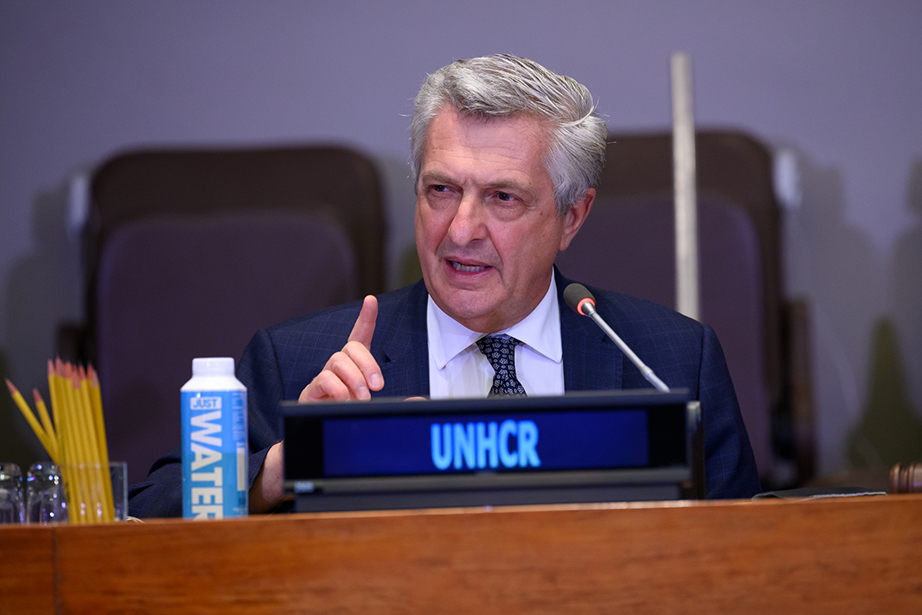
Credit: UN Photo/Loey Felipe
Under the new CEAS rules, arrangements of this kind could become standard practice across the EU. “If Greece or Germany decide tomorrow that Sri Lanka is a safe third country for an Afghan refugee,” Mouzourakis said, “they would be within their rights under the Pact to do so.”
Mouzourakis also flagged the implicit withdrawal clause: if an asylum seeker misses an appointment or fails to renew documentation, their case could be dismissed with no opportunity to reopen it—and an immediate deportation order attached. Under the new Pact, return decisions would now be issued automatically alongside negative asylum decisions. “You have a refugee from Sudan,” he said. “They don’t renew their asylum seeker card on the day it expires. Case denied.” He also described lawyers catching case decisions containing footnotes linking to ChatGPT. “A few case workers have even left these footnotes there,” he said. “They haven’t even bothered to fix it.” RSA repeatedly requested formal consultation with Greece’s migration ministry on the implementation plan. Every request was ignored. Greece is one of the only EU member states that has not published its implementation plan—and when access was formally requested, the government denied it, citing public security grounds. “I struggle to see what would be confidential about that plan,” Mouzourakis said.
While governments remain opaque, civil society is already preparing. Across Germany, around 1,500 legal advisers working for organizations including Pro Asyl and Amnesty International began training for the reform’s implementation, and a new telephone hotline was established to help asylum seekers navigate the new rules.
The woman who arrived in Samos in March 2025 did not know she was living inside a blueprint. She knew only the container, the floor, the broken toilets, and the uncertainty of what would come next. What she experienced may soon become the norm—not just on a Greek island, but at every external border of the European Union.
The reform arrives at a moment of profound institutional strain. In October 2025, Filippo Grandi warned that UNHCR projected ending the year with roughly 25% less funding than 2024—the lowest level since 2015, when the number of forcibly displaced people was half of what it is today. The agency that is supposed to monitor, advise, and support the very system now being rolled out across Europe is doing so with fewer staff, fewer resources, and fewer offices than at any point in a decade. What happens at Europe’s borders after the June deadline will not only test the reform—it will test whether the institutions built to protect the world’s most vulnerable people can still do their job.
About The Author