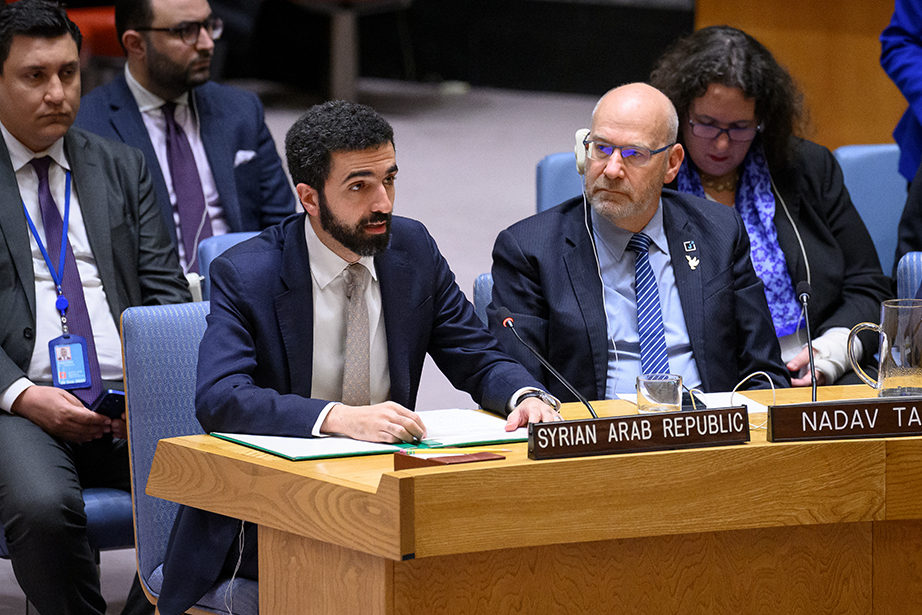
From a legal activist to the Security Council Chamber, the young ambassador now carries Syria’s bid to turn revolution into a diplomatic renewal.
At 32, Syria’s new Ambassador to the United Nations, Ibrahim Olabi, speaks with the gravity of someone shaped by upheaval. “The war made us really age,” he told Envoy in an exclusive interview on March 3. “The things that I’ve seen in these 32 years or in the last 10 years in terms of death, destruction, betrayal from the international community, the speed of things, the fact that I’m here, the learning curve, we had to age really quickly. There was no other choice.”
Ambassador Olabi was born to a Syrian father and an Egyptian mother who met in Germany. Raised in Saudi Arabia, his family was active in the coffee and the construction industries. He initially pursued law, he said, for commercial reasons and undertook internships to help the family business. However, the Syrian revolution of 2011 altered that trajectory. “The year the uprising started was 2011 and that was the year also I finished my school” he said.
He earned a bachelor’s and a master’s degree in security and international law from the University of Manchester, where he was named both Undergraduate and Postgraduate Student of the Year, before going on to complete a Master of Public Policy at the University of Oxford. While at Oxford, Olabi turned his attention to international human rights law, international criminal law, and public policy. Equipped with “a passport that allowed me to travel and languages that I could speak,” he said he began “smuggling [myself] from Turkey to Syria to work as a fixer for journalists.” He describes moving between worlds. He would spend “one week in Syria then get back to my modules in Manchester.”
His interest in law came even before his official studies. When he was 19, he founded the Syrian Legal Development Program, an NGO advocating for compliance with international law compliance, capacity building and training. He later completed an LL.M., became a lawyer to acquire, he said, the “skill sets in terms of courtroom advocacy and greater credibility at the international scene.”He added that he was in the country when the chemical attacks took place and in “different parts of Aleppo before the siege.”Witnessing the ongoing horrors of the war, he said, is what forged his commitment to the field.
“I witnessed firsthand what was happening and I saw it’s my role to come into New York, Geneva, The Hague to go to parliaments and to speak and to advocate on those things,” he said.
Although he engaged with diplomats from around the world for more than a decade, “never did I ever think I’ll become the ambassador of Syria at any point in time,” he said. The decisive moment came unexpectedly. Olabi was in Doha when the Assad regime fell. With no established connections to the new leadership, he began texting the numbers that the new leadership had made public for consular support and went door knocking on the foreign ministry to introduce himself. Olabi had a straightforward message: “this is what I can do, this is what I can help.”
A few weeks later, he met the new Foreign Minister, and he initially volunteered as a legal adviser and later formally became the minister’s legal advisor for seven months, working on issues such as sanctions, chemical weapons cooperation, and international justice mechanisms. He then received an unexpected proposal: “would you become the Permanent Representative in New York?” For Olabi, saying yes meant embracing uncertainty. “There was a lot of unknowns and it’s a big leap of faith to close our life in London but we did and I said yes”.
Olabi said he sees his role as a collective one. “This is a new era where this seat now represents the people who struggled so much. I see my role as bringing Syria to the world, and the other way around.” His path from student activist to ambassador was unplanned, driven by principle rather than ambition. As he told his wife that night, his nomination came as a “plot twist”. He spoke to Envoy about Syria’s new era, its foreign policy goals and the internal situation. His remarks were edited and condensed for clarity.
Syria’s transitional government: Unity, sovereignty, and a new regional equation
What is the government’s view on this significant agreement with the SDF?
The recent agreement with the Syrian Democratic Forces (SDF) represents not a political victory for one side over another. It is a success story for all Syrians. From the country’s liberation, the government has framed its approach as rooted in diplomacy and engagement rather than zero-sum confrontation.
The March meeting in Damascus between the government and SDF Commander General Mazloum Abdi was a historic agreement. Even during periods of limited military operations, the doors to diplomacy were constantly open. The accord is a proof of a long-standing commitment to dialogue and national cohesion. We all want a united, strong, prosperous Syria that respects all its components emphasizing that implementation has already begun. Security forces have deployed to designated areas, coordination meetings are underway, and things seem to be running smoothly.
If obstacles arise, we maintain that resolution mechanisms will remain strictly domestic. We do not see this as an internationalized matter. This is a Syrian matter underscoring confidence in dialogue as the primary instrument for dispute settlement. Although the United States and other countries facilitated discussions, we believe that current conditions reduce the likelihood of major impediments.
Diversity as strength, not vulnerability
Questions persist internationally about the protection of ethnic and religious communities, including Syria’s Greek-Orthodox population and the Patriarchate of Antioch. Can Damascus guarantee the full rights of the Greek-Orthodox communities, including property restitution and freedom of worship?
We don’t use the premise minorities. All are Syrians who deserve equal rights and protection. The communities themselves resisted such labels, stating that they do not need our protection. They see themselves as Syrians. The government’s position is that all Syrians deserve protection regardless of their background before the eyes of the law.
To signal inclusivity, the leadership points to ministerial appointments that reflect Syria’s social mosaic. We don’t categorize individuals primarily by sect or ethnicity, there is representation at the highest levels from Muslims, Christians, Alawites, Druze, and Kurds. Kurds were integrated into security services even prior to the SDF agreement, and Alawites have joined security institutions in various regions. Christmas celebrations were publicly supported, with government officials attending church services and participating in festivities. During a recent visit by Security Council members to Damascus, religious leaders from across denominations were included. Diversity is a form of strength, not a cause for concern. Syrian jews, once exiled from Syria under the former regime, are also now returning to their century old synagogues in Damascus and Aleppo.
The government also emphasizes accountability. Following unrest on the Syrian coast, Damascus invited the UN Commission of Inquiry to investigate, something that was unprecedented in the history of Commission. The resulting report concluded that individual acts, were not a government policy. In a separate case cited from Germany, a court reportedly ruled that there is no persecution of Alawites in Syria. These examples are presented as external validation of the government’s efforts. Trials in Syria have begun for those events. The former regime weaponized sectarianism to its advantage to stay in power. Rebuilding trust, therefore, is both necessary and fraught, but one the leadership is prepared to undertake in words, actions, steps, and responsibility.
Recalibrating relations with Europe
How does Damascus evaluate its relations with Europe?
Damascus views relations with Europe as strategically important and seeks a relationship that is in the interests of both parties in an equal way. We remember the European opposition to the Assad regime very positively, and we proceed to a new page in bilateral relations. The government highlights its openness and engagement, expressing hope that the European Union will reciprocate in ways that benefit both European interests and Syrian reconstruction”
Political transition and Resolution 2254
What concrete steps does Damascus plan ahead for an inclusive political transition in line with Security Council resolution 2254, particularly regarding constitutional reform and nationwide elections?
The government adopted a nuanced stance toward UN Security Council resolution 2254. Parts of the resolution have been overtaken by events, but elements concerning constitutional reform and elections remain relevant. We intend to act in harmony with the resolution. We published a five-year transition plan that has the constitutional declaration, the parliamentary elections, which we just held and hopefully we are going to hold now in the new areas in the northeast of Syria. Then you have the constitutional committee, then you have elections, and so on. But we made sure that there is no political vacuum, and that is why we announced the plan, and everything was done orderly, in a way, so that we uphold the institutions and uphold the rule of law, and that is the key thing for the Syria that we would like to build.
Israel, UNDOF, and the Golan Heights
Are there any developments on the security talks with Israel? What message would you be conveying to Israel?
We reiterate our adherence to the 1974 Disengagement Agreement, endorsed by the Security Council and monitored by the UN Disengagement Observer Force (UNDOF). Following the fall of the former regime, Israel moved into certain UNDOF areas, citing security concerns. Damascus contests the temporary nature of this presence. It does not look temporary. We recently visited the area with UN Under-Secretary-General for Peacekeeping Operations Jean-Pierre Lacroix. Syria’s position is that Israel must respect the 1974 agreement. While the United States has mediated talks, our engagement does not entail relinquishing claims to the Golan Heights. There is a recent UN resolution supporting Syria’s position received 123 votes. Security concerns for both sides we can address, but land grab we cannot.
Al-Hol Camp and the legacy of fragmentation
What is the situation in Al-Hawl camp? UN experts warn that Al-Hawl is becoming an incubator for extremism.
“Al-Hol camp is a part of a broader legacy the new Government has inherited, consisting of sanctions, economic collapse, displaced populations, and territorial fragmentation. Now, Damascus has taken full responsibility and is engaging with relevant governments to ensure they assume their obligations. Cooperation with UNHCR aims to improve services, and we acknowledge the camp’s grim conditions. It is an open-air prison. Our objective is a solution that is secure, just, and humane.
Resetting a strategic diplomatic relationship
How would you reset a strategic diplomatic relationship with major powers the Arab world and the Gulf states?
Syria has already engaged with all parts of the world. With historic trips to the White House and the Kremlin, we have stated that we want to have balanced diplomacy. Simultaneously, we are reasserting our Arab identity. President al-Sharaa’s first official visit was to Saudi Arabia, signalling reintegration into the Arab fold. The broader objective is balanced engagement with all neighbours -European states, regional partners, the United States, Russia, and Türkiye- in a way that is respectful and not mutually exclusive. That includes the UN too, where Syria is able to make decisions in the national interest of Syrians back home, and get involved in international initiatives that is informed by the harsh Syrian experience. We want to turn how the world sees us: From survivors to leaders.
About The Author