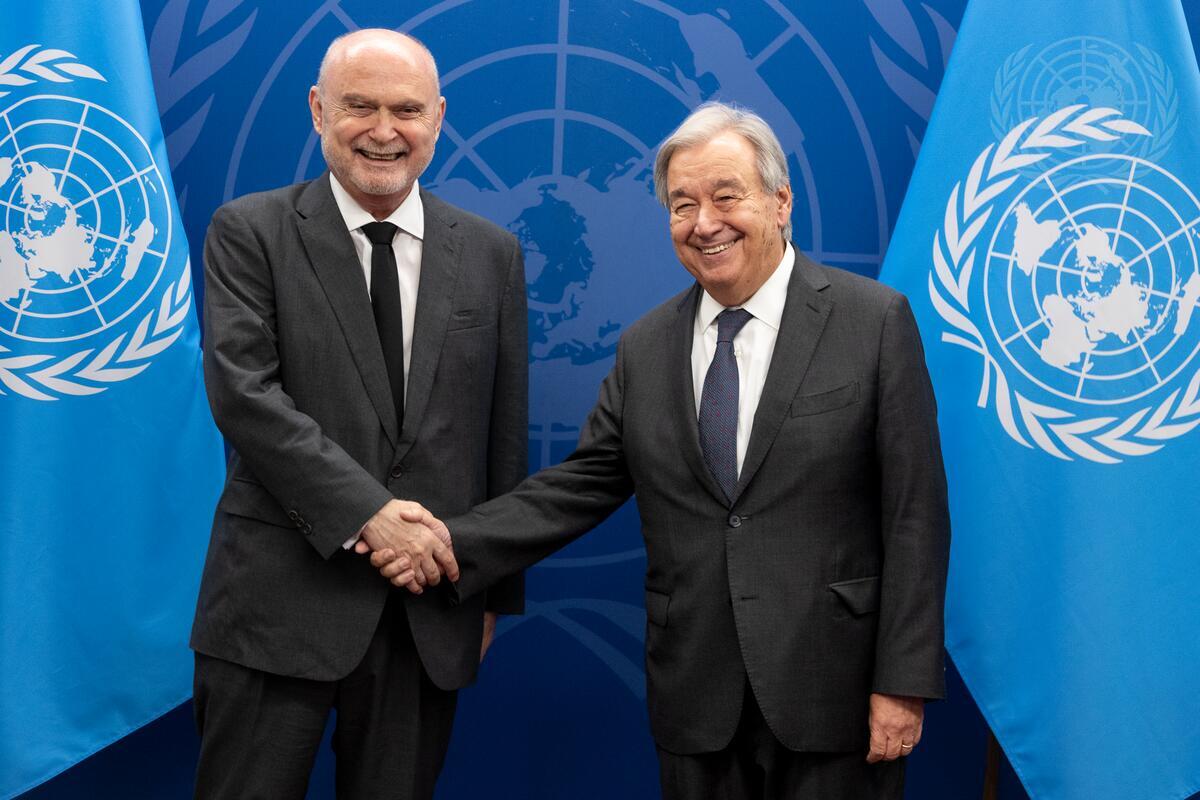
Türkiye officially enters the race to lead the UN as the Security Council struggles to rally behind a frontrunner. Can veteran diplomat Feridun Sinirlioğlu leverage Ankara’s ties to Washington and Moscow to overcome resistance to another male candidate from outside Latin America?
Following weeks of speculation, Türkiye has Officially Nominated Feridun Sinirlioğlu for UN secretary-general, the country’s ambassador to the UN told Envoy Magazine on Friday.
“Today, I submitted the nomination of Ambassador Feridun Sinirlioğlu to the United Nations secretary-general position by a letter from President Erdogan”, Ahmet Yıldız, Türkiye’s permanent representative to the UN, told Envoy.
Sinirlioğlu’s nomination comes as the Security Council appears to struggle to unite around a single candidate, and late entrant Lana Nusseibeh only received seven votes in favor and six votes discouraging her candidacy.
According to Yıldız, Ankara was waiting for the result of the latest round of informal voting to formalize the diplomat’s nomination. After the seventh round of voting, Rebeca Grynspan of Costa Rica remains the frontrunner of the race, but still faces four “discourage” votes.
Sinirlioğlu’s will likely face strong opposition from Latin America and advocacy groups, as his candidacy goes against the informal regional rotation and widespread support for a woman to lead the organization.
“Since none of the candidates from Latin America and the Caribbean until now got the required majority in color-coded votes, and taking into account today’s non-colored straw poll, and taking into account that some other nominees [are] entering into the race from out of Latin America and the Caribbean, the Turkish government decided to nominate Ambassador Sinirlioğlu for this position,” Yıldız said.
A career in international diplomacy
Although well known among diplomats in New York and Vienna, the 70-year-old Sinirlioğlu is less familiar to the wider UN community. His candidacy brings a career diplomat into a race increasingly shaped by disagreements among the world’s major powers.
Born in 1956, Sinirlioğlu studied political science and international relations at Ankara University and Boğaziçi University before joining Türkiye’s Foreign Ministry in 1982.
He served at Turkish diplomatic missions in The Hague and Beirut before becoming a political counsellor at Türkiye’s permanent mission to the UN in New York from 1992 to 1996. He later advised President Süleyman Demirel on foreign policy and held senior positions overseeing Middle Eastern affairs.
From 2002 to 2007, he served as Türkiye’s ambassador to Israel. In 2009, he became undersecretary of the Foreign Ministry, its highest-ranking career civil-service position, and briefly served as foreign minister in 2015.
Sinirlioğlu returned to New York as Türkiye’s permanent representative to the UN in 2016, serving until 2023. In December 2024, he was appointed secretary-general of the Organization for Security and Co-operation in Europe (OSCE), whose 57 participating states include the United States, Russia and Ukraine.
Meeting Guterres during UNGA81
Speculation around Sinirlioğlu’s began a few weeks ago, after he met UN Secretary-General António Guterres during the high-level week of the 81st General Assembly in September 2026, according to an OSCE statement.
The meeting took place as Ankara was exploring Sinirlioğlu’s candidacy to succeed Guterres, whose term ends on December 31, 2026. No public confirmation indicates that the two discussed the succession or that Guterres endorsed him.
An Associated Press report published in October said diplomats briefed on the matter described Türkiye’s interest in Sinirlioğlu as serious.
Could Erdoğan’s ties to Trump and Putin help?
President Recep Tayyip Erdoğan’s working relationships with US President Donald Trump and Russian President Vladimir Putin could give Ankara useful channels for discussing Sinirlioğlu’s candidacy.
The United States and Russia are two of the five permanent members of the Security Council, each holding veto power over the recommendation of a secretary-general.
If Erdoğan can persuade Trump and Putin that Sinirlioğlu’s appointment serves their interests, those relationships could help reduce the risk of opposition from Washington or Moscow.
But neither government has publicly committed to supporting him. Personal relationships between leaders do not necessarily translate into agreement over a UN appointment, and both countries will make their own calculations.
Türkiye’s ability to maintain dialogue with Western governments and Moscow could nevertheless be a defining feature of Sinirlioğlu’s candidacy.
Regional disputes could complicate his bid
Sinirlioğlu’s diplomatic record also presents challenges. Türkiye’s disagreements with Greece and Cyprus over maritime boundaries and the future of Cyprus could raise questions among those governments about his perceived impartiality.
His previous ambassadorship to Israel may also attract scrutiny amid deteriorating Turkish-Israeli relations and disagreements over the war in Gaza.
These disputes would not automatically determine how he might act as secretary-general, but they would make it important for him to demonstrate independence from Ankara and a commitment to applying the UN Charter consistently.
Diplomacy runs in the family
His wife, Ayşe Sinirlioğlu, is also a career diplomat and former Turkish ambassador. She served as ambassador to Romania from 2008 to 2011 and to Spain from 2011 to 2014, and held senior positions in the Turkish Foreign Ministry.
She also served as Türkiye’s G20 Sherpa during the country’s 2015 G20 presidency. Her career reflects a parallel commitment to international diplomacy and economic cooperation.
Pau Torres Pagès contributed reporting.
About The Author