It’s day four of the UN General Assembly, and by now, most delegates still in town are running on little sleep and a lot of coffee.
Pakistan’s prime minister was the day’s headliner, using the world stage to return US President Donald Trump’s earlier praise. Several small island developing states also took the rostrum.
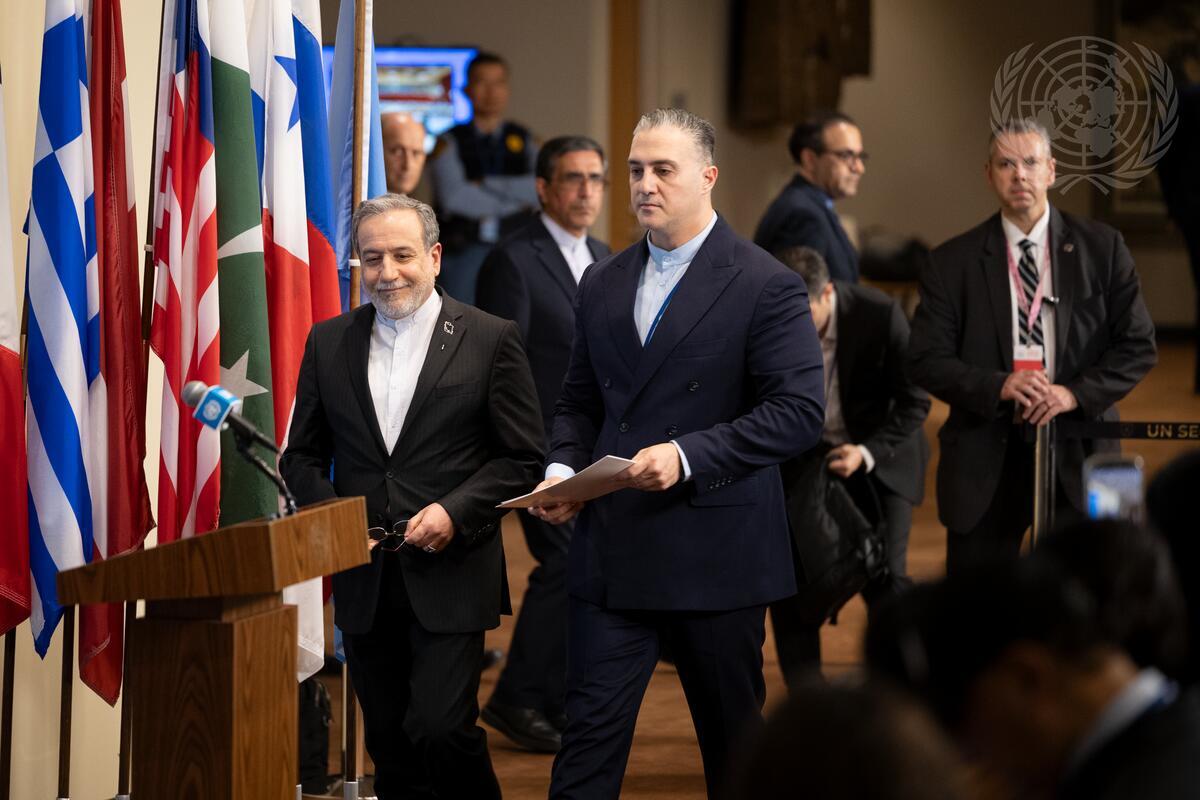
It was a slow day until the news broke: Iranian Foreign Minister Abbas Araghchi said Tehran had sent, through Qatar, a seven-day plan to reopen the Strait of Hormuz.
“The timeline will start as soon as the United States accepts this plan,” Araghchi said.
Also on the agenda was a meeting on pandemic preparedness, where UN Secretary-General António Guterres warned that the next pandemic was not a question of if, but when.
On the secretary-general front, candidate Carolyn Rodrigues-Birkett was spotted leaving a meeting with the Russian delegation. Saint Lucia, Saint Vincent and the Grenadines, and the Bahamas all openly backed her in their respective speeches, following the regional line.
“A former foreign minister who has presided over the Security Council, she understands what rules mean for nations with no other protection,” Bahamian Prime Minister Philip E. Davis said. “In 81 years, this organization has had nine secretaries-general. All of them men. None has come from the Caribbean. The Bahamas believes the time has come for both to change.”
Choose Peace, Not War
By Dawn Clancy
In this dangerous moment, Prime Minister Shehbaz Sharif said Pakistan chooses peace.
“War is a choice, but peace is also a far better choice, and sometimes the greater courage lies not in starting a war, but in preventing one. Pakistan has made its choice,” said Sharif. “We have chosen peace over war.”
Addressing the General Assembly as the high-level week at the UN winds down and lines at the cafeteria’s coffee kiosk get shorter, Sharif touched lightly on a mix of topics. On domestic issues, he referred to Kashmir—a long-running territorial dispute between Pakistan and India—as Pakistan’s eternal “jugular vein.” He promised its people that Islamabad will “continue to extend our full diplomatic, political, and moral support to them till they are granted their inalienable right to self-determination.”
Sharif also thanked President Trump for his “resolute and visionary leadership” in helping resolve a brief military exchange between Pakistan and India in May.
“Who knows … the extent of devastation that could have taken place had President Trump not stepped in at this critical moment with clarity of thought and action,” Sharif added.
On foreign policy, he noted the “dangerous surge of hostilities” in the Gulf region, and said the Strait of Hormuz and the Bab el-Mandeb Strait, “the arteries of the global economy,” must remain open to connect nations and not become “choke points of confrontation.” He added, “These waters must carry the promise of prosperity, not the perils of war.”
In April, Pakistan mediated talks between the US and Iran to end the ongoing hostilities. The meetings produced the Islamabad Memorandum of Understanding, which has since collapsed.
The Next Pandemic Is Coming. The World Is Unprepared.
By Mercedes Gallego
Memory is short. It’s been just three years since the COVID-19 pandemic was officially declared over. It killed at least 20 million people and wiped out more than 10 trillion dollars from the global economy. But instead of using that terrible experience to prepare for the next one, “as soon as COVID was declared over, the investment in health, and especially in health security, started to decline,” Tedros Adhanom Ghebreyesus, director-general of the World Health Organization, told reporters on Friday.
Asked whether the world had learned from COVID, he was candid. “That’s very difficult to say, because there is still this cycle of panic and neglect.”
For him, COVID exposed and exacerbated fault lines in global health security. “It taught the world many painful lessons. It’s essential that the world learns those lessons, because the next pandemic is not a matter of if, but when.” There is a fear that keeps him awake at night, he confessed: “A respiratory pathogen may emerge.” Then it would be COVID all over again.
Speaking to reporters on the sidelines of the General Assembly’s second high-level meeting on pandemic prevention, Tedros called it “very alarming” that countries are investing “trillions in security to kill each other,” while neglecting investment in health security to prevent or manage a virus, “which is an enemy to all humanity,” he said. By his own calculation, last year’s military expenditure globally was 2.7 trillion US dollars.
The meeting failed to reach a consensus. The United States, which withdrew from the WHO for the second time after Trump returned to power in January 2025, joined a few other countries in refusing to endorse a political declaration meant to prepare the world for the next outbreak. The text, which is not binding, now goes to a vote of the full Assembly, probably in December. It commits governments to measurable action on prevention, surveillance, financing, and equitable access to vaccines and medicines. It also calls for a One Health approach linking human, animal, and environmental health.
Tedros is confident the General Assembly will approve it. The same happened last year with a declaration on noncommunicable diseases, which passed in a vote after the US objected. “It has majority support,” he said. “It’s democracy in action. There are different opinions, and they couldn’t resolve it by consensus, so going to a vote is not really a problem.”
The breakdown is only the most visible sign of how unready the world remains. The system meant to guarantee fair access to vaccines, the Pathogen Access and Benefit-Sharing annex of the WHO Pandemic Agreement, is still unwritten. Ebola is spreading through eastern Congo. A recent hantavirus outbreak aboard a ship was another reminder of the need for an international response to an international threat. It was controlled and stopped, Tedros said, thanks to the cooperation of many countries, “especially Spain.” And money for health security has been draining away since the emergency ended.
“The ongoing Ebola epidemic in the Democratic Republic of the Congo is a reminder that an outbreak can start anywhere, any time,” he warned. His message is simple: “We are as strong as the weakest link.” That’s why the WHO chief insists not only on international cooperation, but on investing in national capacity to detect early and respond swiftly: surveillance, collecting information, sharing. “Unless we invest, especially in countries that are vulnerable, the whole world will be affected by the weaknesses you see in some places.”
Investment in health security “is not charity,” he underlined. “It’s actually in the best interest of all countries,” because the world is so interconnected that “a virus can start somewhere and move to another place within hours.”
Another good investment is peace. In eastern Congo, the Ebola outbreak declared on May 15 is “not yet under control,” said Mohamed Janabi, WHO Regional Director for Africa. As of September 23, there were 7,890 confirmed cases and 3,799 deaths, and two new health zones were affected just last week. With over a million people displaced and a shaky health infrastructure, responders cannot reach some areas to trace contacts; displaced people carry the virus to new places; and crowded camps are, in Tedros’s words, “a perfect place for transmission.” Meanwhile, the spread continues. “Peace is the best medicine,” Tedros said.
None of that resonated loudly enough on the floor of the General Assembly to approve the declaration by consensus. The US said it was “not in a position to support this text in full,” according to Health Policy Watch, citing “divisive ideologies that lack definitional consensus.” It did not say which passages it meant, but Washington has used that phrase across the UN system to object to language on gender and on sexual and reproductive health, and the declaration’s commitment to universal access to sexual and reproductive health care survived the negotiations. Other changes went through quietly: a reference to tuberculosis as a leading infectious disease was removed, and the progress review was shortened from every five years to every three years. The US was not alone. The European Union objected to language favoring compulsory licensing of medicines, and Italy, breaking with its EU partners, said it does not support the Pandemic Agreement at all.
The US also objected to the declaration’s references to the unfinished pathogen-sharing negotiations. At the briefing, a reporter from Zimbabwe raised what a former European negotiator told Health Policy Watch is “the elephant in the room.” The US has been signing bilateral agreements with dozens of low-income countries that give it access to pathogen data as part of aid packages, with no guaranteed access to products in return. Some African countries have refused them over data-sharing concerns, at the risk of losing HIV funding. The deals make Europe reluctant to sign on to benefit-sharing rules its own pharmaceutical industry would have to follow, while US manufacturers wouldn’t. Tedros declined to criticize Washington. “I don’t think, as a principle, there is any problem with the US signing bilateral agreements with some countries,” he said. “No problem at all.”
The declaration that stalled on Friday was meant to lock in commitments before memory fades further. Instead, it waits for a December vote. “As human beings, maybe we forget and move on,” Tedros said. “And that’s not good, because the next pandemic could be a serious one.”
Mercedes Gallego and Stephanie Fillion contributed to this story
About The Author