The candidates to lead the United Nations all have views on AI policy, but the institution’s survival will depend on something harder: deploying it from within. The field is uneven.
The world is already being reorganized around artificial intelligence. At the UN, the conversation still focuses largely on regulation: frameworks, safeguards, treaties, governance principles. Those debates matter, but they will mostly be shaped by member states. The next secretary-general faces a different problem. The institution they will inherit is financially strained, politically fragmented, operationally overstretched, and losing public trust. In that environment, AI is not another topic on the multilateral agenda. It is a question of institutional capacity and leverage.
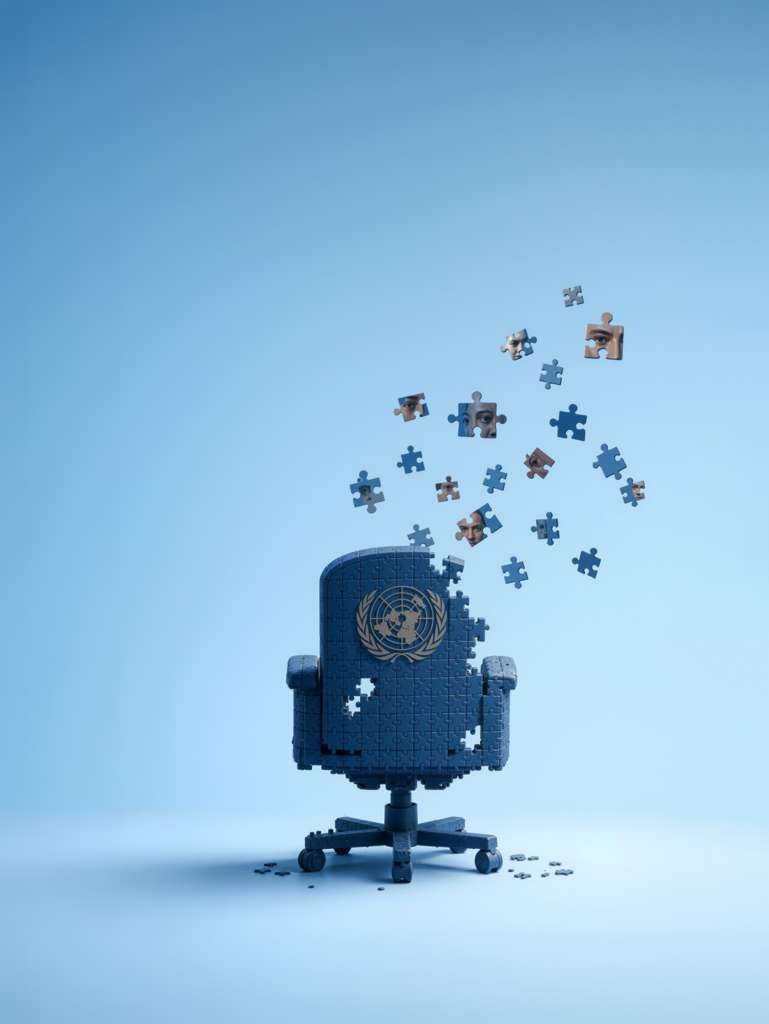
Beyond the policy challenge, another test for the next secretary-general is whether they can integrate AI into the UN’s operational machinery faster than institutional decline overtakes the organization. What separates the candidates is how they would meet that test.
What the Candidates Said
For Michelle Bachelet, AI is primarily a governance and institutional challenge. Her vision frames technological disruption through institutional trust, human dignity, and multilateral coordination. Yet there is a tension at the center of her position. Many of the reforms she advocates—integrated reporting, anticipatory governance, early-warning systems, cross-agency coordination—would depend on extensive AI infrastructure. Her 2021 call, as UN high commissioner for human rights, for a moratorium on AI systems that threaten human rights reveals a cautious instinct toward the technology itself. Reconciling operational modernization with institutional restraint would be the defining tension of her tenure—and the one most likely to slow the integration the institution now needs.
Rebeca Grynspan treats AI as structural economic transformation, alongside trade, finance, and industrial competitiveness. The risk of countries being left behind reflects an instinct, shaped by her tenure at the UN Conference on Trade and Development (UNCTAD), that AI will deepen global asymmetries unless governance keeps pace. But Grynspan is also alone in already using AI inside the UN system. “We are using much more data science and AI in some of our work,” she said last year, describing how UNCTAD absorbed a 20 percent post cut without losing delivery capacity. Of the candidates, only Grynspan can point to an agency she already reformed under pressure. Whether the method scales from a single agency to the whole UN system is the harder question.
As former president of Senegal, Macky Sall made technology a pillar of the “Plan Sénégal Émergent” and invested heavily in digital infrastructure, including a national data center. His framing is rooted in sovereignty: AI can either accelerate development or deepen Global South dependence on foreign technologies. But when it comes to reforming the UN itself, his broader doctrine remains vague. Of the four candidates, Sall was nevertheless one of the few to propose a concrete operational role for AI inside the institution: translation and interpretation. Expanding linguistic access beyond the UN’s six official languages, he argued, is finally becoming affordable. A practical proposal, but still a narrow answer to a much broader reform challenge.
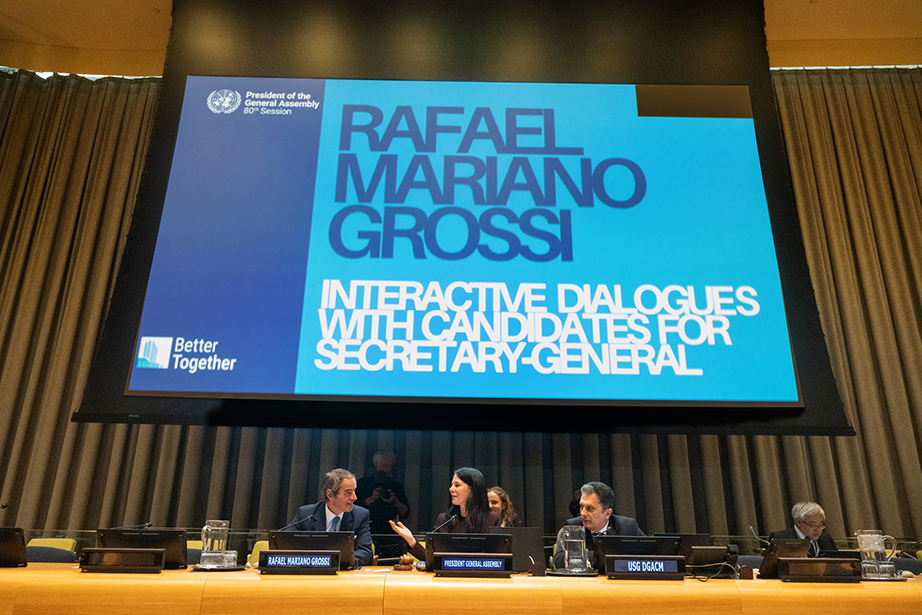
Rafael Grossi, widely seen as the technocratic front-runner and currently leading prediction markets for the role, represents perhaps the clearest operational instinct among the candidates. He frames technology primarily through institutional modernization: digitizing operations, improving coordination, supporting evidence-based decision-making. The posture fits the moment, but Grossi has offered relatively little on how to govern the geopolitical and societal stakes of AI itself. AI, he has said, is “in and by itself neutral.” For him, the challenge is in deployment, not governance. That instinct may align with what the UN needs. What is missing is the urgency it requires.
The Real Challenge
The broader challenge goes beyond any single platform. The next secretary-general will confront AI not only as a policy issue, but as a force entering the machinery of multilateralism itself: conflict monitoring, multilingual diplomacy, humanitarian coordination, mandates analysis, institutional memory, real-time policy assessments.
Quietly, the operational logic of international organizations is changing. António Guterres’s UN80 reform agenda, his final push to consolidate, digitize, and rationalize the system before he leaves, already presumes the kind of AI-enabled coordination most candidates have not described. At the moment multilateral institutions face declining trust, fragmentation, and budgetary pressure, effectiveness depends on processing information and coordinating at scale. That, not regulation, is the AI challenge that matters most. Meeting it will mean doing more with fewer resources while reforms across the system—integrated reporting, early-warning mechanisms, multilingual access—increasingly rely on AI-enabled infrastructure.
All of the candidates appear capable of engaging with artificial intelligence in some form. Far less certain is whether they understand the extent to which AI may become essential to reforming and sustaining an increasingly strained multilateral system. The real risk for the next secretary-general is not misjudging AI regulation, but misjudging how central the technology may become to the UN’s own operational survival.
Jérôme Crettol is the founder and CEO of DiploTools, a Swiss govtech company developing AI tools for diplomacy and multilateral affairs. Formerly at the Swiss Mission to the UN in New York, he focuses on AI applications for diplomatic workflows and institutional analysis.
About The Author