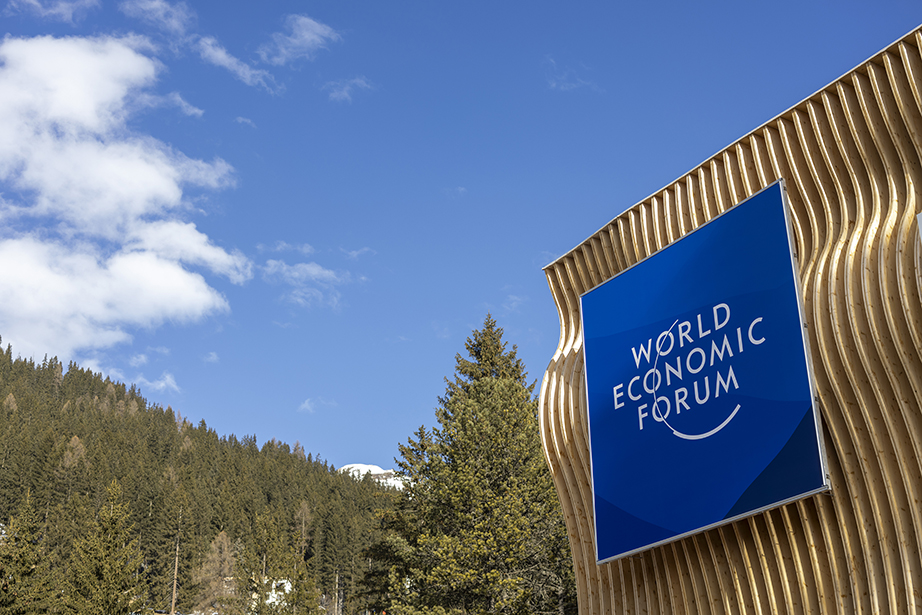
While many people initially compared it to the U.N., it might actually be closer to the World Economic Forum in Spirit and in Structure.
In January 2026, President Donald Trump used the World Economic Forum’s annual meeting in Davos, Switzerland, to formally ratify the charter of his Board of Peace, placing the initiative before an audience of political and business leaders gathered at one of the world’s most influential elite forums.
After the event’s launch, many people compared the newly announced venture to the United Nations. However, few considered another possible comparison: the World Economic Forum.
Washington likely did not pick Davos randomly for the Board’s launch. The setting was more than just a backdrop: It underscored the extent to which the Board of Peace, in tone and political style, appeared closer to the elite, leader-driven world associated with Davos than to the rules-based multilateralism of the United Nations.
Of Power and Influence
The Board of Peace was endorsed by U.N. Security Council Resolution 2803 with a mission to help rebuild Gaza. The resolution backed a body that would serve as a “transitional administration … that will set the framework, and coordinate funding for, the redevelopment of Gaza…” as stated in the resolution. However, the body that emerged looks strikingly unlike a transitional administration meant to coordinate redevelopment funding for a specific territory. In form and function, it more closely resembles the World Economic Forum: exclusive, expansive in ambition, and structured around elite access.
The Board’s charter makes no mention of Gaza. There is no obvious reason why a transitional body for coordinating development funding in Gaza should have lifetime appointments or memberships. In a way, Trump has near-total control over who is in and who is out, similar to the Forum’s exclusive formula. Canada’s Prime Minister Mark Carney learned it the hard way.
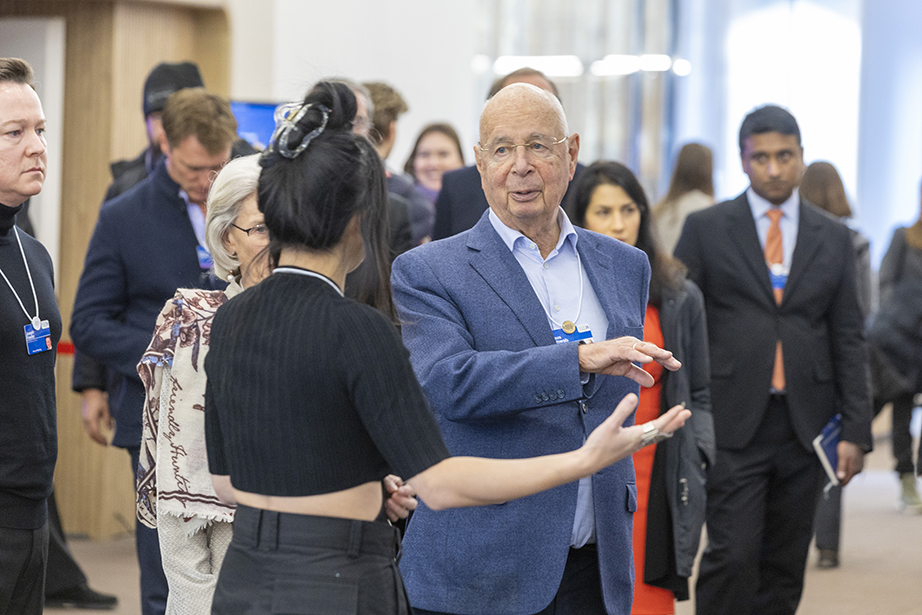
Copyright: World Economic Forum/Chris Heeney
The Board’s charter includes dual roles for Trump as US representative and as chairman, free from term limits. The World Economic Forum also had the equivalent of a chairman for life: Klaus Schwab. Schwab, a German engineer, founded the Forum in 1971 to promote “stakeholder capitalism,” arguing that businesses should serve not only shareholders but also society, governments and the public. Schwab made more than $1 million a year in compensation and had a hefty expense account before he left the Forum.
Both the Board and the Forum’s membership schemes have something in common: They are by invitation only, and members get premium access for a fee. Although membership in the Forum is limited to large corporations deemed foremost global enterprises, Schwab placed great emphasis on states in his vision of stakeholder capitalism.
More than 60 heads of state attended the most recent annual meeting in Davos. The Forum faced civil society concerns that it aimed to recast states as stakeholders, thereby weakening their authority, when it entered a strategic partnership with the U.N. in 2019. Schwab considered the Forum to be the International Organization for Public-Private Partnership, which became its tagline after it was recognized under the Swiss Host State Act in 2015 as an “other international body.” The designation grants privileges on an exceptional basis to organizations that work closely with intergovernmental or international organizations based in Switzerland, but it does not confer the broader legal status enjoyed by genuine international organizations.
Unlike the Forum, the Board of Peace members can secure lifetime memberships on the Board of Peace for dues of $1 billion. More than 25 governments joined the first Board of Peace meeting alongside investors and organizational leaders at its by-invitation-only event. The Board takes a different route than the Forum in asserting its own status as an international organization through its charter. The text asserts an “international legal personality” akin to legal and political recognition to represent and constrain its members. The United Kingdom and France declined invitations to participate on the board after voting in its favor, citing concerns over its asserted authority and scope.
The Board and Forum are products of a shared history. Neoliberal economic policies since the 1980s have concentrated wealth at the top of the distribution and in private enterprises, which came to be treated as a logical place for states to seek resources and expertise. Members of both are beneficiaries of this trend. Asset management is experiencing unprecedented consolidation today.
Furthermore, unlike the U.N., the Board places private actors in executive leadership over its state members. The Board’s Executive Board includes Americans Martin Edelman, who directs an Abu Dhabi-based investment fund and is senior adviser to Abu Dhabi’s sovereign wealth fund, and Marc Rowan, co-founder and chief executive of the asset management firm Apollo Global Management. Qatar and Saudi Arabia, founding members of the Board and regulars at Davos, back Executive Board member Jared Kushner’s investment firm, Affinity Partners. Member states “may submit recommendations and guidance with respect to the Executive Board’s activities.” While states could use the U.N. as a forum to cooperate on regulating private capital, the Board, more effectively than the Forum, turns the tables.
The Forum defines its ultimate purpose vaguely as to “improve the state of the world.” It has taken up priorities overseen by the U.N. Economic and Social Council, such as education, health, food security and sustainable development. The Board of Peace’s charter, for its part, defines its mission as seeking to “promote stability, restore dependable and lawful governance, and secure enduring peace in areas affected or threatened by conflict.” This is security language, divorced from its initial justification as a development platform for Gaza, and broad enough to allow the Board to evolve into something much broader, which can already be seen in Gaza.
To be sure, the comparison is not perfect. The World Economic Forum is, above all, a convener, best known for its annual gathering in Davos rather than for exercising formal governing authority. The Board of Peace, by contrast, has a charter, defined memberships and more explicit institutional ambitions. Still, the resemblance is revealing. Even if the Board is not a replica of the Forum, it shows how quickly a body presented as a peace and reconstruction mechanism can take on the features of a more exclusive model of governance—and, in doing so, reflect a growing willingness to look outside the United Nations on questions of peace and security.
BIO: Rose Worden is a researcher and writer based in New York.
About The Author