
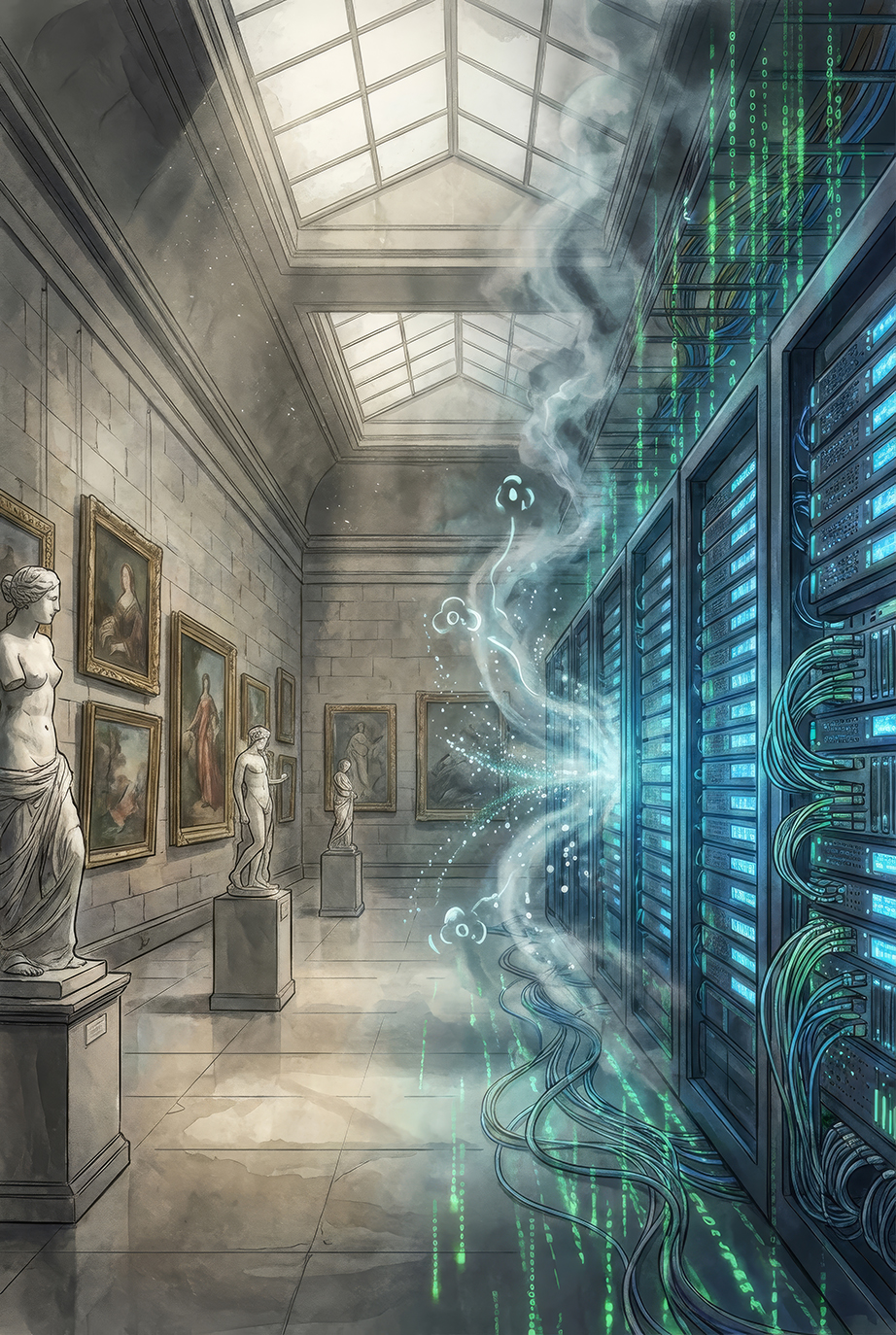
When we think of climate responsibility, we picture coal, factories, cargo ships and data giants — not museums or libraries. Has the Mona Lisa’s climate footprint been questioned? Now the world’s cultural institutions are joining the climate change battlefield.
Many art companies across Europe are assessing not only their popularity measured in projects or thousands of visitors but also their sustainability — measured in tons of CO₂ equivalent emissions. The Greenhouse Gas Protocol is increasingly becoming part of our cultural agenda. Indeed, institutions are turning into more climate-friendly operations — from their heating, lighting and energy sourcing, to exhibition design and even staff travel.We find the Victoria and Albert Museum reporting out 16,583t CO₂e emissions in financial year 2023/24, equal to 4.24 kg of CO₂e per visitor and employee. Or the British Museum launching their “Energy Centre Programme.” Or the British Library putting in place a decarbonizing strategy for its buildings with over 170 million items, and programming on climate literacy. UK institutions, large and small, being among leaders of the green agenda is not surprising given the country’s government commitment to reaching net zero by 2050. A UK movement Culture Declares Emergency is now uniting almost 1900 organizations and individuals — among them the Akram Khan Company and the Old Vic Theatre, who’ve declared to create not just art but a regenerative world.
Cultural heritage hubs — those that have been saving the past for the future, are now called to reconsider what they’re preserving and how they’re storing it. The push comes from multiple European groups and initiatives to look particularly at digital infrastructure. Digitalization is adding to the complexity of what needs to be managed.
A 2025 study Cultural Website Sustainability Benchmark by Supercool and Digital Carbon Online tracked the web traffic of 66 UK cultural organizations — including theatres, galleries, universities, and museums. Their webpages hosted nearly nine million visits in three months, and produced roughly 8–9 tons of CO₂e — the equivalent of ten passengers on a London-to-New York flight. Most of that digital footprint came from homepages and event listings. The report outlines steps to reduce the environmental footprint of these pages — among them image optimization, cutting text-heavy sections, a content and video audit to remove those not being watched, and eventually — moving to green hosting. Overall arts, culture and heritage websites still earned an average carbon rating of D.
Knowing virtually every website’s carbon footprint and environmental impact is now easy. Take, say, the Louvre’s particular page — Masterpieces of the Louvre, presenting 40 most remarkable artworks of museum’s collection, including the Mona Lisa. Websitecarbon.com measured the web page’s carbon rating of C — 61% cleaner than that of all web pages globally. Another tool, Imagecarbon.com, suggests ways to reduce the page’s CO₂e by 53%.
The energy of the future
Half a century ago, in the midst of the Industrial Revolution, the British economist William Stanley Jevons observed that making coal use more efficient only made people burn more of it. Today the same paradox haunts the digital world, and AI leaders are well aware of it. What coal was to the 19th century, data is to the 21st — a commodity we only need more of. Today sufficiency is the new efficiency.
A recent report Regenerative Digital Transformation by the Environmental Sustainability Task Force within the Europeana Association analyzed the cultural sector’s digitalization. The survey, which gathered over a hundred responses from 24 European countries and six others worldwide, shows that only 42% of institutions have formal sustainability strategies, and only 14% actively measure the carbon footprint of their digital services. Most organizations keep multiple redundant backups — from three to six copies of every digital asset. Add to this the so-called “dark data” — the half of all stored information that is never accessed or used.
Some solutions are low or zero cost: PDF and JPEG formats that still dominate digital archives could be replaced by WebP or JPEG XL, cutting storage size — and thus emissions — by up to 60%. Hardware repair and reuse is also a game changer: extending the lifespan of devices by just three years can reduce costs by a third. Still, only 8% of institutions consider repairability. Repairing, reusing, and upcycling technology rather than endlessly replacing it aligns not just with digitalized future but with planetary sustainability.
The promising numbers are the 78% of institutions that recognize the importance of environmental responsibility. But the real challenge for those ready for changes is lack of knowledge and skills gap about opportunities.
“Many cultural heritage institutions would be looking up for certain legislative framework to guide them and help them prioritize steps towards climate-conscious practices. Some actions they could take internally. More specifically, looking up for directives on the EU level and national levels that would be creating legal obligations for member states and, cascading down to the relevant cultural heritage institutions. Such an enforced framework would not only push the cultural heritage institutions to take actions, but most importantly it’ll push the information and communication technologies industry to apply standards. We already see specific directives, regulations and voluntary frameworks on a European level regarding the software and hardware efficiency, data centers, and the use of renewables. Sooner or later, we will need to start discussing not just in fragments, but a uniformity in frameworks for the field of cultural heritage preservation,” says digitalization specialist Evangelia Paschalidou, the report’s task force chair.

Behind the digital scenes
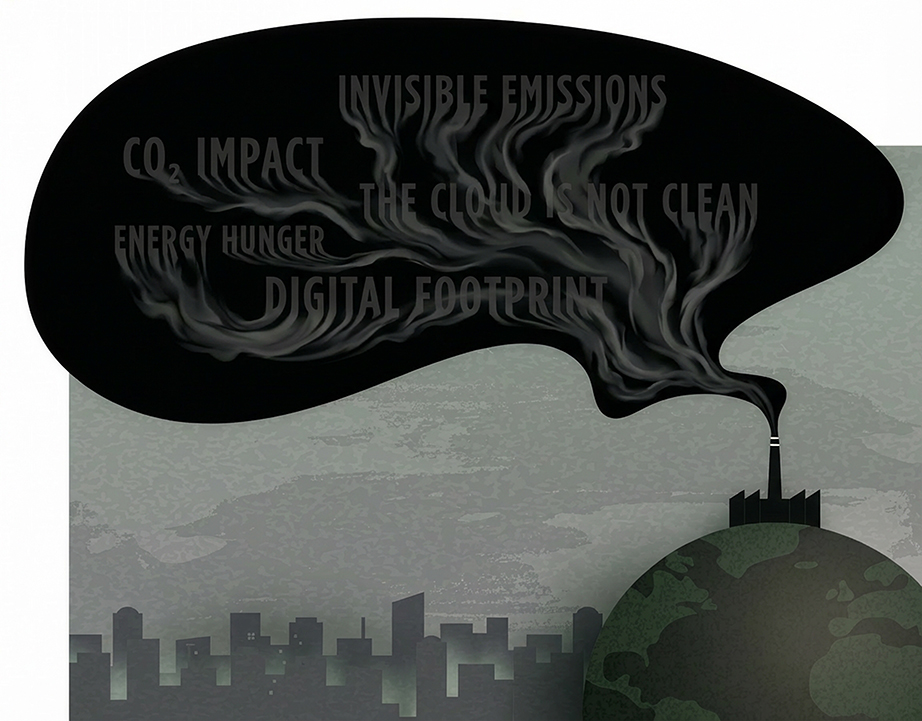
What increasingly becomes a focus to energy and sustainability obligations in the EU is the digital infrastructure and services that cultural heritage institutions rely on. Behind images of masterpieces, virtual reality tours through history or high-resolution scans stored in the cloud is an invisible yet energy-hungry backbone — the world’s network of data centers.
According to the International Energy Agency’s 2025 Energy and AI report, these facilities consumed roughly 1.5% of global electricity in 2024 — or 415 terawatt-hours (TWh) — more than the entire electricity use of many countries combined. The United States accounts for about 45% of this share, followed by China (25%) and Europe (15%). The figure is set to more than double by 2030, reaching nearly 945 TWh, as investment in AI-driven infrastructure accelerates. The IEA warns that the energy used by these digital engines could generate, on different scenarios, from 300 to 500 million tons of CO₂e emissions by 2035 — a significant grow from today’s 180 Mt. 2024 research from McKinsey showed that in Europe alone data centers already use around 2% of total electricity, projected to reach 5% by 2030.
The scale of the digital challenge is impossible to ignore. For cultural institutions, this means their digital footprints are part of a much larger energy ecosystem. They are modest players compared to the tech giants, yet their moral influence is far larger. They are the ones placing humanity above figures. “It’s important how many cultural institutions are seeing themselves and what social role they want to play. They are not silent repositories keeping artefacts. Instead, they are active social actors in constant dialogue with society and communities. Especially when we think of heritage lost because of the displacement of communities. It’s the imperative of the era of climate crisis, for cultural heritage institutions to reconfigure their role,” shares Ms. Paschalidou.
Ultimately, what we choose to preserve, how we store it and for how long defines the environmental legacy of the future we’re saving everything for.
About The Author
